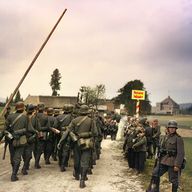
The Bohemian Campaign was one of the earliest battles of World War II in Central Europe, marking Germany’s first major land offensive against the Fourth Eurasian Communist International (COMINTERN). The battle arose from the sudden realignment of The Danubian Federation, which had broken from the Kaiserliche Eisenpakt after its government embraced socialism and entered into the South European Pact (SEUROP), de facto becoming allied with Neosocialist France and The Union of Soviet Socialist Republics. Though the Federation’s civilian leaders committed to war against Germany, the Danubian Army remained divided, with many senior officers loyal to the Habsburg monarchy and hesitant to fight their former allies.
Civil unrest further destabilised the Federation. When the war began, widespread revolts erupted in Bohemia, where the local population overwhelmingly opposed the socialist government and the war effort. These uprisings disorganised garrisons and paralysed supply lines, giving Germany the opportunity to act decisively. Several German generals, acting with initiative rather than awaiting full mobilisation, launched a swift offensive across the Bohemian frontier.
German forces met little coordinated resistance, as mutinies, desertions, and local uprisings compounded the Federation’s inability to defend the region. By November, the Deutsches Heer had secured all of Bohemia. The occupation was quickly regularised: administration of the territory was handed to the Danubian Restoration Army, a pro-German force formed from defected officers and soldiers who declared their aim to overthrow the socialist regime and restore the Danubian state under a constitutional Habsburg monarchy, as it had been before the socialist takeover.
The fall of Bohemia marked the collapse of the Federation’s northern front and became a rallying point for the Germans, who had been suffering loss after loss at the hands of the Eurasian Axis. While Hungary, Romania, and the Slavic lands remained committed to South European Pact (SEUROP), Austria and Bohemia became centres of the Restorationist cause.