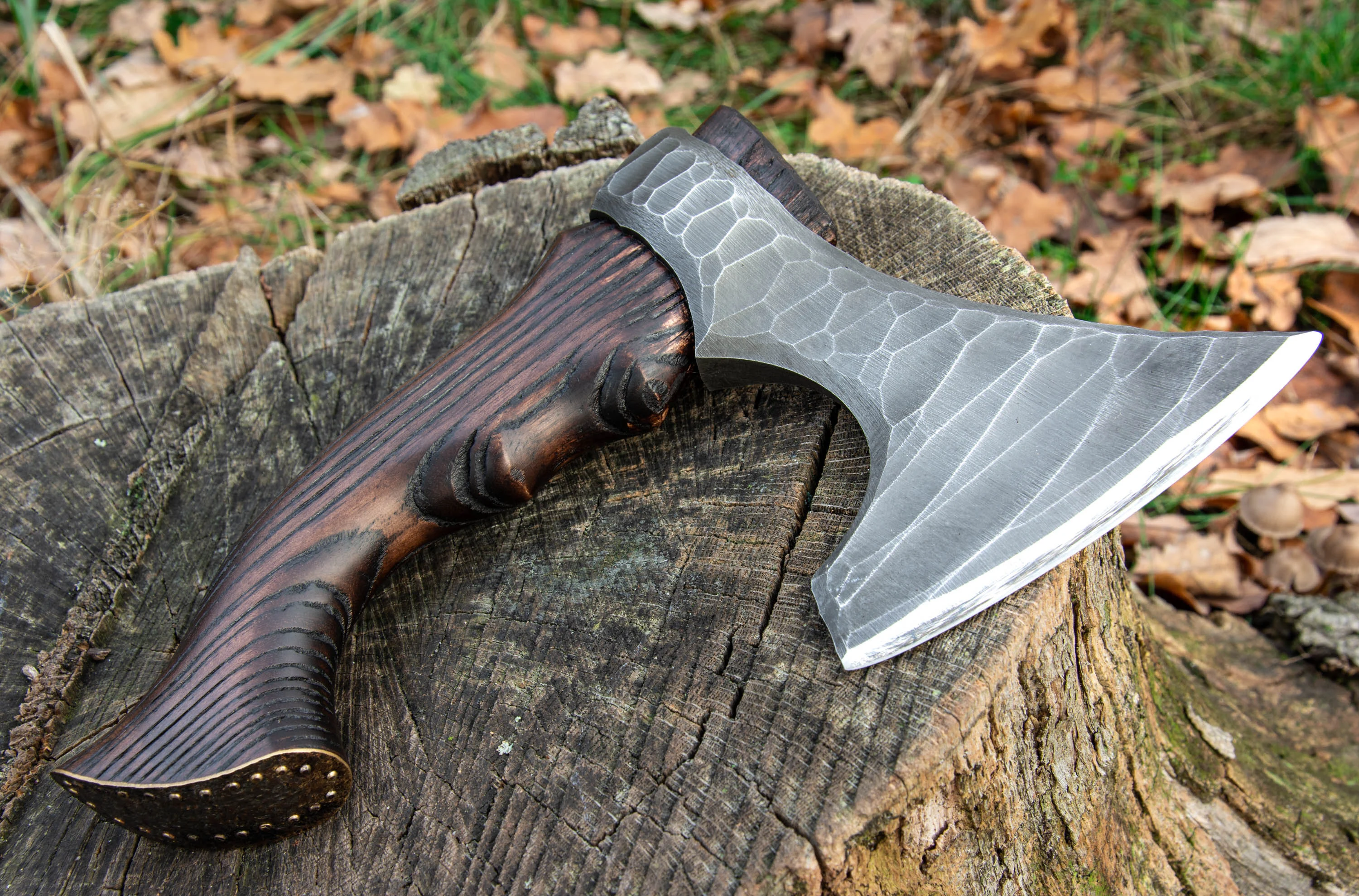
The Stonecutter Hatchet served as the secondary weapon of choice for Dow warriors of antiquity. Forged from the same black bronze alloy that defined Dow weapon-smithing, it embodies the culture’s balance between practicality and bellicosity. Every warrior, artisan, and miner carried one, and few weapons better captured the Dow philosophy that a tool well-made should serve in both work and war.
Its design is pragmatic: a short, sturdy haft of treated ironwood, perfectly counterbalanced to the broad, curved axehead. Despite its compact profile, the weapon’s forward weight and sharp curvature granted it unexpected reach and cutting force, allowing precise strikes within tight formations. Against unarmoured or lightly protected foes, a single swing could dismember limbs cleanly. In the Stronghold's armies, the Stonecutter was the companion to the Stoneslab Warhammer, used when speed or dexterity mattered more than raw impact. When the heavy lines broke and the fighting turned chaotic, Dow warriors would abandon their hammers and draw their axes.
Yet, outside of war, the same weapon found use in daily life. Dow miners, builders, and travellers employed their axes to fell trees, split stone, and prepare shelters in the highlands. To own a Stonecutter was to bear a mark of self-reliance. It was said that no Dow warrior was ever buried without his axe, for to part from it would mean leaving his craft, and that of his ancestors, unfinished.
Unlike the Stoneslab Warhammer, whose utility became less pronounced with advancements in armour and especially after the introduction of firearms, the Stonecutter Hatcher was readily adopted by the peoples that later came to inhabit the Great Dividing Range, especially the Montagnards, to whom it is a symbol of identity.