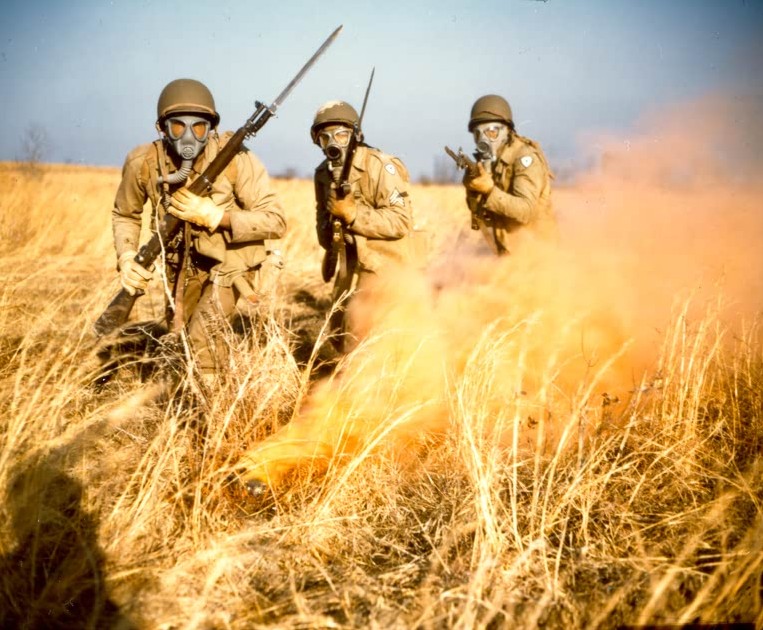
The Yellow Winter is the great encore of World War II, and according to contemporary writers, the death of the Old World as it was known then. Despite only lasting 38 days, it would be the most well-remembered event of the whole war, particularly so by the men who fought in it. At least, those that came back alive.
The summer of 1945 had already fundamentally changed the rules of war. With The German Empire and The Union of Soviet Socialist Republics both achieving successful atomic tests, the phantom of nuclear annihilation now loomed over the head of Europe. In the Pacific Theatre, The United States of America had moved beyond demonstration; when the Atomic Bombings of Hiroshima and Nagasaki failed to force a total cessation of Japanese hostility, Operation Downfall was executed, aiming to invade the Home Islands through Kyushu. Five further tactical nuclear strikes systematically erased the last remnants of the Imperial Japanese Army and the last remaining flotilla of the Imperial Japanese Navy. By the time Japan accepted to surrender in late November, American forces were on their way to Korea, successfully securing half of the peninsula, but being met by a Sino-Soviet force halfway through.
On Christmas Day, 1945, Soviet High Command, cornered and desperate, authorised the deployment of the full arsenal derived from Project PERUN. Amongst their weapons were a weaponised strain of anthrax nicknamed as "the Red Plague" by the western press, the hyper-lethal nerve agent known as Sarin gas, and the toxic Chlorine Trifluoride, capable of setting even concrete and sand on fire. The Allied response was as swift as it was primitive. Lacking the cutting-edge weapons of mass destruction of the Soviets, they responded with sheer volume. From the Baltic to the Carpathians, the sky was permanently choked by thousands of tonnes of Chlorine, Phosgene, and Mustard Gas. The Republic of Great Britain, possessing its own weaponised anthrax stock, initiated Operation Vegetarian, bombing Soviet supply lines and troop concentrations with anthrax spore cakes. The Eastern Front quickly became a laboratory of misery.
This period from December 25th, 1945, to February 1st, 1946, earned its moniker as "the Yellow Winter" from the horrific transformation of the landscape. The winter snow, which should have been a pristine white blanket, turned into a viscous, sickly, yellow slush, thanks to the sheer concentration of chemical particulates present. If there was ever a hell, either in the fiery plains of Venus or in the demonic gardens of Pandemonium, it had now been dethroned by the sulfuric snowscape of Eastern Europe. The skies were darkened, and the soldiers rotted alive in their trenches. An infantryman's life expectancy could be measured in minutes.
Despite the deployment of every superweapon in the human arsenal, no side could secure a breakthrough. The contamination was so absolute that any force attempting to move was instantly decimated by lingering toxins. The front lines simply dissolved into a series of static, isolated outposts of sickly men, separated by a yellowish wasteland. And despite this, the worst was yet to come, as on the night of February 1st, the genie came out of the bottle.