Alongside the law, one will
also find convention. This can be whatever happens to be in vogue at the
time of the grant, or based on a long standing familial or cultural
tradition.
The use of various charges and tinctures show the clearest patterns, but
is also the omissions of the vast majority of arms that give insight
into this.
Supporters, Mottos, and Crests
One would note the distinct
absence of supports, mottos, and crests in virtually all noble arms. In
fact, the only armorial to encompass all three is the arms of House of
Paling,
the national arms itself. One may therefore think that this would be a
law prohibiting such grants, but this is untrue, at least in
technicality.
The reason behind this
absence harkens back to early coronation ceremonies and other official
state functions. Each aspect of the full heraldic achievement were
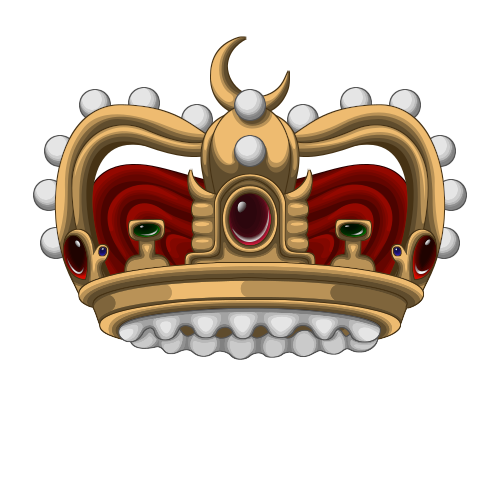
required to be present. Using the arms of Palingvyre as an example, flanking the
monarch, a live forest lion would be presented sinister, with the
correct colouration dyed upon it and the Palatine Coronet, and the
Pallon swan dexter, necklaced
with a ducal circlet. The monarch would wear the Crown, the Sash of the
Order, and the Adorned Robe, (this bearing the red field with the golden
lion embroidered upon it), and the curtain behind the throne being
white stoat
fur on the interior, with gold thread on the exterior. To complete the
achievement, a second, junior Pallon swan would be suspended in a cage
topped with an ducal imperial coronet and the motto, 'Ad Coronam Regula'
chanted by
the attending nobility.
It is apparent why many of
these additional touches may be foregone by most nobility, as it simply
is not practical on the scale that is required. In addition, mottos in
particular
have been viewed as increasingly outdated and improper, the current
monarchy excepted, of course. As mentioned, there is no law preventing
these from being requested, but so stiff has the tradition become, no
sound Lord would
ever request them.
Tinctures of the Field
Like most modern nations,
Palingvyre adheres to a particular set of tinctures prescribed by
heraldic law, however even within this, their is clear favouritism
towards four ‘primary
tinctures’ blue, red, silver, and gold. Of these, red and gold are the
most popular. At the other end of the scale, the least used tincture for
the field is purple, although this is an international trend too, and
following
this is green. The use of these colours also varies, with there being a
far greater number of single tincture fields of red and blue, while
silver and gold often appear partitioned alongside the two other
primaries. A silver
field will always be depicted as white, which, matching the flag of
surrender, explains its frequent use alongside other colours.
Heraldic Animals
The use of animals as charges
is common practice in Palingvyre, with the most common being the forest
lion. That being said, effort is often taken to avoid having the lion
charged
in gold given the association with royalty, particularly if the lion is
the sole charge.
Other common animals are the
swan, often linked with military prowess, and the ox, a beast of burden
and industry. Horses and deer feature infrequently, the former often
being associated
with Hythness, the latter often considered to be an animal of the Elven
Fringe. Other Hythnetic animals like the pard and the otter have no
presently accounted uses, but have been seen historically.
Marshalling
The practice of merging and
displaying two sets of arms on a single escutcheon is exceedingly rare
in Palingvyre. The Crown must approve the union of two noble families
and given
the imbalance of power this can often cause it is unusual for this to be
allowed. Even when this does happen, the tradition has always been for
the lessor house’s arms to be subsumed or even entirely replaced by the
dominant house. In the case of marriage, it will be the greater rank
that takes precedence.
Many arms that may be
perceived to be marshalled, such as the arms of Arnell, are more often
designed with a union in mind, but are distinct designs. In the case of
Arnell, the founder,
Lily Arnell, was a commoner, so took a plain silver escutcheon and
decorated the dexter side with the royal colours of red and gold. On the
other hand, an example of arms that are marshalled would be those of
Peakly-Rustford
which bear the arms of Peakly, blue cleaved per pale with silver,
quartered alongside the arms of Rustford, green with three bronze
ringlets.