Credit: Ideas & Images from Dale Kellegrew's Artificer (slightly altered by me). Purchase: DMs'guild Link.
Artificer
Masters of invention, Artificers use ingenuity and magic to unlock extraordinary capabilities in objects. They see magic as a complex system waiting to be decoded and then harnessed in their spells and inventions. You can find everything you need to play one of these inventors in the next few sections. Artificers use a variety of tools to channel their arcane power. To cast a spell, an artificer might use alchemist’s supplies to create a potent elixir, calligrapher’s supplies to inscribe a sigil of power, or tinker’s tools to craft a temporary charm. The magic of artificers is tied to their tools and their talents, and few other characters can produce the right tool for a job as well as an artificer.
Seekers of New Lore
Nothing excites an artificer quite like uncovering a new metal or discovering a source of elemental energy. In artificer circles, new inventions and strange discoveries create the most excitement. Artificers who wish to make their mark must innovate, creating something fresh, rather than iterating on familiar designs. This drive for novelty pushes artificers to become adventurers. Eberron’s main travel routes and populated regions have long since been explored. Thus, artificers seek the frontiers of civilization in hopes of making the next great discovery in arcane research.
Creating an Artificer
When creating an artificer, think about your character’s relationship with the artisan who taught them their craft. Does the character have a rival? Talk to your DM about the role played by artificers in the campaign and the sort of organizations you might have ties to.
Quick Build
You can make an artificer quickly by following these suggestions. First, put your highest attribute value in Intelligence, followed by Constitution or Dexterity. Second, choose the guild artisan background.
Class Features
As an artificer, you gain the following class features.
Hit Points
Hit Dice: 1d8 per artificer level
Hit Points at 1st Level: 8 + your Constitution modifier
Hit Points at Higher Levels: 2d4 (or 5) + your Constitution modifier per artificer level after 1st
Proficiencies
Armor: light armor, medium armor, shields
Weapons: simple weapons, firearms
Tools: thieves’ tools, tinker’s tools, one type of artisan’s tools of your choice
Saving Throws: Constitution, Intelligence
Skills: Choose 2 from Arcana, History, Investigation, Medicine, Nature, Perception, and Sleight of Hand.
Equipment
You start with 100 gold, or the following equipment, in addition to the equipment granted by your background:
- (a) studded leather armor or (b) scale mail
- (a) five javelins or (b) any simple melee weapon
- any two simple weapons of your choice
- a light crossbow and 20 bolts
- thieves’ tools and a dungeoneer’s pack
Level 1:Magical Tinkering
You’ve learned how to invest a spark of magic into mundane objects. You can use this feature a number of times equal to double your proficiency modifier. You regain expended uses when you finish long rest.
To use this ability, you must have thieves’ tools or artisan’s tools in hand and uses of Magical Tinkering. You as an action touch a nonmagical object, up to Large in size, and expend a use of magical tinkering to create one of the following effects.
Cantrip infusion.
- You can infuse an artificer cantrip in an object (you needn’t have the cantrip learned or prepared). While holding the object, a creature can cast the spell’s effect from it, using your spellcasting attribute modifier.
- The chosen cantrip lasts until you take a long rest. As an action, you can touch the object and end the property early.
- You can choose to maintain an infusion on an item if you expend a Magical Tinkering use at the end of a long rest.
Fast Mending. You can cast mending as an action.
Level 1: Artificer Spellcasting
You’ve studied the workings of magic and how to cast spells, channeling the magic through objects. To observers, you don’t appear to be casting spells in a conventional way; you appear to produce wonders from mundane items and outlandish inventions.
Tools Required
You produce your artificer spell effects through your tools. You must have a spellcasting focus - specifically thieves’ tools or some kind of artisan’s tool - in hand when you cast any spell with this Spellcasting feature (meaning the spell has an “M” component when you cast it). You must be proficient with the tool to use it in this way. See the equipment chapter in the Player’s Handbook for descriptions of these tools.
After you gain the Infuse Item feature at 2nd level, you can also use any item bearing one of your infusions as a spellcasting focus.
Cantrips (0-Level Spells)
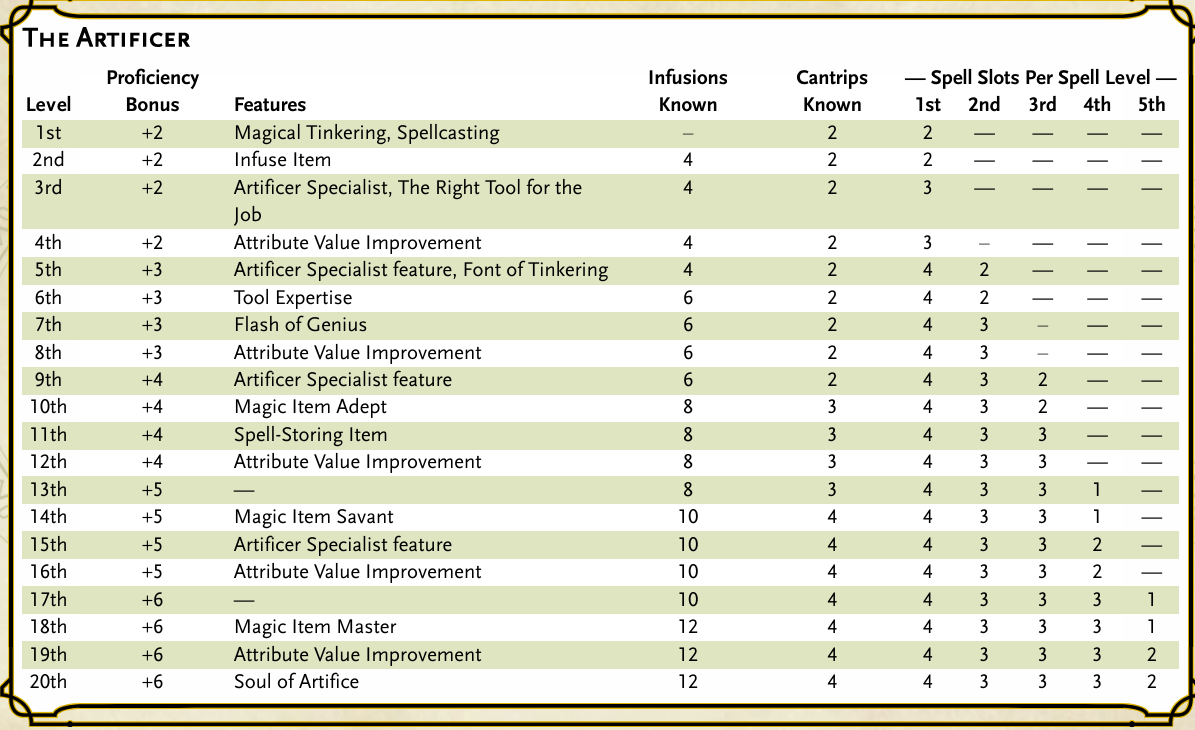
At 1st level, you know two cantrips of your choice from the artificer spell list. At higher levels, you learn additional artificer cantrips of your choice, as shown in the Cantrips Known column of the Artificer table. When you gain a level in this class, you can replace one of the artificer cantrips you know with another cantrip from the artificer spell list.
Preparing and Casting Spells
The Artificer table shows how many spell slots you have to cast your artificer spells. To cast one of your artificer spells of 1st level or higher, you must expend a slot of the spell’s level or higher. You regain all expended spell slots when you finish a long rest.
You prepare the list of artificer spells that are available for you to cast, choosing from the artificer spell list. When you do so, choose a number of artificer spells equal to your Intelligence modifier + half your artificer level, rounded down (minimum of one spell). The spells must be of a level for which you have spell slots.
For example, if you are a 5th-level artificer, you have four 1st-level and two 2nd-level spell slots. With an Intelligence of 14, your list of prepared spells can include four spells of 1st or 2nd level, in any combination. If you prepare the 1st-level spell Cure Wounds, you can cast it using a lst-level or a 2nd-level slot. Casting the spell doesn’t remove it from your list of prepared spells.
You can change your list of prepared spells when you finish a long rest. Preparing a new list of artificer spells requires time spent tinkering with your spellcasting focuses: at least 1 minute per spell level for each spell on your list.
Spellcasting Attribute: Intelligence
Intelligence is your spellcasting attribute for your artificer spells; your understanding of the theory behind magic allows you to wield these spells with superior skill. You use your Intelligence whenever an artificer spell refers to your spellcasting attribute. In addition, you use your Intelligence modifier when setting the saving throw DC for an artificer spell you cast and when making an attack roll with one.
Spell save DC = 8 + your proficiency bonus + your Intelligence modifier
Spell attack modifier = your proficiency bonus + your Intelligence modifier
Ritual Casting
You can cast an artificer spell as a ritual if that spell has the ritual tag and you have the spell prepared.
Level 2: Infuse Item
You’ve gained the ability to imbue mundane items with certain magical infusions, turning those objects into magic items.
Infusions Known
When you gain this feature, pick four artificer infusions to learn. You learn additional infusions of your choice when you reach certain levels in this class, as shown in the Infusions Known column of the Artificer table. Whenever you gain a level in this class, you can replace one of the artificer infusions you learned with a new one.
Infusing an Item
As an action, you can touch a non-magical object and imbue it with one of your artificer infusions by expending a Magical Tinkering use, turning it into a magic item. An infusion works on only certain kinds of objects, as specified in the infusion’s description. If the item requires attunement, you can attune yourself or someone else to it the instant you infuse the item.
- The infusion lasts until you take a long rest. You can choose to maintain the infusion on an item if you expend a Magical Tinkering use at the end of the long rest.
- If an infusion ends on an item that contains other things, like a bag of holding, its contents harmlessly appear in and around its space.
- The infusion also vanishes if you replace your knowledge of the infusion.
Level 3: Artificer Specialist
You choose the type of specialist you are. Your choice grants you features at 5th level and again at 9th and 15th level.
Level 3: The Right Tool for the Job
You’ve learned how to produce exactly the tool you need: with thieves’ tools or artisan’s tools in hand, you can magically create one set of artisan’s tools in an unoccupied space within 5 feet of you. This creation requires 1 hour of uninterrupted work, which can coincide with a short or long rest. Though the product of magic, the tools are nonmagical, and they vanish when you use this feature again.
Level 4: Ability Score Improvement
When you reach 4th level, 8th, 12th, 16th, and 19th level, you can increase one attribute value of your choice by 2, or you can increase two attribute values of your choice by 1. As normal, you can’t increase an attribute value above 20 using this feature.
Level 5: Font of Tinkering
You can sacrifice spell slots to gain additional Magical Tinkering uses. Converting a Spell Slot to Magical Tinkering uses. As a bonus action on your turn, you can expend one spell slot and gain a number of Magical Tinkering uses equal to the slot’s level.
Level 6: Tool Expertise
Your proficiency bonus is now doubled for any attribute check you make that uses your proficiency with a tool.
Level 7: Flash of Genius
You’ve gained the ability to come up with
solutions under pressure. When you or another creature
you can see within 30 feet of you makes an attribute
check or a saving throw, you can use your reaction to
add your Intelligence modifier to the roll.
You can use this feature a number of times equal to
your Intelligence modifier (minimum of once). You
regain all expended uses when you finish a long rest
Level 10: Magic Item Adept
You achieve a profound understanding of how to use and make magic items:
- You can attune to up to four magic items at once.
- If you craft a magic item with a rarity of common or uncommon, it takes you a quarter of the normal time, and it costs you half as much of the usual gold
Level 11: Spell-Storing
You can now store a low-level spell in an object. Whenever you finish a long rest, you can touch one small or tiny object, and you store a spell in it, choosing a 1st- or 2nd-level spell from the artificer spell list that requires 1 action or bonus action to cast (you needn’t have it prepared).
While holding the object, a creature can produce the spell’s effect from it, using your spellcasting attribute modifier. If the spell requires concentration, the creature must concentrate. The spell stays in the object until it’s been used a number of times equal to twice your Intelligence modifier (minimum of twice) or until you use this feature again to store a spell in an object.
Level 14: Magic Item Savant
Your skill with magic items deepens more:
- You can attune to up to five magic items at once.
- You ignore all class, race, spell and level requirements on attuning to or using a magic item.
Level 18: Magic Item Master
You can attune up to six magic items at once.
Level 20: Soul of Artifice
You develop a mystical connection to your magic items, which you can draw on for protection:
- You gain a +1 bonus to all saving throws per magic item you are currently attuned to.
- If you’re reduced to 0 hit points but not killed out right, you can use your reaction to end one of your artificer infusions, causing you to drop to 1 hit point instead of 0.