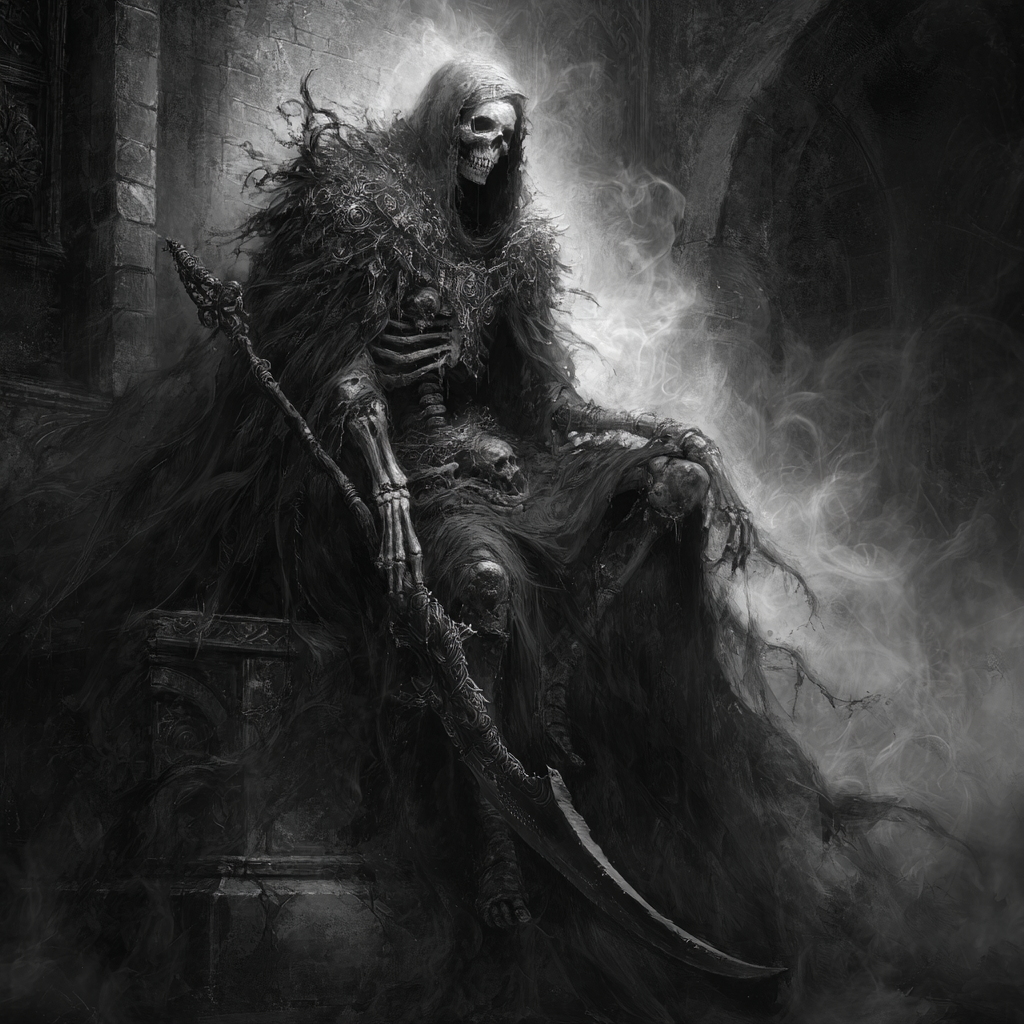
Moros
Major Aspect of Death
He Comes, He Comes, He Comes...
Moros is the grim personification of impending doom, violent death, and the inescapable sorrow that accompanies demise. It is the chilling realization that one's time has run out, and the end will not be gentle.
Moros takes the form of a towering, skeletal figure draped in ever-shifting, absolute black mist that seems to absorb all light. Its bones are ancient and stained, visible only as stark white against the dark shroud. Where its eyes should be are two pits of swirling, absolute darkness, yet a mortal gazing into them sees their own final, terrifying moments played out. Its touch is chilling to the bone, its voice a hollow, rattling whisper that carries no comfort, only the countdown to the inevitable end. In some depictions, it wields a scythe or a rusted, notched cleaver, symbolizing the sudden, brutal cutting short of a life.
Moros embodies the sheer, brutal finality of a life violently taken, OR the unfeeling, natural cessation of existence when time simply runs out. It is the chilling realization that one's time has ended, regardless of the cause. For the Diovani, it is a being that revels in the suffering and panic it brings, feasting on the terror of its victims. For the Ronayu, it is viewed as an unfeeling, necessary force of nature—a grim reaper whose touch is indiscriminate, a chilling agent of fate that ensures no mortal escapes their destined end, be it through quick violence or slow decay.
Rites
The Last Breath's Echo: Performed at the site of a violent death. Followers acknowledge the brutal finality by leaving behind a piece of polished obsidian or a small, broken weapon. They chant the name of the fallen until the last syllable fades into silence, honoring the inevitability of their fate.
The Feast of Dread: A ceremony reserved for the dedicated, performed under a new moon. Participants recount tales of brutal, sudden death, consuming bitter herbs after a fast. The goal is to fully face and accept the terror and power of Moros, believing this acknowledgement might momentarily stave off their own end.
The Shadow Pledge: An oath taken by those who mete out swift death (assassins, executioners). They dedicate their next act of killing to Moros, asking for a clean, quick, and final strike. This is accompanied by the solemn sharpening of their weapon and prayers of necessity.
Celebrations
The Deepening Night (The Black Sun Vigil): Held during the winter solstice. Followers gather and light only a single, flickering lamp, spending the longest, darkest night in silent, tense vigilance, contemplating their own mortality and the moment their luck might run out. When dawn breaks, they extinguish the lamp and scatter, a chilling reminder that the morning is a temporary stay against the eternal night.
Effigy:
A Rusted Iron Cleaver: Notched and used, representing the violent severance of life.
A Shard of Obsidian: Dark and reflective, symbolizing the cold, hard, and unforgiving finality of death.
A Single, Dead Flower: Pressed and brittle, placed upon a small, smooth stone of granite, representing a life cut down in its prime.
Domains: Inevitability, Doom, Fear, Catastrophe, Finality.
Legends: It is whispered among the Diovani that the earliest mortal wars were not sparked by greed, but by the maddening presence of Moros. It stalked the camps, whispering the exact, violent manner of death each warrior would face. Driven to madness by the foresight of their unavoidable end, they fought with reckless, despairing abandon, creating a tide of premature, brutal deaths that only ceased when the sheer volume of slaughter sated Moros, causing it to retreat into the shadows.
Goals:
To ensure all mortals face their destined, final end, whether it be violent or through slow, natural cessation.To cultivate the understanding that fate is immutable and the final hour cannot be bargained with, whether it arrives suddenly or by natural decay.
To consume the fear and dread produced by those facing an unavoidable, tragic end, and to collect the souls of those who accept the inevitable, adding to its silent dominion.
Draws Strength From:
The Agony of Dread: The terror, fear, and panic of mortals facing a sudden, violent, or inescapable end (This is the energy source favored by the Diovani interpretation); The Weight of Finality: The quiet, heavy realization and absolute, ultimate acceptance that a mortal's time has run out, regardless of the cause (This unfeeling, inevitable interpertation, is acknowledged by the Ronayu).
Rivels:
Aluvima: Moros despises Aluvima's quest for peaceful transition, viewing it as a fundamental weakening of death itself. Moros demands that the moment of death—whether it’s a sudden catastrophe or the slow flicker of life's candle—be a moment of absolute, unquestionable finality, not a gentle passage.
Onrir: Moros actively seeks to corrupt the souls Onrir guides, aiming to claim them in terror and disrupt the peaceful guidance of ancestral spirits.
Urweh: Moros represents the unbending line of inevitable doom, challenging Urweh by ensuring that all her careful weaving of destiny ultimately becomes meaningless when the tragic, final hour strikes.
Graous: Moros seeks to ensure that Graous's chaos is terminal and all-consuming, fighting the deity's attempts to bring guidance and salvation through the fury of a tempest.
Originating Culture: Diovani, Ronayu, and others.