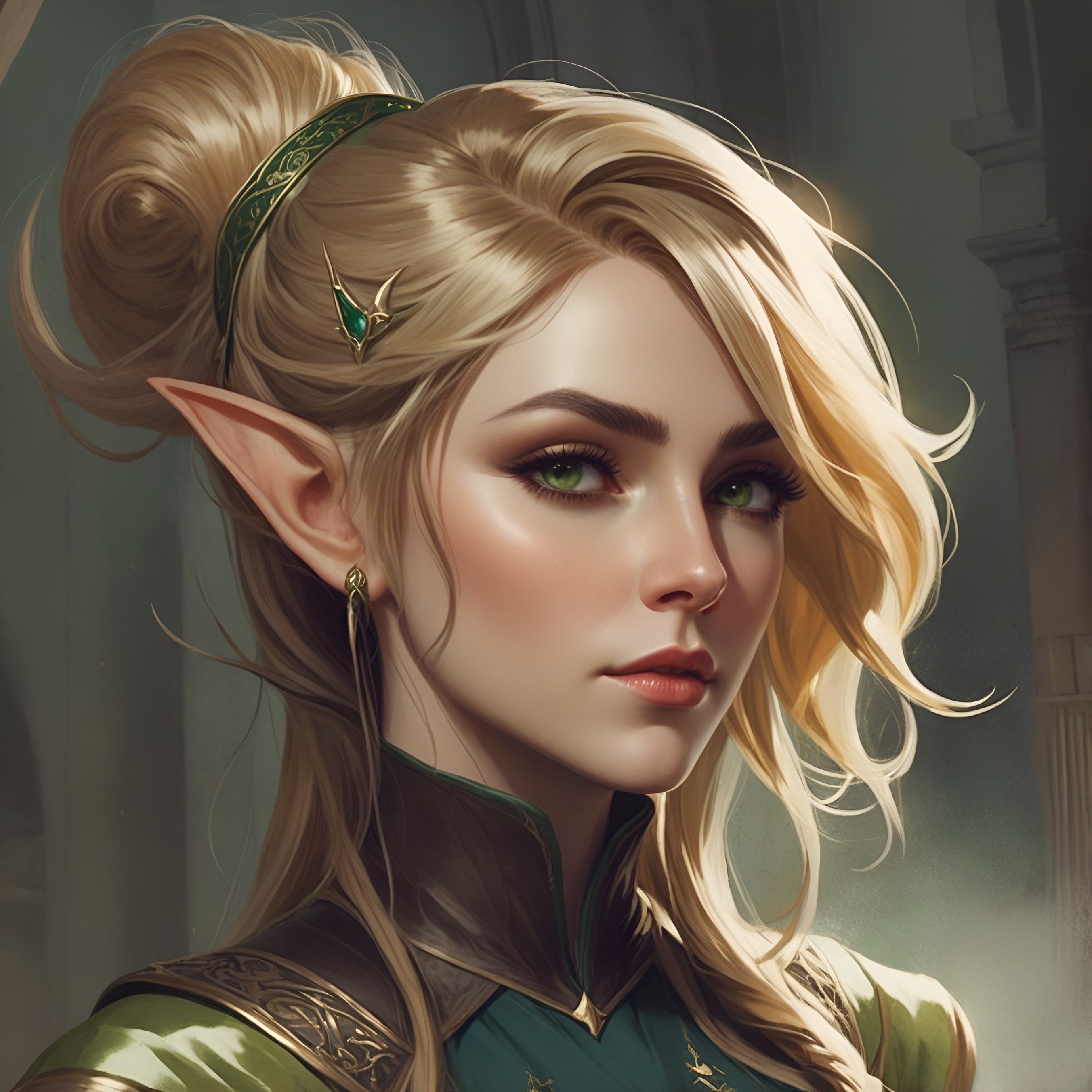
Physical Description
The Valarith, or High Elves, are a vision of ethereal grace and timeless beauty. Taller than their Wood and Veloren kin, they stand between 5'8" and 6'4", with slender, elegant frames. Their skin ranges from pale ivory to a golden sun-kissed hue, reminiscent of Lunora’s dawn light. Hair colors are often bright and vibrant, spanning shades of silver, platinum blonde, and shimmering gold, though deeper hues like midnight black or sapphire blue are not uncommon.
Their eyes are perhaps their most striking feature—luminescent and crystalline, reflecting the arcane energies that course through their veins. They shine in shades of violet, azure, and emerald, and seem to glimmer faintly in the dark, a reminder of their deep connection to magic.
Valarith attire is a blend of elegance and arcane craftsmanship. They favor robes woven from enchanted silks, shimmering with protective runes, and adorned with delicate embroidery that tells tales of their ancestors. Jewelry is intricately designed, often set with enchanted crystals or blessed metals.
History
The High Elves trace their origins back to the First Age, during the dawn of Lunora when the world was untamed, and raw magic flowed like rivers through the land. From the lingering essence of the departed Titans, the first High Elves emerged within the grand plains, their ancient land of the Great Weald. During these early years, the Valarith shaped the world with a grace and mastery over magic that seemed limitless.
They built towering citadels of marble and glass, suspended in sunlight and bound by arcane ley lines. Their cities hovered amidst clouds or stood upon cliffside perches that defied gravity, testament to their mastery of magic. It was a golden age of art, philosophy, and boundless exploration of the arcane.
However, the rise of other races, particularly humanity, brought challenges. Humans, with their rapid expansion and adaptability, began to encroach upon lands the Valarith once deemed sacred. Conflicts arose, and the High Elves, unaccustomed to change and defensive of their traditions, found themselves struggling against the tides of progress. This led to the Great Sundering, a period of elven decline as their territories shrank and their influence waned.
Despite this, the High Elves endured, adapting to the new world order. Some retreated into isolated enclaves, maintaining the grandeur of old, while others sought to integrate into other societies as scholars, diplomats, and artisans. In the Nagan Empire, they rose to prominence, becoming the core of the Empire’s aristocracy, deeply devoted to the Five Gods—Laaos, Nori, Gao, Liao, and Takata—who they believe to be the spiritual inheritors of Diion's divine essence.
Outside of the Nagan Empire, the Valarith have adapted their beliefs to match the local traditions of Midora, embracing local deities and customs while retaining their signature elegance and mastery over the arcane.
Society and Culture
High Elven society is an embodiment of refinement, leisure, and scholarly pursuit. They prioritize the perfection of art, magic, and diplomacy, with entire communities dedicated to the mastery of these disciplines. Their cities are architectural marvels—ivory towers draped in shimmering vines, floating gardens enchanted to bloom eternally, and pathways of marble that gleam under moonlight.
Valarith Social Hierarchy:
High Elven society is woven with intricate layers of prestige and purpose, defined by a rigid yet graceful hierarchy. Among the Valarith, status is not merely a matter of wealth or power, but of lineage, magical prowess, and societal contribution. This hierarchy is deeply ingrained and meticulously observed, with each family knowing its precise standing. Outsiders, even those who interact regularly with the Valarith, often remain unaware of these finely drawn lines, mistaking their elegance for unity.
The Luminaries (High Mages and Archmagisters) At the pinnacle of Valarith society are the Luminaries, a council of the most powerful mages and scholars. These families trace their bloodlines back to the earliest days of Lunora’s founding, and their mastery of the arcane arts is unparalleled. Luminaries serve as stewards of magical law, presiding over ancient rites, managing ley line networks, and safeguarding the grand archives within the Nagan Empire. Their influence is absolute within Valarith borders, and their word is considered law among their kind. | The Luminites (Highborn Warriors) Below the Luminaries are the Luminites, a caste of elite warriors bound to the protection of Valarith domains. These warriors are not mere soldiers; they are arcane knights, trained from birth to wield both blade and spell with precision. Families of the Luminites often trace their lineage to legendary war heroes, and their prestige is only rivaled by the Luminaries. They serve as the hands of the Luminaries' will, executing justice and defending against external threats with unmatched grace and discipline. | ||
The Eminents (Scholars and Diplomats) The Eminents hold a vital role in Valarith society, serving as scholars, diplomats, and keepers of history. Their families are dedicated to the preservation and interpretation of elven knowledge, both arcane and political. Eminents are often seen in council chambers, libraries, and embassies, acting as intermediaries not only between Imperial cities but also with outside realms. They are trained from a young age in rhetoric, history, and arcane theory, making them exceptional negotiators and chroniclers. Their libraries are vast, and their influence is subtle but far-reaching, as they craft treaties and ensure the legacy of the Valarith endures through recorded history. | The Silverrite (Artisans and Spellcrafters) Artistry is seen as a form of divine expression among the Valarith, and those who craft the enchanted weapons, spellwoven garments, and ethereal architecture are highly respected. Members of the Silverrite family lines are masters of their craft, blending magic with creation to produce works of art that last for centuries. Silverrite Artisans are particularly renowned for their spellforged weapons and arcane-infused jewelry. | ||
The Glimmerkin (Merchants and Nomads) Though often seen as transient within Valarith borders, the Glimmerkin hold an essential role in society. They are merchants, traders, and negotiators, bringing in rare materials and exotic treasures from across Midora. Despite their mobility, Glimmerkin families are well-regarded for their cunning and ability to forge connections far and wide. They often serve as the Valarith’s eyes and ears beyond Lunora, gathering information and solidifying trade agreements with other elven kin and mortal societies alike. | The Rootborn (Peasants and Laborers) At the foundation of Valarith society are the Rootborn, families tasked with sustaining the grand cities and enchanted gardens of the High Elves. Farmers, builders, and caretakers of Lunora’s magical flora, they live modestly compared to their noble kin. Despite their lower status, the Rootborn are respected for their role in maintaining the beauty and prosperity of Valarith domains. Many among the Rootborn aspire for their children to join the Silvershade or Glimmerkin, seeking to elevate their family’s standing through mastery of a craft or mercantile success. |
While the hierarchy of the Valarith is rigid, there are rare instances of social mobility. A particularly gifted Rootborn may be accepted into the Silverrite through apprenticeship and mastery of spellcraft. Similarly, a Glimmerkin family that secures lucrative trade agreements or uncovers rare magical artifacts may ascend to the ranks of the Eminents. However, such elevations are often met with suspicion and scrutiny, as tradition weighs heavily on the Valarith’s perception of status. The Luminaries and Luminites are almost exclusively bound by bloodline, with only extraordinary deeds granting access to their echelons.
Religion and Beliefs
The Imperial High Elves of the Nagan Empire are devout worshippers of the Five Gods, descendants of Diion who represent each season and its divine essence: Laaos, Keeper of Order (Spring) Nori, Watcher of Rivers (Summer), Gao, Warden of Time (Harvest), Liao, Judge of Fire (Autumn), Takata, Paragon of War (Winter)
Their grand temples are wonders of magic and architecture, with enchanted gardens that bloom perpetually and statues that sing the hymns of old. The Valarith outside the Empire, however, have integrated various local deities into their worship, adapting to survive and thrive in diverse societies.
Names and Language
The Valarith speak High Elven (Valari), a melodic and refined tongue filled with arcane intonations. Their names are often lyrical, reflecting both their grace and arcane prowess.
Common First Names: Elion (Radiance of Dawn), Calithar (Starbound Grace), Serelith (Moon’s Echo), Vaelis (Keeper of Secrets)
Surnames: Sunstride, Dawnweaver, Silverleaf, Starhaven
Relations with Other Elves and Mortals
The Valarith maintain a sense of polite distance from other elven kin. They view the Wood Elves with mild disdain, perceiving their nomadic ways as primitive. The Veloren Elves, however, command a grudging respect for their celestial origins and adaptation to the magical wilds. Relations with the Umbraith are tense and shrouded in mistrust due to the latter's dark pursuits of forbidden magics.
With humans, the Valarith are more welcoming than most elves, particularly in cosmopolitan centers where they serve as advisors, artisans, and diplomats. It is said that their acceptance of Half-Elves—a stark contrast to other elven cultures—has softened relations between their people and humanity, though not without controversy.