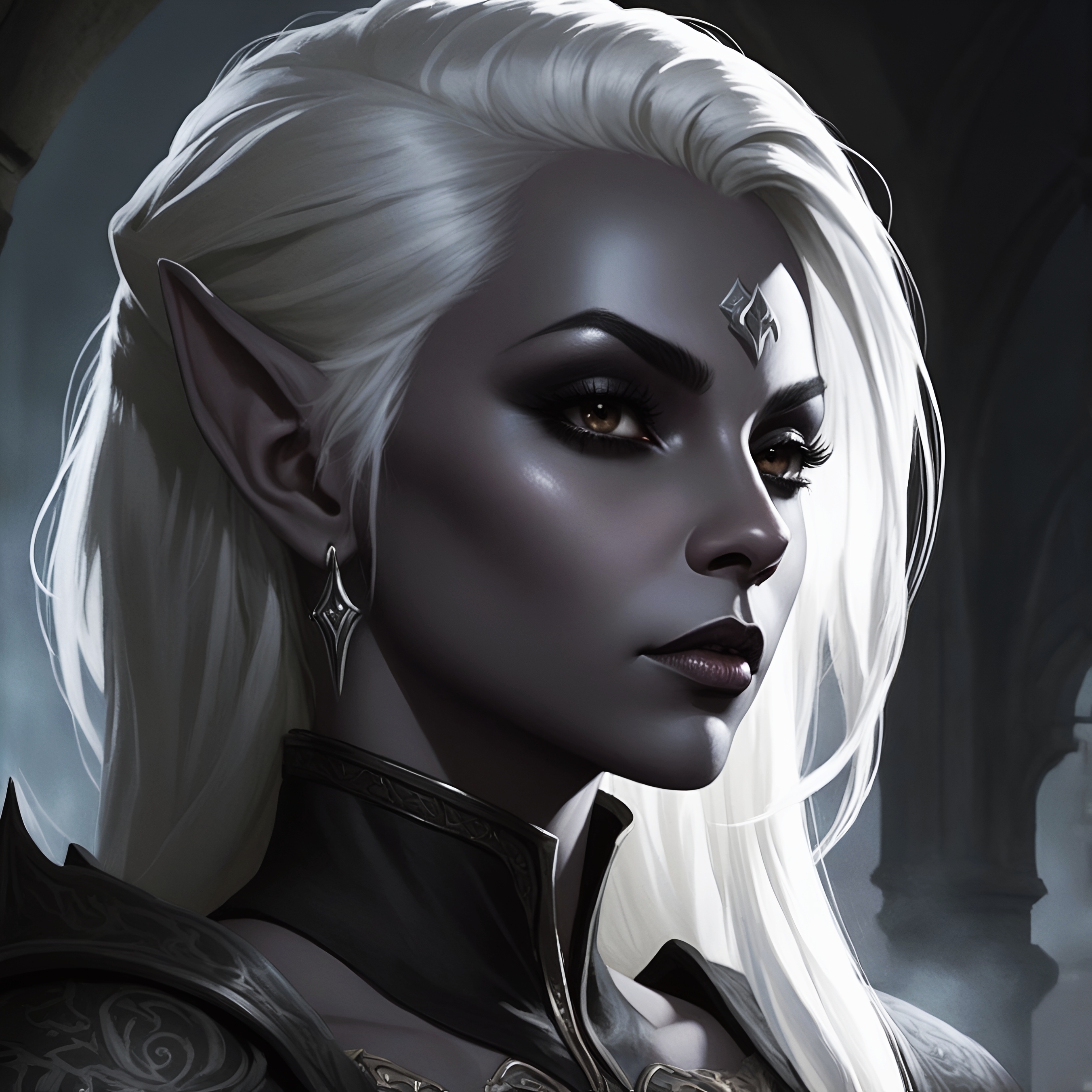
Physical Description:
Umbraith, more commonly known as Dark Elves, are immediately recognizable by their stark and enigmatic appearance. Their skin ranges from deep obsidian black, ashen grey to pale white, a testament to their long-forgotten exile into the shadowed depths of the world. Hair is typically a stark contrast—either ghostly white or jet black—often worn long and braided in intricate patterns that signify status or family lineage. Their eyes, eerily luminescent, shimmer with hues of crimson, violet, or pale silver, adapted to pierce through darkness and shadow. Standing between 5 and 6 feet tall, they possess lean, wiry builds that emphasize agility and grace over brute strength.
History:
The history of the Umbraith is one steeped in mystery, betrayal, and eventual liberation. Once among the eldest of the elven kin, the Umbraith began as scholars and seekers of arcane truths. However, their fascination with forbidden magics—shadowcraft, necromancy, and entropy—caused a rift between them and their Valarith kin. Their pursuit of these darker arts was seen as heretical, leading to their exile from Lunora's shimmering cities and lush forests.
Banished to the shadowy underworlds and forgotten corners of the world, the Umbraith thrived in darkness, mastering the magics others feared. For centuries, they honed their craft in secret, whispering to shadows and binding souls to their will. When they re-emerged, they were forever changed—no longer the same kin that walked the sunlight of Lunora but a shadowed reflection of their former selves.
Ages later, on the dawn of the Fourth Age, the Nagan Empire was rocked by a brutal civil war on the island of Eros, south of Lunora. The conflict was led by rebellious factions, predominantly humans and dwarfs, who sought independence from Nagan rule. The Dark Elves sided with the rebels, lending their maritime prowess and shadowed magics to the cause. When the rebellion was won, the Vache Kingdom was established, ruled by three "Iron Kings," each representing a distinct kin: human, dwarf, and dark elf. The Dark Elf crowned as Iron King of the Sea became a symbol of their newfound power and legitimacy.
Society:
Umbraith society is built upon principles of power, secrecy, and ruthless ambition. Now masters of the seas around the Vache Kingdom, they are unparalleled seafarers, pirates, and traders, dominating maritime routes with cunning and unmatched naval prowess. Their cities are labyrinthine ports of shadowed grandeur, often hidden from plain sight and guarded by enchantments that deter unwanted visitors.
Internally, Umbraith society is a tangle of political maneuvering and backstabbing. Powerful aristocratic families vie for dominance, their influence determined by wealth, arcane mastery, and bloodline. These families maintain private fleets, merchant companies, and clandestine networks that span across Lunora and beyond. Assassinations, espionage, and sabotage are common tools in the Umbraith's endless game of political chess.
Religiously, the Umbraith of the Vache Kingdom are proudly godless, placing their faith only in their own strength and ambition. To them, bending the knee to any higher power is seen as a betrayal of their sovereignty. Outside the Kingdom, however, Dark Elves live with fewer social restrictions, and many turn to darker powers for aid—particularly the abyssal children of Rhaaga. These cultists form hidden sects that practice forbidden rites in exchange for power and forbidden knowledge.
Racial Names and Language:
The Umbraith speak a unique variant of Elvish known as Undera that is exclusive to their kind, a tongue laced with guttural undertones and shadowy inflections. Among themselves, this language is used almost exclusively, preserving their secrecy and reinforcing their sense of unity. When dealing with outsiders, they revert to Common or the standard Elvish dialect (Valari), though often begrudgingly. Many Dark Elves are also raised to understand Undercommon, the trade language of the deep and the dark, enabling them to communicate with underground dwellers, merchants, and other races that inhabit the shadowed places of the world.
Umbraith names are often sharp and fluid, evoking whispers and the echoes of deep caverns.
Common male names include: Kaelen, Drevon, Xylar, Valric.
Common female names include: Lirae, Velith, Myrrha, Saelis.
Surnames are typically familial, often related to shadow or maritime themes: Shadowtide, Duskmantle, Deepwalker, Blackreef.
Relations with Other Races:
The Umbraith’s reputation precedes them; they are often regarded with suspicion and mistrust by the other elven kind, particularly the Valarith who still view them as heretical and corrupted. Relations with the Therannis and Veloren Elves are strained but pragmatic, with rare alliances formed in times of mutual need. Humans and Dwarfs of the Vache Kingdom accept them as equals, recognizing their naval dominance and strategic prowess. However, outside of the Kingdom, Dark Elves are often seen as mercenaries, assassins, or shadowy manipulators, living on the fringes of society and skirting the edges of the law.
Culture & Beliefs:
The Umbraith are fiercely independent and value cunning, resilience, and ambition. Their culture praises self-reliance and resourcefulness, and weakness is seen as an unforgivable flaw. Rituals are often shadowed affairs, shrouded in secrecy, where the most powerful families make pacts in blood and shadow to secure their futures. Though largely godless, the Umbraith are known to engage in rites of passage and secret gatherings where dark pacts are made, and rivalries are settled in ritual combat.
Their disdain for divine intervention does not imply a lack of spirituality—rather, it is a different kind, one that draws upon the raw essence of entropy and darkness itself. They believe strength is earned, not granted, and the path to power is paved with shadow and sacrifice.