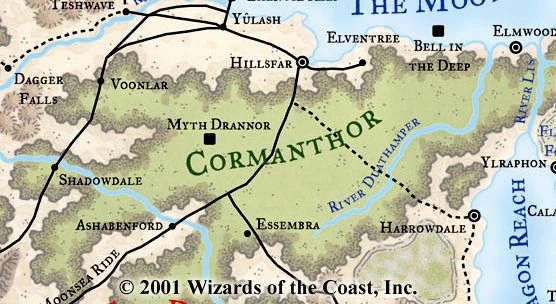
Although Cormanthor could be considered one forest, it incorporated four different forests: the Elven Court, Semberholme, the Tangled Trees, and the Vale of Lost Voices. The first three of these four roughly corresponded to the old elven communities of the same names. The forest was also divided roughly according to tree type.
The Rimwood was mainly made up of Unknowns and was the least dense part of the forest. It was an area that ran around the edge of the forest, a ten or twenty-mile border between the interior forest and the rest of the world. The soil here was not rich in minerals and was quite sandy, so it lacked the variety of vegetation found further in the forest. Most of the trees were Unknown and Unknowns, but they had spread quite far apart, rarely touching one another, and didn't often grow over 20 feet (6 meters). Because these pines dropped slow-to-decompose needles on the forest floor, other foliage, except softwood Unknowns, struggled to grow. The hillsides could be home to Unknown, Unknown, and clumps of Unknown. Although vegetation caused a lack of animal species in the Rimwood, insects such as Beetles, Lice, Mosquitoes, Red Ants, and Red Leafhoppers thrived here. Major roads running through the Rimwood included Halfaxe Trail, Moander's Road, Moonsea Ride, and Rauthauvyr's Road.
The Midwood consisted chiefly of Unknown and Unknowns. The trees here were dense enough to provide a predominantly unbroken canopy. It separated the Rimwood from the Starwood and accounted for roughly half of the total area of the forest. There was a wide variety of other vegetation, in part thanks to the rich soil, including Unknowns and Unknowns in the hills north of Mistledale, Unknown and Unknowns in meadows and Unknowns and Unknowns in groves near Essemore, and Unknown, Unknown, Unknowns, Unknown, and Unknown. Some of the weirder vegetation included Unknown, Unknown, and Unknown. The Moonsea Ride skirted this area.
The Starwood was made up mostly of giant Unknowns and Unknowns and was the densest part of the forest. The maples averaged a height of 200 feet (61 meters), and some of the oaks could reach 400 feet (122 meters). The soil here was rich enough to be almost black and constantly moist, which produced a wide variety of undergrowth, and traveling through this could be difficult because of its density. Because of the high humidity, various lichens and mosses grew here. The Starwood was rich in animal species such as Deer, Dire Wolf(ves), Elk, Emerald Constrictors, Finches, Manticores, Owls, Porcupines, Skunks, Weasels, and Wood Rats. Adventurers could also find some unusual vegetation here. These included Unknown, Unknown, Unknown(ies), and Unknown. This forest area was split roughly into four, each with its distinct tree types, but all areas of the Starwood contained tall oaks, maples, and hickories. The central Starwood was west of the River Ashaba and home to spruce and Unknown. The north Starwood was rich in cedars and the home of Myth Drannor, the ruined elven city. The east Starwood contained the Elven Court and Tangled Trees regions, both former elven communities, and was home to Unknowns and Unknowns. Finally, the west Starwood had Unknown and Unknowns and contained Semberholme.
The edgelands were patches between the forest areas where magic could go haywire and small animals' diets would change significantly. They were roughly circular areas no more than 60 miles (97 kilometers) in diameter, and there were usually only two or three in the forest at any time. They only occurred between spring and autumn and were caused by energy drifts from Myth Drannor. They faintly radiated magic, caused spells to fail or go wrong, interfered with the powers of magic items, and caused unusual weather effects, such as snow during summer.
Cormanthor was home to two main rivers that provided water to its inhabitants: the Duathamper, also known as the Elvenflow, and the Ashaba. The Duathamper ran along the southeastern border of the forest. The river was generally deep, more than 30 feet (9 meters) in most places, and wide, although it did become narrow and shallow enough in places to wade across. It had a large population of Bass, Catfish, and Trout. The Ashaba cut the forest roughly from Shadowdale in the Dalelands to Semberholme. The river was several hundred yards across and deep, more than 30 feet in places. Its banks sloped steeply in most places, and it was home to Carp, Walleye, and Bullhead. The carp, in particular, could grow enormous, large enough to threaten a human-sized creature.
Cormanthor contains several portals, such as one to Cormyr, Glister, and the River Chionthar, and the Elven Unification Portal created by Jhaurmael and leading to @Evermeet.
Climate
Light rain served the forest year-round, and the ground was usually moist, keeping humidity high. Winds could not penetrate the thick, dense canopy, so the forest was calm at ground level. At the height of the summer, the sun provided direct light for 16 hours a day. The extended daylight allowed crops to mature quickly, and summer storms could come and go in just an hour. There were often patches of dense fog in the forest, especially near the northern Unknown. This fog was thick and grey in the Starwood, allowing only a few hundred feet of visibility. According to Elminster Aumar, the magic of Myth Drannor could account for Cormanthor's favorable weather.
EXTREMES
It was not unknown for climate extremes to strike the forest and, with them, their effects.
In 1350 DR, a summer drought caused the Unknown to fail and the Red Deer to starve.
In the autumn of 1367 DR, the frost arrived early in the forest, causing the wildflowers and berries to die north of Highmoon, which left the Leucrottas hungry, and they turned on the Halflings in the nearby village of Casckel, eating them all.
Flora & Fauna
Main article: Cormanthor/Flora
The Fyrefly(ies) in the forest could cause wild blazes, especially on clear summer nights, when they assembled in huge swarms. In the past, efforts had been made to control their population, including introducing Giant Wasps to eat their food supply Unknowns, but they moved on to Unknown and Unknown instead. The elven mage Horquine attempted to breed a variety of Azmyth that would eat the fyreflies, but they could not digest their abdomens, the source of the flames, and they had to spit them out, yielding a flame.
Although Dragons were incredibly rare in the forest in recent history, hundreds of years ago, Green Dragons were common. Because the dragons overhunted the Centaurs, their numbers began to dwindle. They began to blame one another for the lack of food, which triggered a civil war that damaged much of the Starwood, and only a small number of green dragons remained.
During the Retreat, the elves left behind thousands of Green Warders. By 1371 DR, Dalelanders began complaining about warders on the fringes of the forest who were acting far more aggressively than usual.