Adventurers of the Flanaess
Classes of Dungeons & Dragons 5th Edition
As should be expected, all character classes and class options presented in the 2014 Player's Handbook are fully compatible with the Greyhawk setting. Additionally, most of the expanded character options presented in both Xanathar’s Guide to Everything and Tasha’s Cauldron of Everything are also perfectly acceptable options in Greyhawk, although some alterations to class flavor have been made to help integrate the class deeper into the Greyhawk set and setting.
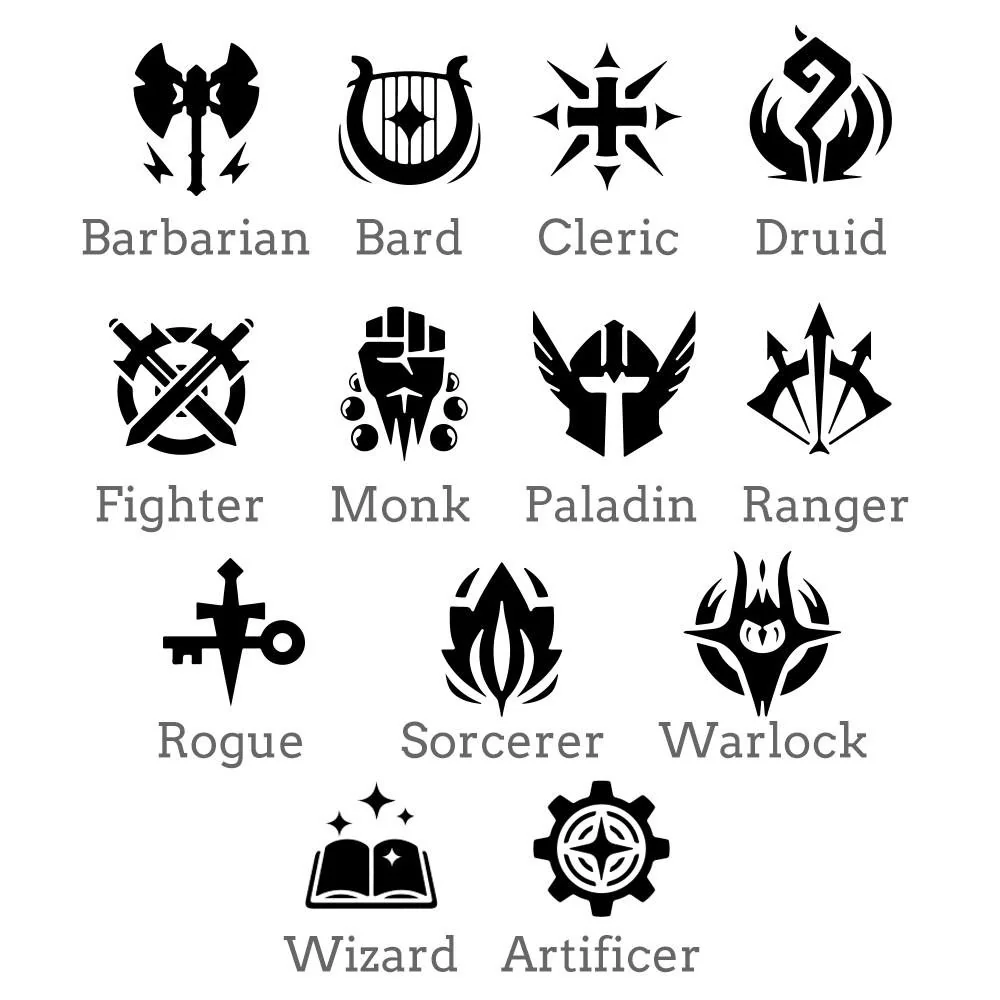
Artificers — Artificers are those who spend most of their free time creating all sorts of magical devices, compounds and more. With the exception of alchemy, artifice magic is exceedingly rare, so much so that outside the City of Irongate most do not even know if its existence. Gnomes are the most frequent artificers while some dwarf clans have learned from gnome artificers and adapted techniques to their own needs. Perhaps the best-known non-alchemist artificers on the Flanaess are the members of the Artificers Union of Irongate.
Barbarians — Barbarians are most common in the extreme north or the extreme south of the Flanaess. Those in the north generally hail from one of the four groups of horseback-traveling nomads – the Tiger Nomads, Wolf Nomads, Rovers of the Barrens, and Hold of Stonefist. The barbarians in the northeast of the Flanaess – the Fruztii, Schnai, and Cruskii – are more settled and are excellent seafarers. Barbarians from the steamy jungles of the south are considered more primitive than their northern counterparts, but no less savage. The barbarians listed, residing at the fringes of the Flanaess, are often of Olman, Suel, or mixed heritage.
Bards — Bards are commonly found throughout the Flanaess, particularly in urban centers such as the Free City of Greyhawk. Those in rural areas are often closely aligned with the Old Faith of Druidry, and are talented performers who are interested in seeing that no side in the cosmic struggle for dominance – law and chaos, good and evil – ever completely dominates the others. In either case, whether with tales spoken in glades in deep woods, or songs sung in smoky urban taverns, the life of a bard emphasizes the eternal nature of struggle, the cyclical nature of history, and how even the most seemingly invincible foe can be overcome, only to start the cycle anew.
Clerics — There are a wide variety of deities and religions in the Flanaess and its environs. Like much of the history and culture of the Flanaess, its religious makeup has been shaped by the wanderings of the various peoples over its face, particularly after the Invoked Devastation and Rain of Colorless Fire a millennium ago. Many of the deities worshiped in the Flanaess are common, which is to say their worshipers are found in Oeridian, Suel and Flan communities. Others are limited to a single pantheon, and their worship is naturally limited to areas that are populated by the descendants of their original worshipers.
Druids — The druidical religion is known as the Old Faith. In most places, the followers of the Old Faith and those of the various clerical religions get along at least moderately peacefully, and it is not unknown for certain deities to have both druidic and clerical priests. The druidic hierarchy is strongly maintained in the Flanaess, with each major woodland having its own Great Druid, and a Grand Druid governing over all.
Fighters — It is no exaggeration to say that the Flanaess is constantly at war. Border skirmishes between Iuz and his neighbors to the south; raids by the Bandit Kingdoms into neighboring Tenh, the Pale, or Urnst; incursions by humanoid tribes attempting to overrun civilized lands (and sometimes succeeding!); maneuvers and battles by full-scale armies as the Great Kingdom and the Iron League; the Flanaess produces many fighters, and some of those veterans become adventurers.
Monks — While the monks of the Scarlet Brotherhood are perhaps the most infamous monastic order, most monks in the Flanaess receive their initial training in individual monasteries which are ultimately of Baklunish origin, as the devotees of the demigod Zuoken brought the practices of meditation and unarmed combat from the far west of Oerik. Monks who come from such monasteries need not be of the Baklunish race, as families of any race will send younger children to a nearby monastery with a good reputation, or even one with a poor reputation if there are simply too many mouths to feed.
Paladins — An overwhelming number of paladins in the Flanaess are devotees of Saint Cuthbert, Heironeous, Pholtus, or Rao. There are few paladins who are dedicated to Nature, and those dedicated to the protection of Nature are typically champions of balance as a concept, not necessarily as holy warriors against evil. As such, paladins are not often directly aligned with the Old Faith except under the most unusual of circumstances. The exception to this most often comes from paladins of elven extraction, such as those found in the courts of the Ulek states or Celene.
Ranger — Rangers can be found throughout the Flanaess, usually, but not exclusively, in woodlands. In some places, such as the Gnarley Forest, they are organized into a loose but effective organization, while in other places they either remain solitary or operate in small independent bands. It should be noted that Underdark is not an available choice of favored terrain for rangers in the Flanaess.
Rogues — Rogues are found across the Flanaess, from its lowest dives to its most refined courts. In some great cities they are organized into powerful guilds, some of which operate so openly that their masters hold seats on the ruling council, such as the City of Greyhawk. In yet other places, thievery is not only legal, but an accepted part of public life, such as in the city-state of Stoink.
Sorcerers — Sorcerers are rare on Oerth, but not completely unknown. Often, those with innate sorcerous ability will hone their skills with more traditional wizardly study, becoming truly formidable spellcasters combining the learned magic of a wizard with the intuitive understanding of a sorcerer
Warlocks — Oerth is a magnet for powerful beings from the other planes, such as demon princes and queens, as well as more esoteric beings.
Wizards — Oerth, more than any other known world, is noted for its wizards. Names such as Tenser, Mordenkainen, Bigby, and Melf are the stuff of legend across the multiverse. Whether they lived centuries in the past, or are still walking the earth today, such mages have developed dozens of specialized spells and skills that have become available to others.