History
World Weep Opening History
Osirion, one of the oldest and most influential human kingdoms in the history of the Inner Sea, was no match for the end of civilizations that Mathesis's tyrannical experiments. Losing the Pharaoh to the failed First Hero's March, the Council of Sun and Sky attempted to lead the nation in the first dark years of Mathesis's reign. But once alchemical experiments rained down upon the lands, even this group of powerful magi fell silent in the resulting destruction.
Age of Collapse History — Era amongst the Dead
The Osirians' unique perspective on history and the nature of power made some people assured that this too shall pass like the catastrophes of old. In the millennium between the first and second Hero's March, the people of Oririon had taken to avoiding the mad Alchemist's gaze by hiding amongst the dead. Those believers have undergone rites of mummification or other rituals to preserve their body, mind, and perhaps soul for the future. Others have attempted to awaken and consult the figures of past ages, often finding their end at the traps of their would-be hero's tombs. And yet again, others use this age to consolidate their power and be prepared for the end of the Alchemist, waiting to burst into the power vacuum of the next age and stake their claim.
Age of Renewal History
The conclusion of the successful Second Hero's March marked the end of rest for the revered dead. The land of Osirion shifted with the sudden awakening of buried rulers and their entombed servants. Pharaohs and whole dynasties from time immemorial arose from the pyramids and tomb complexes dotted across the land, each one vying to place themselves in power once again. The nation that had held together remarkably well finally broke in the crushing struggles for supremacy. For decades, these warlords have made the nation of Osirion their battleground, carving the land amongst themselves with their conflicting claims and ever-shifting bases of loyalty.
Government
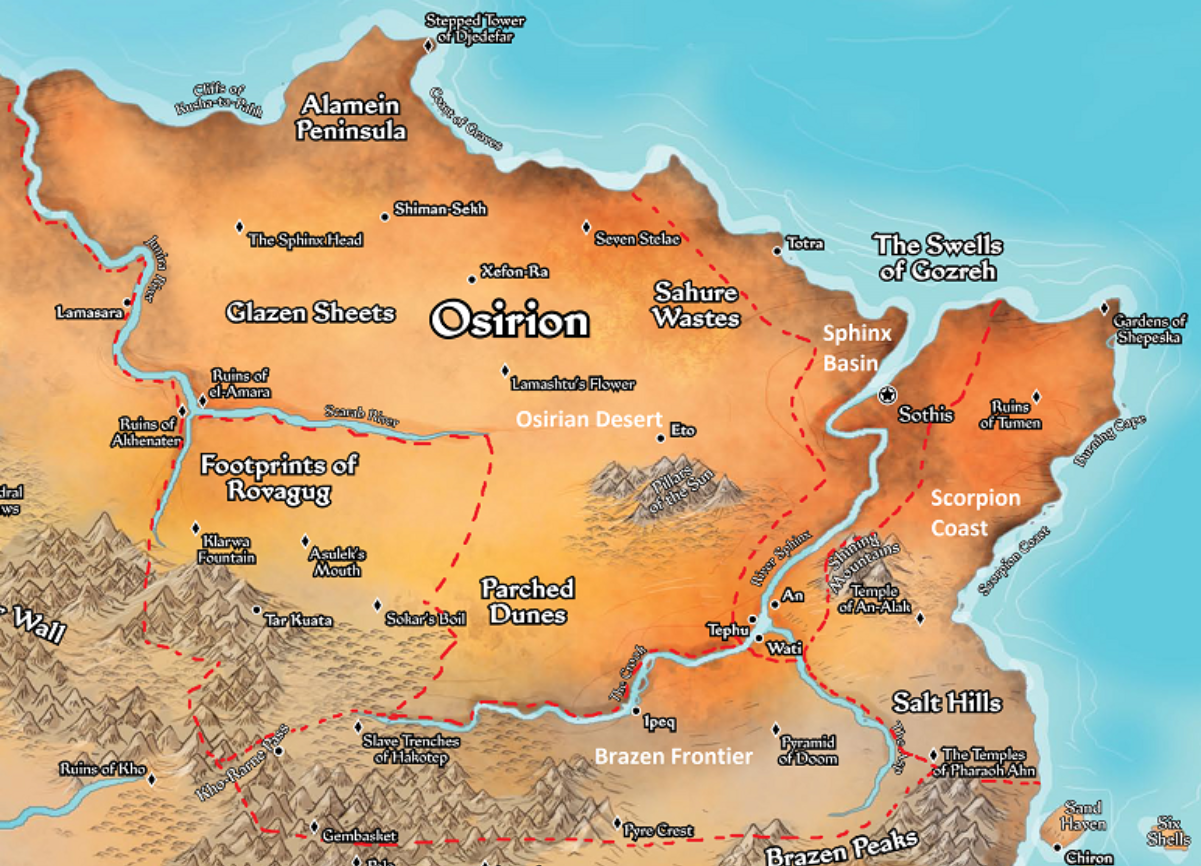
Due to the outstanding civil wars amongst the Pharaohs, the country of Osirion operates as a series of city-states, all claiming Celestial Monarchy over the entirety of the nation, but policies and rulings typically only extend as far as that particular dynasty's actual stake of Osirion land. Many nations tend to treat diplomacy with Osirion as a balancing act of recognizing the claims and legitimacy of all potential rulers as to not ostracize any potential future rulers or alliances, but particularly the one they happen to be attempting trade or pacts with at that moment.
The six most prominent aspirants are:
- The Osirian Desert Gift Giver Tep
- The Brazen Frontier Blind Prophet Anfara
- The Sphinx Basin Hydromancer Neb
- The Footprints of Rovagug Warlord Okai
- The Scorpian Coast Commander Menq
- The City of Sothis Exemplar Gamal
Points of Interest
- The Gifts of Tep are several new oases and springs that have turned the vast central stretch of Osirion into a web of interconnected pop-up communities. These places often adopt names related to the Pharaoh aspirant Tep, like Valley of Tep. Already existing ancient cities like Eto, have been reporting dropping water levels, and several experts in the fields of science have attributed these shifting water tables to the 'miracles' of Tep.
- The city of Sothis has begun reassembling itself into a caricature of its former self through several immortal architects who serve as advisors to the Pharoe-aspirant Gamal and encourage a strict return to the traditions and cultures the city had been practicing in the years before Mathesis's destruction and wrath.
- The Toed City, under the leadership of the Warlord Okai has transformed the once badlands of The Footprints of Rovagug into a myriad of farmland, filtering the poisonous hot springs with strange magiotech into the rich volcanic soils of this region, elevating the city into a major center of agriculture independent of the blessed rivers the other regions of Osirion claim.
- Sphinx Basin hosts many settlements along the banks of its great fanning river system. The most prominent of these is the city Djedta, located in the spot that once contained Tephu, which hosts one of the world's largest new age libraries, where the Hydromancer pharaoh spends most days attempting to consume any knowledge that can be brought to them, and rewarding those who can add meaningful knowledge to this collection.
- The Brazen Frontier has experienced several population booms, with human farming towns and dwarven mining settlements both enjoying unforeseen prosperity. The biggest of these towns, Ipeq, plays host to a blind dwarf-human prophet, whose predictions regarding natural resources and phenomena always prove correct. The prophet insists on respecting the old ways, including the name of the settlements like Ipeq, with those who do not listen to this or other advice falling under severe misfortune.
- The Scorpion Coast plays host to many communities, ancient tombs, and freshwater springs. This concentrated growth in central settlments coming in part due to the depleting water tables present across the coast. In the harshest quarters of the desert, opportunists have been telling tales of steadily resurfacing buried treasures, tombs, and other manner of elaborate dungeons from the millennia of departed rulers of past eras. This has made the region play host to various mercenary and bandit camps over the years.
Organizations Within
- Each land plays host to its own organizations, guilds, and factions that operate on a regional basis. These organizations often operate under the direct control of their respective pharaoh and celestial court. They often play into the respective themes that the pharaoh brings to the region. Such as the militaristic pharaohs playing host to more martial-focused organizations.
- There exist a few national-level organizations operating across the borders of these Pharaonic kingdoms. Two of the most prominent are the various trading companies that have worked out deals or trade mandates to operate across borders and mercenary bands that serve coin above any particular loyalty to a pharaoh's cause.
- Some cults have cropped up across the nation, particularly those devoted to the elder Osarian god Set and those of the beast god Rovagug. They are typically the enemies of all other groups in the nation, although there is a rumor that the warlord pharaoh Okai of the region of the Footprints of Rovagug has elevated a cult to a high position in his court.
Major Conflicts
- The civil war of the pharaohs has waged for decades, since the ascension of the World Weep brought a new age and the awakening of dynasties. These wars have reaped the initial wave of pharaoh aspirants, making the number dwindle over the decades from the hundreds to the six that have now consolidated their power to the major regions of the nation.
- There have been several conflicts due to the high concentration of cults that have arisen across the nation, with several foreign agents, particularly the pure legion of Rahadoum and various well-meaning adventurers.
Events in the Age of Renewal
- The various scribes of the nation have begged, petitioned, and sometimes snuck under the gaze of their pharaoh to make a regular pilgrimage to the city of Djedta and its library, which is said to be the current largest in the modern world. This pilgrimage has become an unrecognized holiday amongst the scholars of the lands of Osirion, but especially recognized in the Sphinx Region, serving as a multi-day-long festival called the Days of Renewal.
- In rare harmony, the six Pharaohs declared the summer month of the Ascension of the Worldweep should be celebrated as a sacred time, and created the Moon of Mercy. One month where borders would tentatively open along the regions, and a ceasefire called across the battlefields. This month of mercy has had several incidents over the year, but the pharaohs and their generals try to generally police themselves fairly during this time.
- Alliances of commoners have created a rogue guild called the Lotus Caravan, which travels from nation to nation and engages in various 'well-meaning roguish' activities, policing corrupt mercenary bands and towns as a sort of benevolent freedom-fighting group.
Other notable changes from the past Golarion
The general population and characteristics of inhabitants mirror the past Golarion. There is a split in religious worship, with some dynasties disavowing the gods due to their silence in the past millennium, and other dynasties maintaining the general customs of old. A few even insist on the apotheosis of their own Pharaohs and lineage into new pantheons of modern God-Kings.