Overview
Mielikki is the neutral good goddess of forests and forest creatures (particularly dryads) and the patron of druids and rangers. The Lady of the Forest was also the goddess of autumn for a time, but Myrkul reclaimed that domain after his return during the Demonic Incursion.
Description
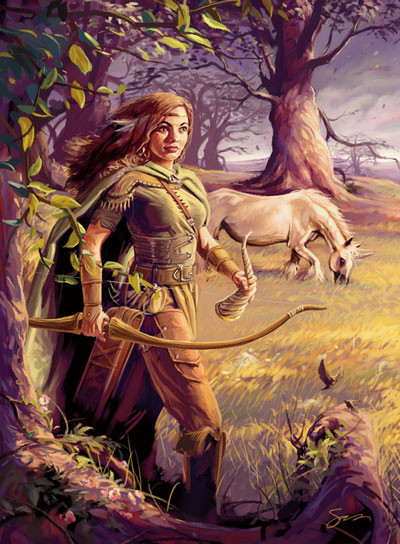
Mielikki's preferred avatar was the Supreme Ranger, where she appeared as a tall woman of robust and shapely build and lithe grace. She moved with the spring of a leaping buck and the ease of a prowling panther. Her russet-colored hair was long and unbound so it hung around her shoulders and down her back, while her eyes were large and brown, and deep like pools. Her clothes were dull green and brown in color and she wore the leather armor commonly used by rangers.
Her other avatar was the Forest Queen, seeming to be a young maiden who had golden-hued moss and leaves for hair. She wore sheer yellow and green gossamer robes, even in chill winter weather, and had summer songbirds fluttering around her person.
No matter her chosen form, Mielikki was 10 feet (3 meters) tall, spoke in a rich low purr, and always walked on the air so her feet never made contact with ground, and thus didn't leave any tracks and didn't make any sound. Occasionally, she had a stag's antlers emerging from her forehead, either already present when she appeared or growing slowly as mortals watched, though she displayed these less often after Beshaba adopted black antlers as her symbol, and had almost abandoned it
Personality
Mielikki was cheerful with a ready smile and had confidence in herself and her path. However, while she fully showed that confidence when in small groups, she was averse to formal speaking and being in charge of larger groups. She did not consider people her friends lightly, but she demonstrated fierce loyalty and protectiveness to those she did. Her views tended to be those of the archetypal ranger. Yet, in the late 15th century DR, mortals saw her as distant and spiritual, and not as human as some other gods. While not uncaring of mortals, her attention and blessings could be harder to attract.
While she knew that death was a part of life and some must die so that others may live, she could not just accept injuries and deaths of both animals and friends. She regularly healed such stricken beings as she found them, rather than leave them to be part of the circle of life as Silvanus would