Overview
Oghma is the neutral or unaligned greater god of inspiration, invention, and knowledge and the patron of bards. The Lord of Knowledge was the leader of the Deities of Knowledge and Invention and as such is the most powerful god of knowledge. Oghma's domain was nothing less than the whole of knowledge and thought, whether they were written down, spoken aloud, or even still remained in the mind, for the idea was the purest and highest incarnation of knowledge.
Description
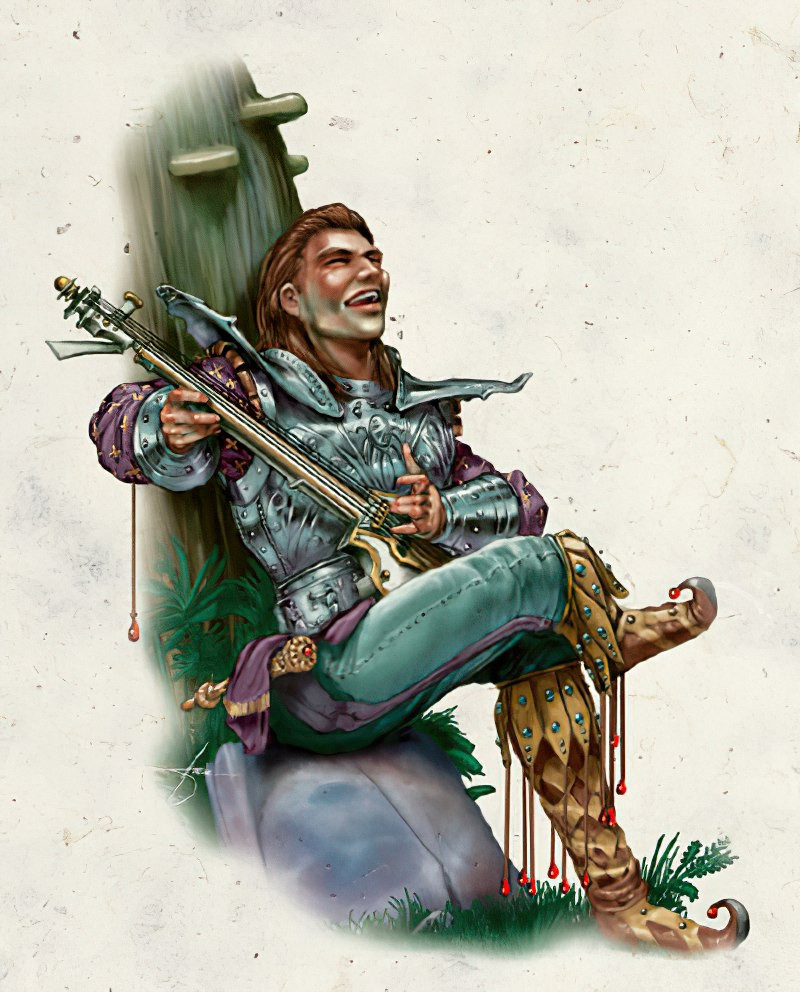
Although he was seldom sighted and is depicted in many different forms, Oghma's avatar most often appeared as a handsome, dark-skinned man in bright, resplendent, and stylish clothes and ornate armor more appropriate to a fantastic stage play than anywhere else. Typically, his outfit included a tabard with projecting, ornamented shoulder plates; a cummerbund with an exquisitely beautiful scene painted on its medallion-shaped buckle; and open-meshwork boots with long pointed toes that curled around and were tipped with dangling crystal teardrops that nearly touched the toes.
On very rare occasions, when the battle was expected, Oghma appeared as an enormous, elderly but brawny man entirely cloaked by his long, flowing hair and beard, which was either white or black streaked with white.
Personality
While Oghma was outwardly carefree and cheerful in manner, often with quiet humor and a ready smile, the Binder was possessed of great wisdom and could be solemn and righteous when needed. He was legendary for his geniality and all beings apart from the evilest and hateful appreciated his fine singing voice and fabled musical talents. He possessed profound powers of persuasion, using his good looks, peerless charm, and rhetorical prowess to sway even his most fierce opposition toward his point of view, and he did so at any opportunity. However, his critics—like fellow deities Lathander and Lliira, who were often radically opposed to conservatism—saw such oratory and charm as manipulative and narrow-minded.
But it was Oghma's burden to choose which ideas and thoughts would spread and which would fade away with their creator so that all others would not be in jeopardy. Resting heavily in his heart were the experiences of millennia and hence in this duty, he was serious, firmly protective, and deeply cautious. He favored a doctrine of ideological conservatism and sticking strictly to the status quo, rather than risking a rogue idea disrupting the delicate balance of knowledge he had been preserving since history began.
Yet after the Spellplague, something changed in Oghma. He was still the judge of ideas and innovations, choosing which would be remembered and forgotten, but the Lord of Knowledge could not stand the suppression of any original thought, regardless of whether the consequences were good or bad. He throve on ideas, especially new ones, and the sharing of knowledge in all its forms.
If the Wise God had a weakness, it might be his tendency to overthink things. He often concocted convoluted schemes in his head and implemented those rather than simply acting directly.