This page lists all current key species for the campaign setting. List might get expanded, or broken into individual articles.
Legend
🔵 Species with this mark are from the
Twilight Imperium sourcebook.
🟠 Species with this mark are original for the campaign setting.
Humans and Human-Like Species
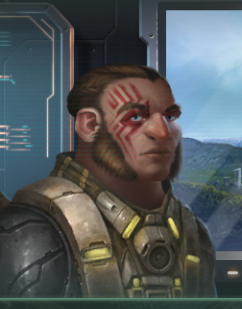
Galdrunni 🟠
(Gal-drun-ni); Galdrunneans Short in stature and renowned for their stout hardiness, the Galdrunni’s ancestors were a subterranean society with deep communal bonds. Before the fall of the last great empire, the heart of Galdrunni industry was a colossal shipyard known as the “Starforge”; a monument of galactic engineering that went lost during the Twilight Wars. There is a sense of superstition deeply seeded in Galdrunni society. On the galactic stage, their leaders are advised by a sect of psinonics known as the “Starseers”, who observe and interpret the ebb and flow of the galaxy itself in strange rituals. |
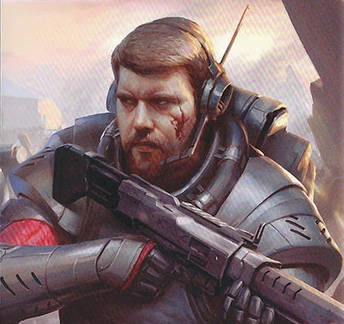
Human 🔵(Hu-man); Humans, Humanity Homeworld: Terra Centered around the Federation of Sol in the Sol system, Humans have spread around the galaxy. They are a young species, but in the years since they discovered mass-drive technology, they have spread between systems at a dizzying rate. They are mammalian bipeds with binocular vision, heralding back to their primate ancestors, known for their physical and psychological endurance. |
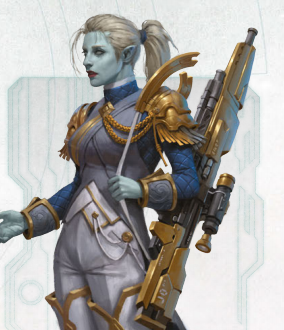
Letnev 🔵(Let-nev); Letnevs, Letnevi Aggressive by culture and notorious for a proud and arrogant presentation on the galactic stage, the Letnev are mammalians with close semblance to Humans — though they are not fond of the comparison. They are towering individuals with pale blue skin and hair ranging from cold white to inky black. They evolved in the deep caverns of their homeworld, lending to an aversion to bright light. They are an ancient people, and among the first to join the last great empire that ruled the galaxy. Even now in its smoldering embers, they do not forget where they once stood.
|
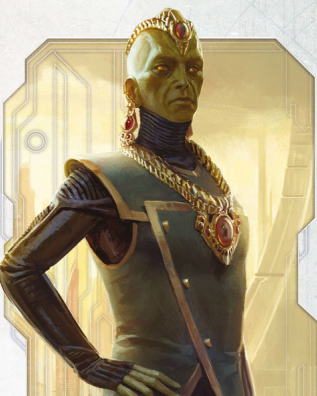
Winnu 🔵(Win-nu); Winnus, Winnaran The Winnu are bipedal humanoids, in many ways similar to humans, with completely hairless bodies and a greenish-golden skin. Warm-blooded and adaptable, the Winnu are studious and dutiful, with a dour demeanour that has entrenched itself in their culture after milennia as the caretakers of their shattered homeworld. Said homeworld is a dry expanse of rocky crags, with little more than inland seas for surface water, though the Winnu are keeping steadfast with a long-lived effort to terraform the planet. Their cities are often called shining beacons, figuratively and literally; they exist as a remnant of the Winnu legacy, but also feature a dramatic excess of artificial lighting. |
Other Humanoid Species
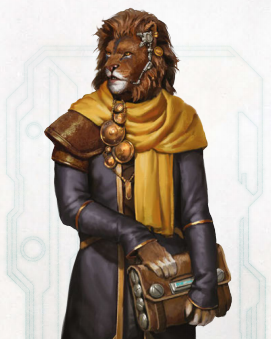
Hacan 🔵(Ha-khan); Hacans, Hacani An ancient and well-established species, the Hacan hail from a cluster of hot and dry planets. From there, they have established themselves as one of the economic powerhouses of the galaxy, both during the Twilight Wars and now in its slumbering embers. They are tall and imposing, covered in a coat of short, tawny golden hair. More masculine Hacan are also predisposed to growing thick manes, and as a society overall they tend toward patience and caution over brash aggression. (GM Note: The Hacans are thematically different kinds of large cat species, but in Twilight Imperium they predominantly are lion-like.) |

Ralkash 🟠(Rahl-kaa-sh); Ralkashi Loosely connected to the Hacan, though not directly related to them, the Ralkash are native to temperate planets with dense vegetation. They are generally known to be reclusive, and have only entered the galactic stage recently, and with direct help from the Hacan. Despite their technological achievements, they place great importance on preserving their ancient customs and rituals, many of which center around introspection and philosophical inquiry. Meidtation and intellectual discourse are considered esteemed pursuits, as well as the honour code of the many clans that their society divides into. The many nations of the Ralkash homeworld trace their lineage to ancestral clans, including the symbols and markings key to each nation’s culture. (GM Note: The Ralkash are thematically different kinds of small cat species and lynxes.) |
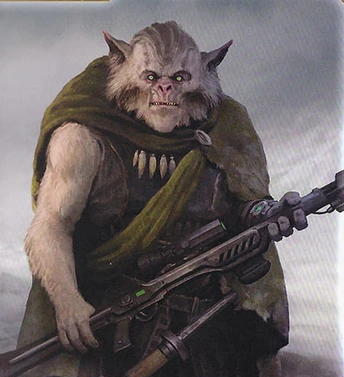
Saar 🔵(Sa-ar); The Saar Historically a nomadic people, the Saar only recently settled themselves a foothold in amidst an asteroid field, makin them as recent of an addition to the galactic stage as Humans are. Despite their voidborn status, given their asteroid home, their physiology still clearly shows that they evolved in a planetary biosphere. They are a mammalian spcies, covered in a thick coat of fur with close, front-set eyes and sharp teeth. Their ancestors were pack hunters, and traces of this still lives on in Saar culture. |
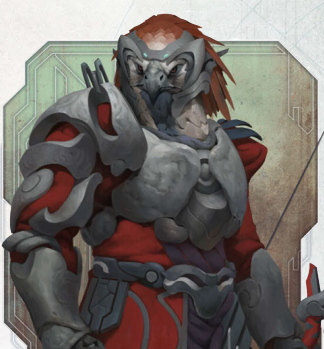
Shikrai 🔵(Shik-rai); The Shikrai The Shikrai are a closely related set of avian species, who all populate a range of planets around a nebula. Their preferred habitat is arid and windswept, though they are able to thrive on any planet that does not have excessive gravity. They are tall and slender, covered in a thick plumage and sporting a sharp beak. Though there are subspecies that are an exception, most types of Shikrai lost their wings to evolution eons ago. Their culture habituates toward smaller, looser congregations over large assemblies. (GM Note: The Shikrai are thematically a catch-all for bird people, might be that some smaller types still have the ability to fly.) |
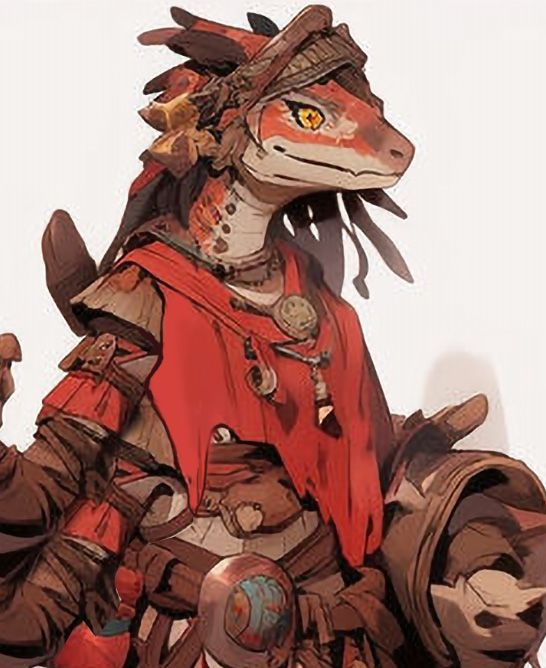
Vrazkir 🟠
|
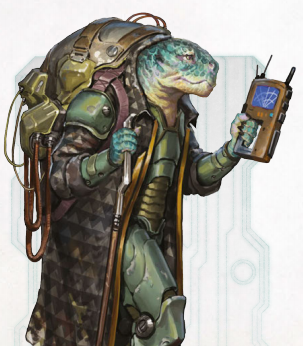
Xxcha🔵(Eks-cha); The Xxchaa The Xxcha are a reptilian species with a reputation for being peaceful philosophers, though to pin them purely as such would ignore their strength as warriors and leaders. Their prowess on the battlefield harkens back to a previous invasion of one of their two homeworlds, an event that taught the never to let down their guard. They are recognized by the dark, blueish scales across their back, and the sprawling, mottled patterns of black and green that scatter out over them. Their bodies are thick-boned and ponderous, remarkably enduring, but they are ill-suited for colder climates due to the ocean-rich tropical environments they evolved in. |