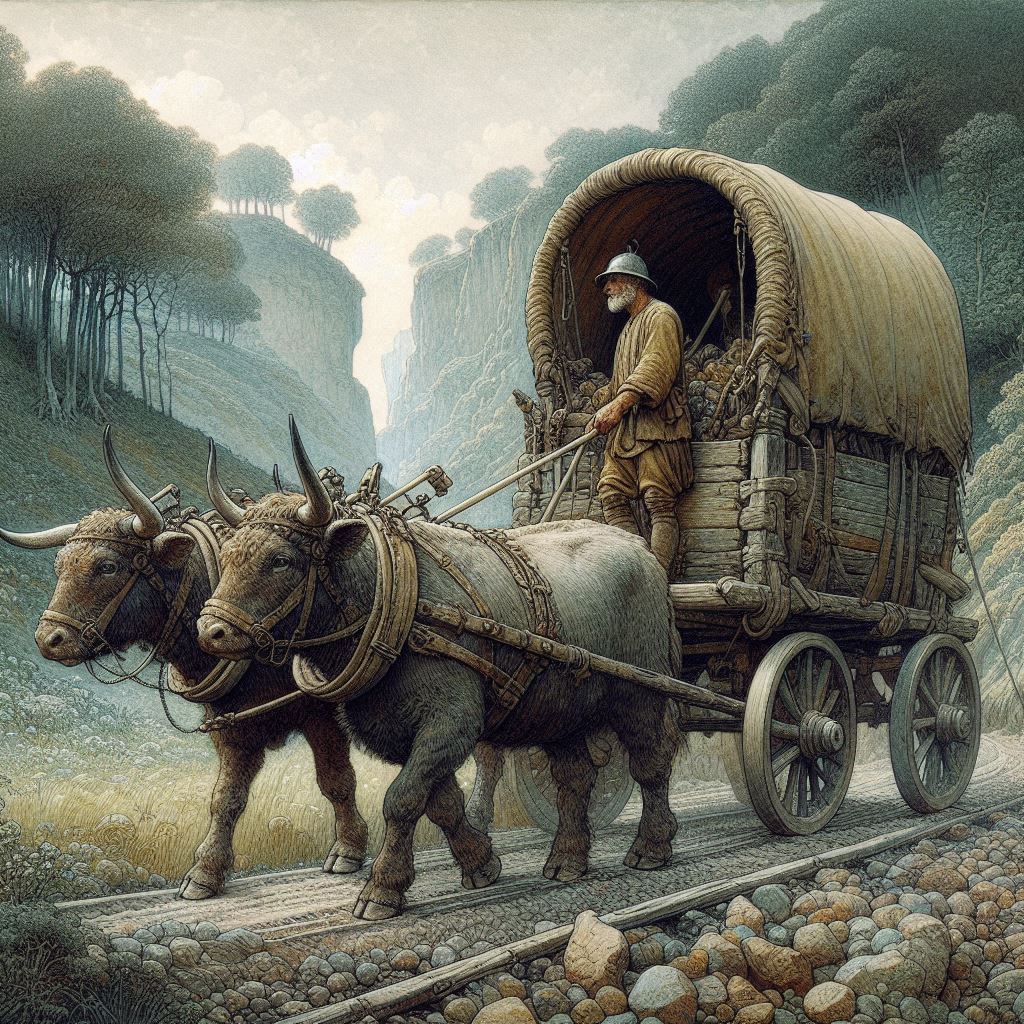
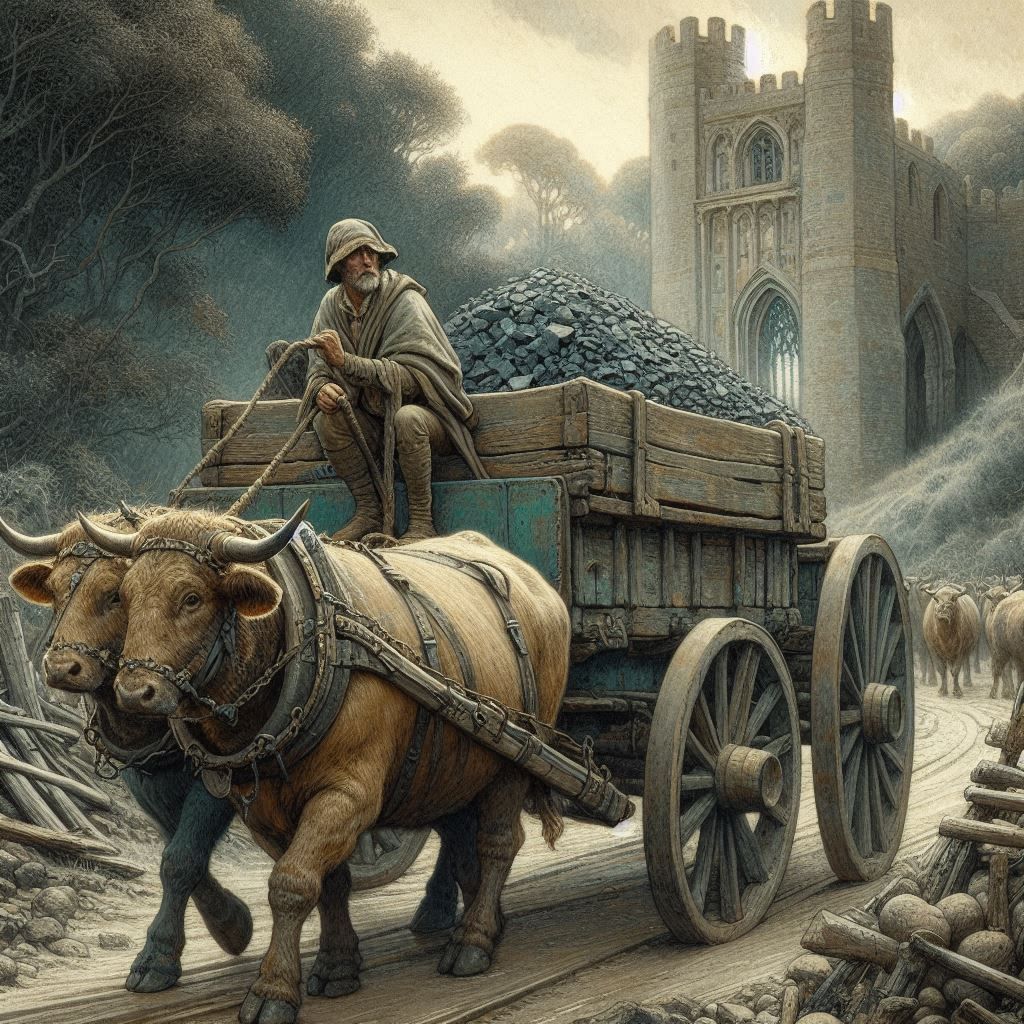
 The profession of teamster is an unguilded one, although teamsters in some areas, such as the Thardic Republic, are working to gain guild recognition for their craft. Although many individuals may lead draft animals or drive carts and wagons, not all of them should be considered teamsters. To be a “true teamster,” driving should be an individual’s sole full-time occupation and they must carry the goods of others, not their own. A serf who drives a wagon of produce from his lord’s manor to market once a tenday is not a teamster, nor is a freehold farmer who drives his own.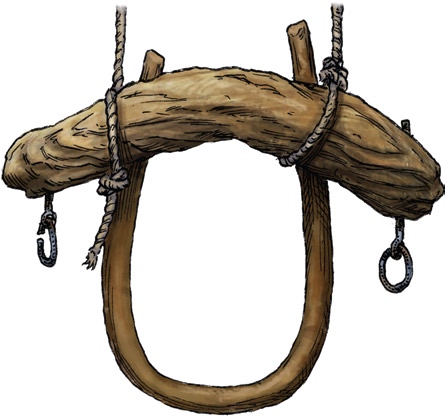
Loading Capacity
Pack animals and vehicles can carry much more than the average human. The Load Capacity table below gives the average load each pack animal and vehicle can carry. Vehicles are listed with the number of oxen typically used. When using other draft animals instead, or additional ones, use the modifiers listed under “Vehicle Multipliers.”
Movement Rates
Movement is assumed to be at the animals’ walking pace. Rates are given in leagues per four-hour watch, which is roughly equal to kilometers per hour. Five leagues is equal to one hex on a regional and atlas maps. Rates are modified by weather conditions. Rain falling for two or more watches will create mud on trails and unpaved roads, reducing movement by 50%. Ground cover, such as grass or gravel, prevents mud except for very heavy rain (one or more days). If there is no mud, rain reduces movement by only 10–25%. For additional weather modifiers, see HârnMaster, Campaign 7 and the Movement Rates Table.
Feed and Rest
Animals may move for two watches per day but require one hour of rest, grazing, and watering after each watch. Grazing must occur in daylight; animals will often not graze sufficiently at night but will eat dry feed. Most teamsters bring feed if insufficient grazing is likely, but this results in extra load to be carried.
If proper resting periods are ignored or if adequate food and water is unavailable, animals are subject to foundering. The daily cumulative chance of foundering is 20% for oxen, 15% for mules, and 10% for donkeys, horses, and ponies. This means a horse has a 10% chance of foundering after one day without any food/water, 20% after the second day, and 30% after the third.
 If an animal is forced to move for more than two watches per day or up
to 25% faster than normal, a foundering roll should be made at the end
of each watch and the animals must rest and graze for two hours instead
of the normal one. The chances are cumulative as above, but per watch
instead of per day.
If an animal is forced to move for more than two watches per day or up
to 25% faster than normal, a foundering roll should be made at the end
of each watch and the animals must rest and graze for two hours instead
of the normal one. The chances are cumulative as above, but per watch
instead of per day.
Breakdown
Vehicles are prone to mechanical breakdown. For each watch, a cart has a 5% chance of breakdown, wagons and coaches 8%. Vehicles of higher quality are less prone to breakdown. GMs may use the Product Quality table on HârnMaster, Skills 20, to determine quality. Each +1 of quality reduces the per-watch chance by 1%.
LOAD CAPACITY TABLE
| Animals | Capacity |
| Donkey or Pony | 220 lbs |
| Horse, draft | 240 lbs |
| Horse, draft, Lankum cross | 280 lbs |
| Horse, draft, Reksyni | 340 lbs |
| Mule, pack | 250 lbs |
| Mule, Sorkin Blue | 300 lbs |
| Ox, draft | 300 lbs |
| Ox, Themeson Dryder | 400 lbs |
| Vehicles | Capacity |
| Bolster wagon, 2 oxen | 9,000 lbs |
| Cart, 1 ox | 2,500 lbs |
| Haywain, 1 ox | 2,000 lbs |
| Wagon, 2 oxen | 8,000 lbs |
| Vehicle Multipliers | Speed | Capacity |
| Use Mules | 1.2 | 1.0 |
| Use Lankum horses | 1.5 | 0.8 |
| Use Reksyni horses | 1.0 | 1.2 |
| Use Dryder oxen | 1.0 | 1.3 |
| Double # draft animals | 0.9 | 1.5 |
Example: A wagon pulled by two oxen can carry 8,000 lb. Using two Dryder oxen instead increases that to 10,400 lb (8000 × 1.3). Doubling it to four Dryer oxen gives a capacity of 15,600 lb (8000 × 1.3 × 1.5).