https://forgottenrealms.fandom.com/wiki/Alimir_Mountains
The Alimir Mountains
“The Spine of the South. The Wall of Wind. The Border of Two Worlds.”
Overview
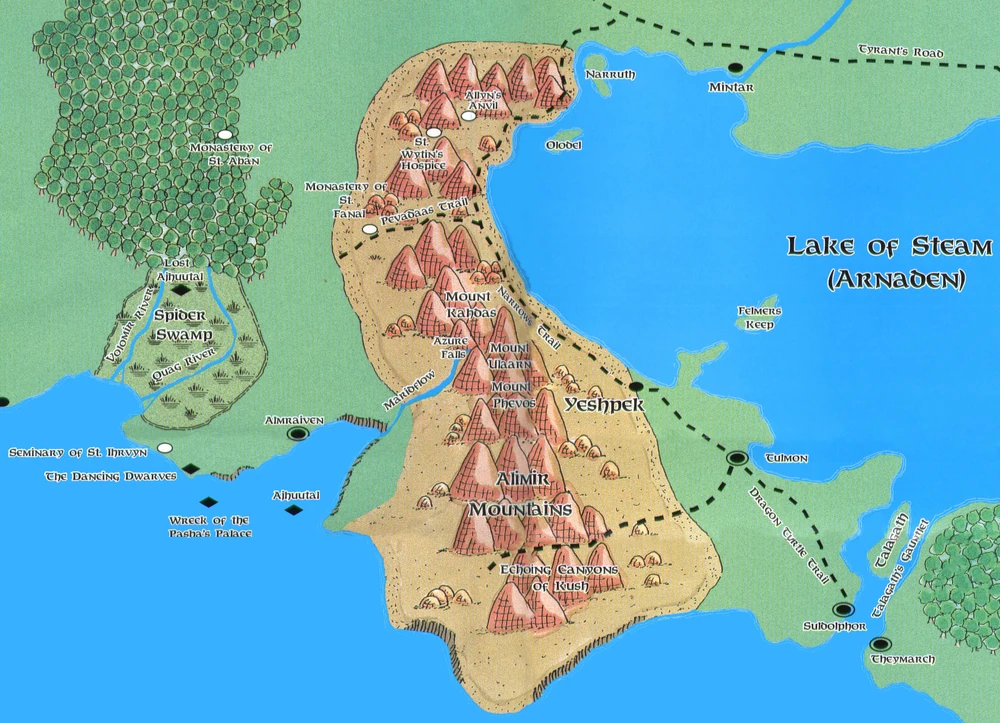
The Alimir Mountains are a vast, jagged range reminiscent of the Caucasus Mountains — steep, dramatic, ancient peaks that stretch from the western deserts to the eastern fertile coasts. They form the natural barrier separating Lygos, Yeshpek, and Tulmon from the sprawling empire of Calimshan to the south.
Travelers call them the dividing line between:
- baking desert winds
- and sea-kissed Mediterranean breezes
Their sheer size, shifting climates, and dangerous inhabitants make them both awe-inspiring and intimidating.
Climate Divide
West of the Mountains — The Arid Frontier
The western foothills face constant hot winds blowing from Calimshan:
- Sparse shrubs and hardy pines
- Dust-choked valleys
- Cracked earth and sandstone outcroppings
- Dry canyons worn by centuries of vanished rivers
This side feels harsh, severe, and unforgiving. Travelers face dehydration and duststorms long before they face monsters.
East of the Mountains — The Fertile Coastlands
Descending the eastern slopes leads into:
- olive groves
- vineyards
- soft rolling hills
- coastal pines
- fertile farmland fed by river run-off
The proximity to the sea and protective mountain winds yields a Mediterranean climate—mild winters, warm summers, and long growing seasons.
This side feeds the cities of Lygos, Yeshpek, and Tulmon.
Geography & Features
Sharp, Snow-Capped Peaks
The highest summits remain snow-bound year-round, glowing pale gold at dawn.
Deep, Silent Valleys
Some valleys are peaceful and lush; others are shadowed and ominously quiet.
Winding Cliffs & Ravines
Narrow switchbacks carved into cliffs are common, and avalanches occasionally reshape entire sections of trail.
Ancient Stone Formations
Galeb Duhr legends say the mountains were once stone giants who laid down to sleep and never woke.
Hidden Caves & Lairs
Dark caverns exist in abundance, often the territory of monsters or bandit hideouts.
The Pevadaas Trail
The Pevadaas Trail is the main and only reliable thoroughfare through the Alimirs.
Features:
- wide enough for caravans
- patrolled regularly by guards from Lygos and Tulmon
- lined with waystations and small garrison huts
- well-maintained bridges crossing steep ravines
- marked stone pillars carved with wayfinding symbols
It is the lifeline between the north and south—a strategic commodity route, a migration corridor, and the safest way across the mountains.
Pevadaas Trail Dangers
Even with patrols:
- rockslides
- sudden weather
- ambush attempts
occur regularly.
Caravans still hire adventurers for protection.
Smaller Trails: The Bandit Paths
Throughout the mountains are dozens of unnamed or semi-mapped footpaths:
- narrow goat trails
- hunter paths
- forgotten smuggler roads
- abandoned mining routes
These are not patrolled, often wind through thick forests or exposed cliffside ledges, and are notorious for:
- bandits, often desperate or ruthless
- organized brigands funded by Calimshan smugglers
- holdout tribes with grudges against the lowlands
- creatures that stalk at night
- traps and ambush chokepoints
Even experienced mountaineers avoid them unless absolutely necessary.
Monsters of the Alimirs
The mountains have long been rumored to house dangerous—and sometimes legendary—creatures.
Beholders
Stories tell of bright-colored Beholders who hover near cliff caves, playing with illusions and terrifying travelers.
Galeb Duhr
Stone-shaping elementals said to be ancient protectors of the range. They judge travelers by intent and may bury evil-doers under rockslides.
Shadowy predators that stalk the forests and foggy passes.
Nest on jagged cliffs and lure unwary hikers into treacherous drops with their songs.
Manticore Sightings
Though rare, some claim to have seen one soaring in the high peaks.
Giant Goats & Griffons
High-altitude residents that can be either dangerous or simply majestic.
Bandits & Monster-Hunters
Humanoids are often just as dangerous as monsters.
Cultural & Political Significance
Barrier Against Calimshan
The range forms a natural border, preventing large-scale invasions, migrations, or desert expansion.
Only the Pevadaas Trail can safely support large caravans.
Controlled Access
Cities like Lygos and Tulmon maintain watch forts on the northern side to monitor all movement.
Smuggler’s Paradise
Despite its dangers, the mountains are a haven for:
- contraband runners
- fugitives
- Calimshan spice smugglers
- artifact traffickers
- rogue mages seeking solitude
Rumors & Legends
- A hidden monastery sits near a high ridge, training monks who “fight like windstorms.”
- A beholder city exists deep inside a collapsed caldera.
- An ancient dwarven hold lies sealed since the Age of Kings.
- A galeb duhr king sleeps beneath the peaks, dreaming the shape of the mountains.
- A forgotten pass leads to a lost valley untouched by time.
- The Pevadaas Trail is watched by an unseen guardian spirit of the mountains.
Adventure Hooks
1. Bandit King of the Goat Paths
A powerful bandit lord controls a network of lesser trails.
2. Missing Caravan
A merchant wagon vanished between waystations — all signs point to harpies.
3. The Beholder’s Prank
A Trickster Beholder disrupts traffic with illusions of rockslides or phantom monsters.
4. The Sleeping Galeb Duhr
Removing a stone accidentally awakens an ancient elemental guardian.
5. Calimshan Intrigue
Spies use a forgotten smuggler path to infiltrate Lygos.
6. Egg Hunt
A griffon’s nest high above the pass holds valuable prizes—if the parents don’t object.