
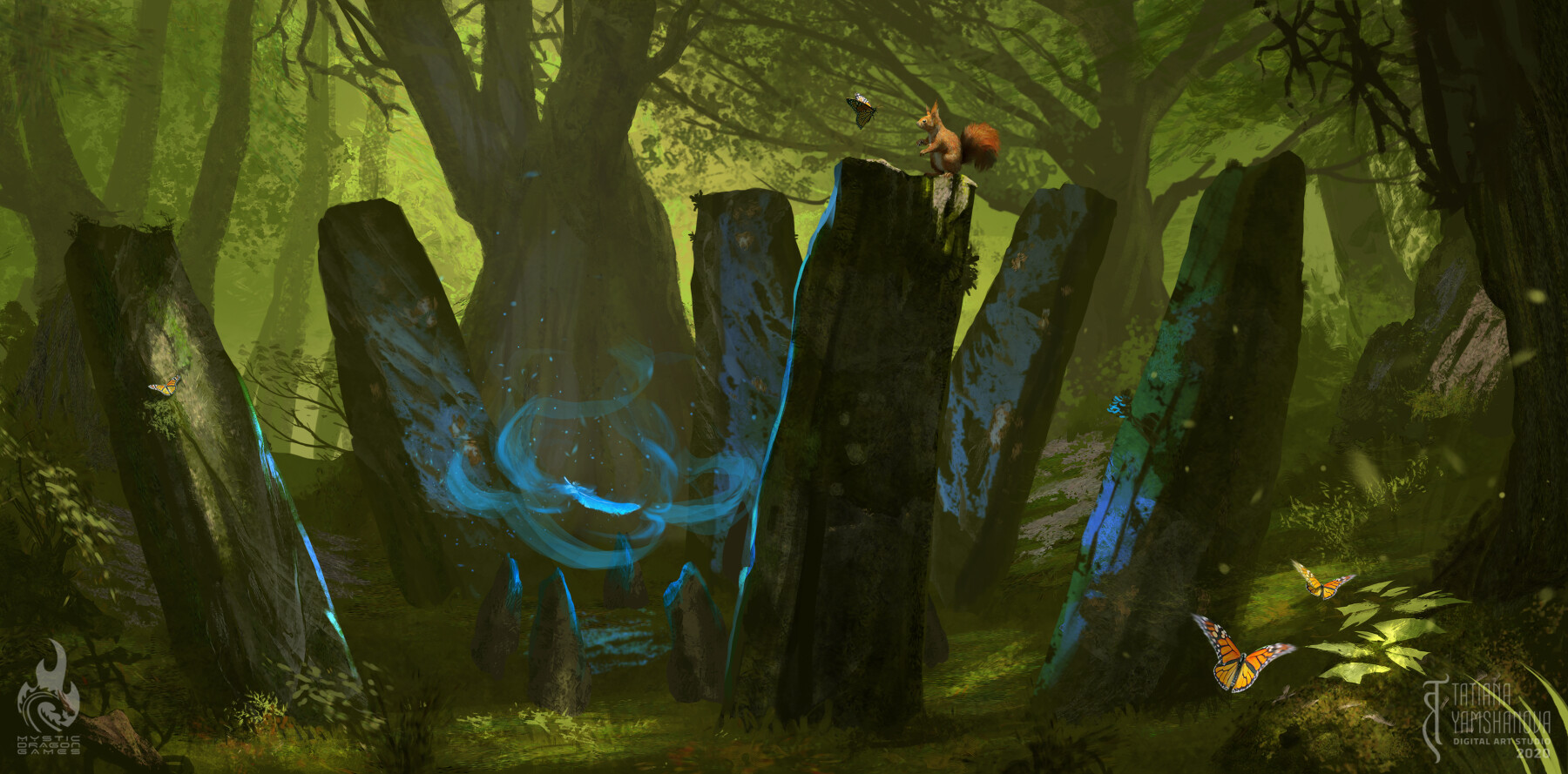
 "I forbid you to return from whence you came. It is the hottest month of the summer, and if you try to return to the desert, you have a 1 in 10 chance of survival. Remain here, and stay out the heat; you may return to your world when the autumn comes."
'-The First Shade of the Sun Seekers Circle, Tharwa Sunburst
Druidic Culture
The Communion of the Circles
The Druidic peoples are a geographically divided and racially diverse cultural group which shares a root ideology. The first druids came from those people who lived among the fey creatures of the Yalewood. These early Wodan Druids learned from the fey creatures and from the forest itself to harness its powers in order to shepherd and protect it. Overtime, they slowly mastered their abilities, and became powerful spellcasters in their own right. They spent their days meditating with the wilds, manifesting love for nature, and maintaining the boundaries of the natural world. Eventually, the druidic teachings would spread across the world, and "the Wode" would come to mean more than just sacred forests, but any sacred part of the natural world, where the links between the feywilds and Adra wore thin. Individual druid groups would come to be known as 'circles', named after the meditative circles, built from stones, trees, pools, and other natural materials, used to commune with nature and connect to the feywilds. Druids would come to be both respected and reviled at various times and in various places; they would often serve as the only protectors of remote villages and travelers from terrible threats, but their influence was viewed by nobility and city-goers as inherently chaotic, and worries about the destruction of civilizations from wild-druids drove many nations to war with the druids. Mostly however, druids exist in such remote places that they tend to just be left alone, and in turn leave the civilized world alone.
The Druidic Culture represents a fairly broad and otherwise differing group of people spread across the whole of Adra. Therefore, there is perhaps less to hold this culture together than many. However, it is considered its own culture for two reasons: 1) all druids share a common set of core values and principles which unites them despite their less important differences, and 2) these druids all exist outside of the boundaries of civilization, and therefore, can call no other culture (in most cases) home. All druids tend to respect the primacy of nature over civilization, the importance of some chaos at the cost of some order, and the duty to defend the wilds against encroachment from industry. Different circles take these core values to different extremes. Some view their job as advocates of nature, while remaining pacifist in the face of encroachment. Others are fiercely militant, attacking and running off any unwelcome interlopers on the wilderness. On the flip-side, some druid circles go into the towns and villages, assisting farmers with ecologically friendly planting, and families with sustainable gardens, while some will do their best in extreme cases to spread the borders of the wilderness closer to cities, in some cases overwhelming some settlements, leaving them abandoned. Most druids value their connections to the feywilds, and honor sylvan creatures to be the perfect model of a druidic-archetype. In rare cases, the most powerful druids spend extended periods of time in the feywilds, and sylvan creatures have been known to live among druidic groups for certain periods. Druids tend to have magical powers, drawn from the natural world itself, but there are many druidic people who are not capable of casting spells. It is quite common for druid circles to have 40-60% of their members unable to cast a spell, and these people often serve the work of cooking, building, gathering, etc. Regardless of magical ability however, all druids value meditation, prayer, and calm; it is only in the quiet contemplation of nature that druids feel they can connect with the world, and with their true selves. However, druidic cultures, individual druid circles, come in many shapes and sizes. Some prominent druid circles include: the Yaleheart Circle, the Skogskydd Circle, the Fellowship of the Far Bogs, the Sun Seekers, the Dioses Commune, the Treekeepers Circle, the Circle of Tears, and the Frozen Circle.
The Druidic people are most highly concentrated in the druid circles which dot all the continents of Adra, but these druidic peoples will sometimes enter the civilized world, though usually only temporarily. The races of the druids have no statistical plurality, and all races are represented more or less equally across the culture, though individual circles will have more of one race or another. The most popular gods among the the druids are predominately Gökotta and Faetari, often referred to as the parents of all druids, but followers among the druids of Aerideia, Ariendale, Hagelia, Ardonis, The Old Ones, Lothal, Xerkune, Eoulous, Alas, Amarok, and Mirkatakatar exist as well. Druids tend to be meditative, thoughtful, and at-home-with-nature. They also tend to be chaotic, reclusive, and hermetic. Druids will often speak languages common in nearby settlements, but all druidic peoples are united by their ability to speak and write in Druidic. In addition, Sylvan is widely spoken as well.
If you choose the Druidic Culture, you gain the following:
~Either a +1 to your Wisdom score or a +1 to your Constitution score~
~A -1 to your Strength score~
~As a known language, either Druidic, Sylvan, or a language appropriate to your circle's local area*~
~A Sub-Discipline in every knowledge skill on checks relating to Druidic Culture~
Back to Other Cultures
Back to Culture
Back to Expanded Backgrounds
Back to Adra - 3rd Era World Guide
*Characters with the Druid Class still gain the Druidic language from their class.