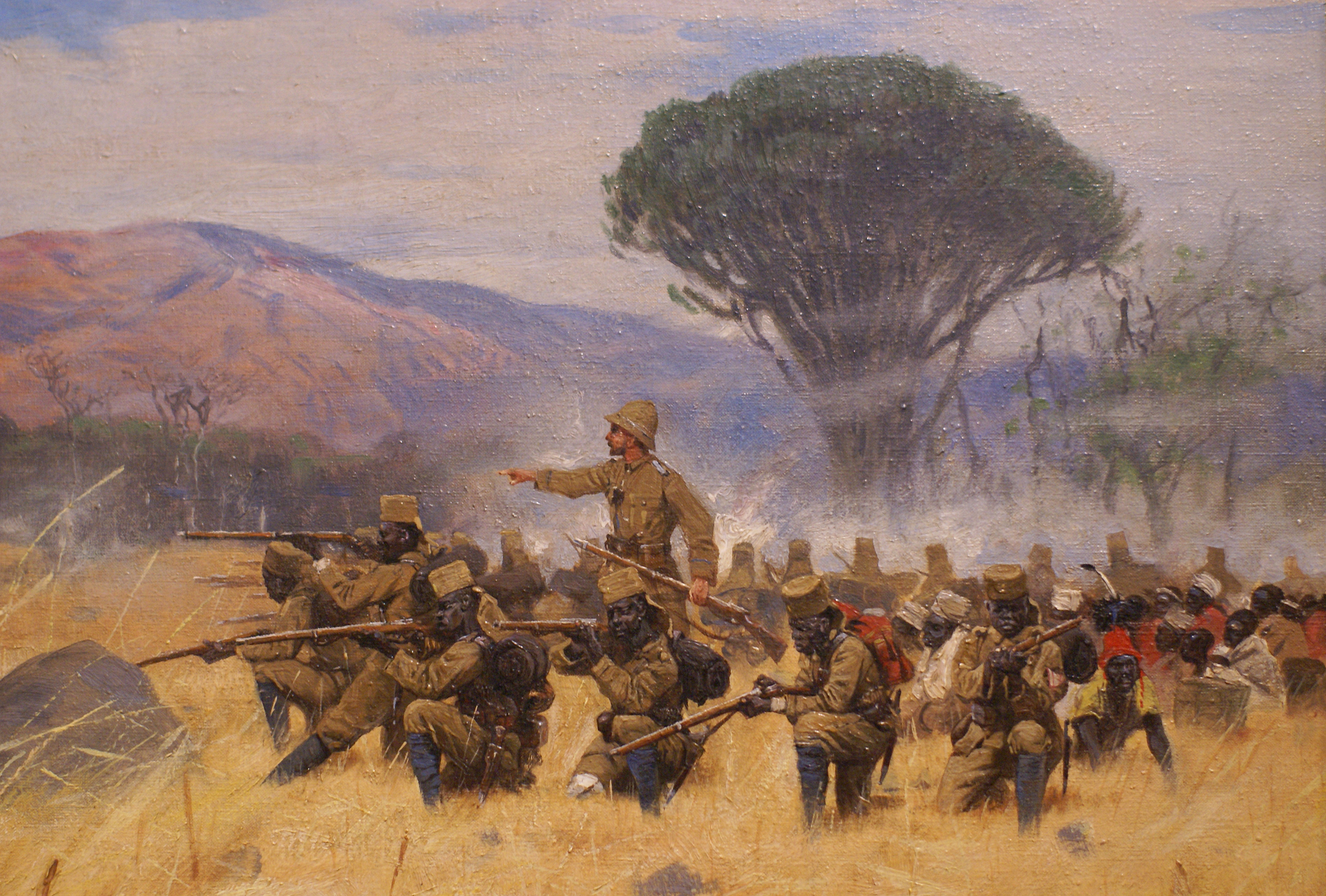
The First Colonial War, fought between 1919 and 1935, was a protracted and brutal conflict waged across the African continent in response to The German Empire's unprecedented annexation of European colonial holdings following its victory in the First World War. Emerging in the vacuum left by the collapse of British, Belgian, and French imperial authority, the war signalled the beginning of the end for classical European colonialism, while simultaneously draining German capacity to respond to Soviet proxy conflicts in Europe, The Red Orchestra.
In the aftermath of the German victory in World War I, the Treaty of Versailles redrew the map of Earth. With the collapse of the British Empire, the occupation of Belgium, and the partial dismantlement of the French colonial empire, Germany claimed dominion over nearly the entirety of Africa, integrating these acquisitions into a vast administrative entity known as The Imperial Domain of Mittelafrika.
Although ostensibly intended to modernise and develop the continent, Mittelafrika was, in practice, administered as an extractive settler-colony, designed to funnel resources to Berlin and provide “living space” (Lebensraum) for a growing German settler population. The administration’s brutality quickly alienated much of the native population, but it was the Delhi Massacre of 1919 that convinced colonial elites and natives alike that German colonialism would be far worse than that of Britain or France (though rivalling that of Belgium). The massacre served as a rallying point for anti-German sentiment across the empire. In Africa, surviving elements of the British colonial military, administrators, and African auxiliary forces coalesced into a loose coalition known as the Imperial African Army (IAA). Although initially dismissed by German high command, the IAA rapidly expanded in both capability and scope, drawing in recruits from across the continent. Key to its success was its messaging: that the German presence in Africa was not merely exploitative, but genocidal. The warning resonated widely, especially among the educated classes in urban centres such as Accra, Nairobi, and Lagos, who remembered well the Herero Genocide just a few decades prior.
The IAA, lacking the manpower and materiel for conventional operations, embraced guerrilla warfare, modelled after the Boer commandos they had fought in the Second Boer War. Sabotage, ambushes, targeted assassinations, and scorched-earth tactics were widely employed across the continent, particularly in the Congo Basin, West Africa, and the Sahel. German forces, often overstretched and undertrained, suffered significant casualties and were forced into a defensive posture.
Internationally, the IAA found enormous amounts of support from Germany's enemies. The United States of America was its main supplier of weapons, ammunition, food and many other implements of war from the west, while The Japanese Empire provided a more limited amount of support from the east. Even The Union of Soviet Socialist Republics, geographically separated from Africa by a significant degree, sent a number of experienced military officers to act as advisors, primarily to the IAA's allied native militias. Even The Republic of South Africa, supposedly a puppet regime of the Germans, spent an exorbitant amount of resources supporting the IAA. Additionally, it was de facto allied with the member states of the West Asian Pact, later The United Arab Kingdom, which was concurrently waging the West Asian War to protect its own sovereignty. Ties between the IAA and UAK remained strong throughout the First Colonial War and served as a catalyst for the formation of the Red Sea Alliance (RSA).
The first crack showed in 1924, when Germany was forced to sign the Treaty of Alexandria with the West Asian Pact, resulting in the reaffirming of the latter's sovereignty over Egypt. By the late 1920s, the German Empire found itself trapped. While Mittelafrika remained formally intact, its internal stability was illusory. German attention was increasingly drawn toward Europe, where Soviet-backed subversion and insurrections were eroding German-aligned regimes. The cost of maintaining the African war effort, in both lives and marks, was becoming unsustainable, especially so after the Great Depression ruined Germany's finances. After over a decade of low-intensity but relentless warfare, the First Colonial War came to a formal end with the Treaty of Khartoum in 1935, recognising the IAA's sovereignty over the newly independent nations of Sudan, Somaliland, Uganda and The Republic of Rhodesia, as well as the total independence of Ethiopia and South Africa. These concessions, though limited on paper, marked the effective end of German ambitions for a fully integrated Mittelafrika.
The war had far-reaching consequences. While Germany retained significant colonial holdings in name, its prestige was shattered. The IAA’s partial success inspired a generation of anti-colonial leaders across the globe, laying the ideological groundwork for the Second Colonial War and the broader decolonisation movements of the mid-20th century. Moreover, the protracted conflict drained German military strength, leaving the empire dangerously exposed during the early stages of World War II. In an ironic turn of events, most of Germany's enemies in Northeast Africa would later join it in the war against the Soviets.