Gwydion the Gray
In the early days of Lowdale, when it was first founded as the westernmost fortress of the Tuathan Feudal Kingdoms, it was often beset on all sides by the forces of the wilderness and human/bestial savagery. It seemed that as soon as the fortress was on solid footing, with plenty of soldiers and guards to protect the growing camp followers, disaster would strike.
Gnoll raids, goblin attacks, and even unnatural disasters would strike the beleaguered community, decimating its defenders and crippling its field and pastures. As often is the case, the rest of the kingdom suffered under its own troubles and reinforcements began to dwindle. But the king of Sidheon would not, could not in all good conscience, abandon the town on the border. Against the advice of his own councilors the King Tuon Llewelyn sent half of his remaining royal guard to Lowdale, under the command of his only son and heir Prince Eochaid.
The Prince and his forces brought some measure of stability to the Lowdale area, but it was a long and ongoing struggle. The sons and daughters of Lowdale joined forces with the Royal Guard, and their sons and daughters kept up the fight. The Prince never married but there were rumors of a partner that he cared for greatly.
Then the worst of times came to Lowdale, and it came from the forests that surrounded it. A family of green/black dragons had moved in from over the mountains to the west. At first, it was nothing but rumors of slaughter of goblins and gnolls, a mixed blessing to be sure. But then the younger of the dragons began raiding cattle fields, and demanding tribute. When the Prince and the Royal Guard repulsed the dragon it flew away. Celebrations were had, but they were premature.
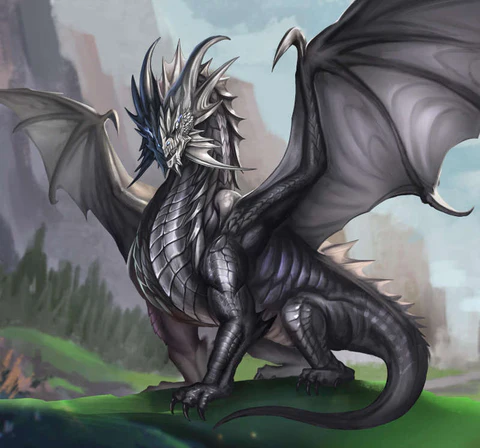 A week later, a fully adult dragon (Syldarmoss) appeared and laid waste to the entire surrounding countryside. Before its might, there was nothing to be done but surrender. But the Prince had heard rumors of another dragon, a dragon said to walk the forests in human form. The Prince and his most famous heroes went in search of the dragon, it is not known how the dragon was found, or what deal was struck, but the great dragon Gwydion agreed to help Lowdale.
The next time Syldarmoss arrived for tribute, they were flanked on either side by younger dragons. But true to his word Gwydion attacked the group of dragons. Eventually, the two younger dragons were slain, and the two adult dragons fought on. But Gwydion had been severely wounded by the younger dragons, and Syldarmoss knew it. With a mighty roar, Syldarmoss drove his opponent into the trees and the ground north of the town. Fearfull for the fate of Gwydion, and feeling responsible, Eochaid and twelve of the mightiest heroes of Lowdale rode into the forest to assist their benefactor. They were never seen again.
A day later, Gwydion walked limping, great wings dragging the ground, out of the forest. In his jaws he carried the banner of the Royal Guard. Laying it before the gate of Lowdale, he spoke and proclaimed "Never shall Lowdale face such a fate again. In honor of your Prince and heroes, when the End of Days comes, the strength of Gwydion shall be withe you."
The Tower of Illusion
The Bardic College of Glyderinga is a place of shining white towers, with pale blue roofs and domes. It appears as an almost classic fairy tale castle with high ramparts and flowing pennants. It has been said to have been standing this way, empty, when Tuathan settlers reached this area.
It is also said by the ancient druids of the forest and the local alfar settlements, that it has been an iron fortress with billowing smoke towers, and fires at the gates. Other research and rumors say it has other appearances, while even others say it was built just recently by the bards of the college themselves. The fact that the college founded here is the center of bardic glamor and illusion knowledge doesn't help the situation.
Others say the the college of bards is not a gathering of bards at all, but a coven of witches maintaining a facade for some unknown nefarious reason. They point to its former appearance of iron and flame as proof.
Philosophers have opined that since illusion can be construed as a different perception of reality, that perhaps the Tower is some sort of nexus for reality and its multitudes of reflections.
The bards consider its nickname "Tower of Illusion" to be a slur and slightly impolite, although they rarely push the issue. Students of the college have come, studied, graduated, and return to the world with nothing unusual to report. The college is in good graces with the surrounding towns, the Tuathan Feudal Kingdoms and the Tuathan Church, even training many of the members of the Order of the Seraph, a branch of the Militant Orders of the Tuathan Church.
The Horror of Dunloch
Many miles to the west, in the hilly terrain of the dark forest, was a beautiful and mystical town named Dunloch. The inhabitants of this town were a mixture of fey, alfar (elves), and human traders and farmers. The town grew in a hilly high valley with three serene lakes, the largest of which was named after the town of Dunoch that sat upon its shores. The land was good for growing crops, and the fish were plentiful. But the main appeal to the area was the opportunity to trade with the fey realm of Distant Shore (in the human tongue). For on the far side of the lake from Dunloch was a shimmering veil that draped across a valley entrance, and it led to the fey realm. The fey on the other side never explained why the veil was there, or why they had a town of white marble and brass situated on the other side, but they were friendly and willing to trade.
After years of prosperity things began to change. People from the town of Dunloch would go missing at an unnatural rate even for a town out in the wilderness. At first the people of Dunloch suspected some type of monster, but eventually, after looking everywhere else, they turned their eyes towards Distant Shore, and rumors started of fey stealing children and even grown people for nefarious reasons. The fey denied the accusations, and accused the folk of Dunloch of growing suspicious and depraved, as all mortals tend to do.
Before the situation could escalate into open conflict, the fey of Distant Shore, with an air of wistful sadness, closed the veil. Most of the people of Dunloch were filled with regret, while others celebrated. As days went by the disappearances continued. Soon the mistrust began to spread amongst each other, elves accusing humans, humans turning on elves and each other. The smarter folk left. Then the humans attacked the remaining elves, and slaughtered them, tossing them into the lake. The entire town became decadent and self serving, poor and barely surviving by scavenging and some weak farming. Weak because the land that had been so fruitful, began to grow fallow and spoiled, and the fish in the lake grew tainted and abnormal.
 But then ogres moved into the edge of town, taking over several ruins and houses. The ogres left the humans alone until the humans descended upon them with pitchforks and torches, at which point the ogres slew 2/3rds of the population, and chased the rest off into the other side of town. Since then there has been a quiet and uneasy truce between the ogres and the degenerate humans, who provide fish and some farm good to the ogres.