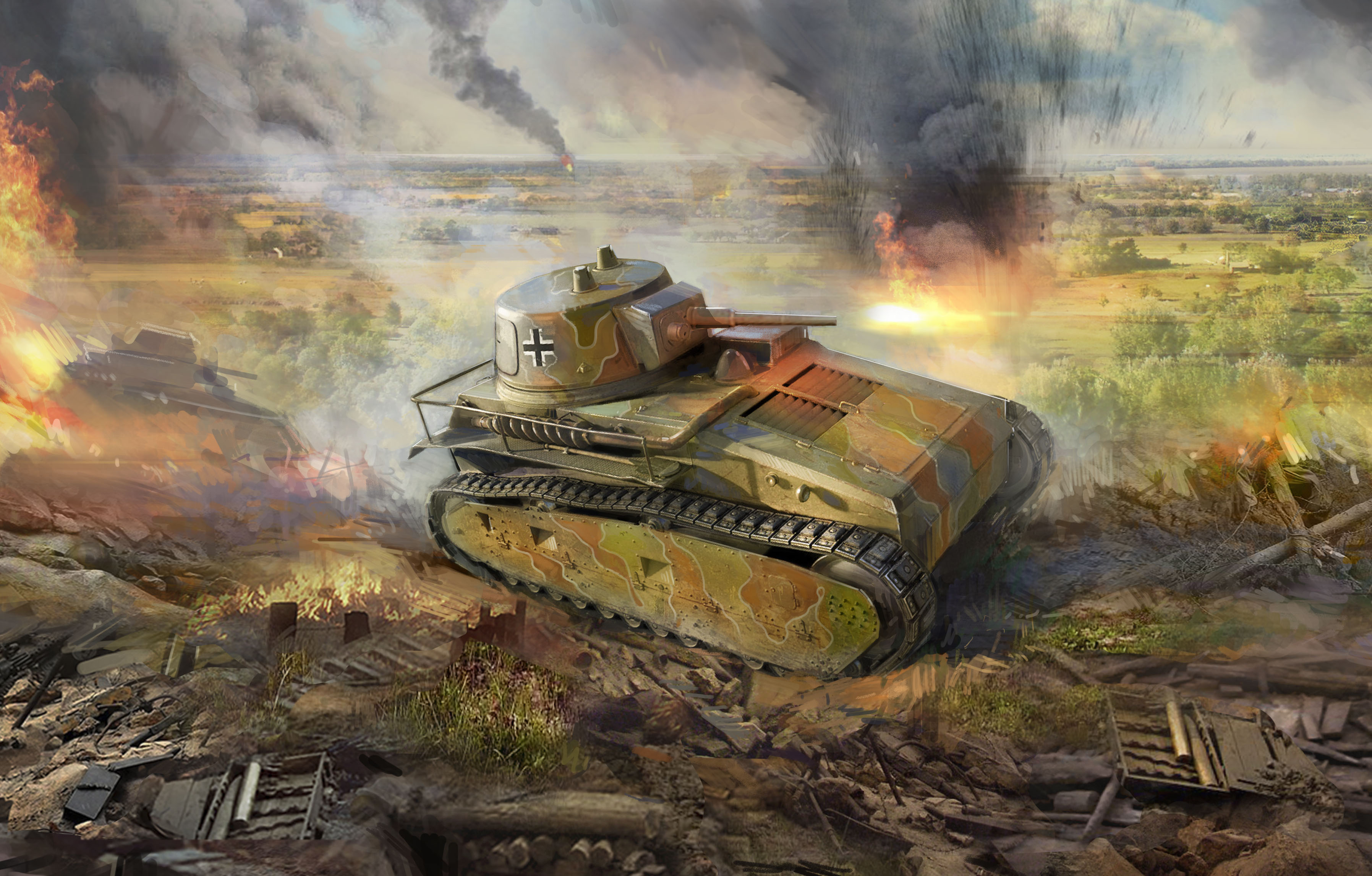
The Kampffahrzeug 21, informally designated Leichttraktor, is a German light tank, the first practical post-Weltkrieg armoured fighting vehicle and the foundation upon which all later German armoured doctrine would be built. Though outwardly modest, it represented a decisive conceptual break from improvised wartime tanks, favouring mechanical reliability, crew ergonomics, and combined-arms integration over armour thickness or firepower. Many of its design elements were borrowed from the French Renault FT, which was closely studied by the Germans after the war. Others, however, were breakthrough innovations, such as the addition of a radio operator and a dedicated loader, completely novel ideas in the early 1920s.
Mechanically, the Leichttraktor prioritises simplicity and maintainability. Its riveted steel hull houses a small crew operating a centrally mounted turret armed with a 3.7cm TAK 1918 cannon and coaxial MG 08 machine gun, allowing it to engage soft and hard targets. While its armour was deemed very thin by later standards, it is sufficient against small arms and shrapnel, reflecting its intended role as a mobile support and reconnaissance platform rather than a breakthrough vehicle.
In service, the Kampffahrzeug 21 was never intended to dominate the battlefield by itself. Instead, it functioned as a doctrinal laboratory, testing turreted combat, radio coordination, and armoured tactics in preparation for future conflicts. Additionally, it was perfectly well suited for Germany's expeditionary conflicts abroad, including a variety of anti-communist interventions and the First Colonial War, where its opponents would almost always lack armour of their own or anti-tank weapons.
By the early 1930s, the Leichttraktor had been relegated to training and reserve roles, but its influence perdured. Every subsequent German tank design bore traces of its layout, philosophy, and doctrine. Many of the features of the Panzerkampfwagen series were a direct evolution of the Leichttraktor's own.