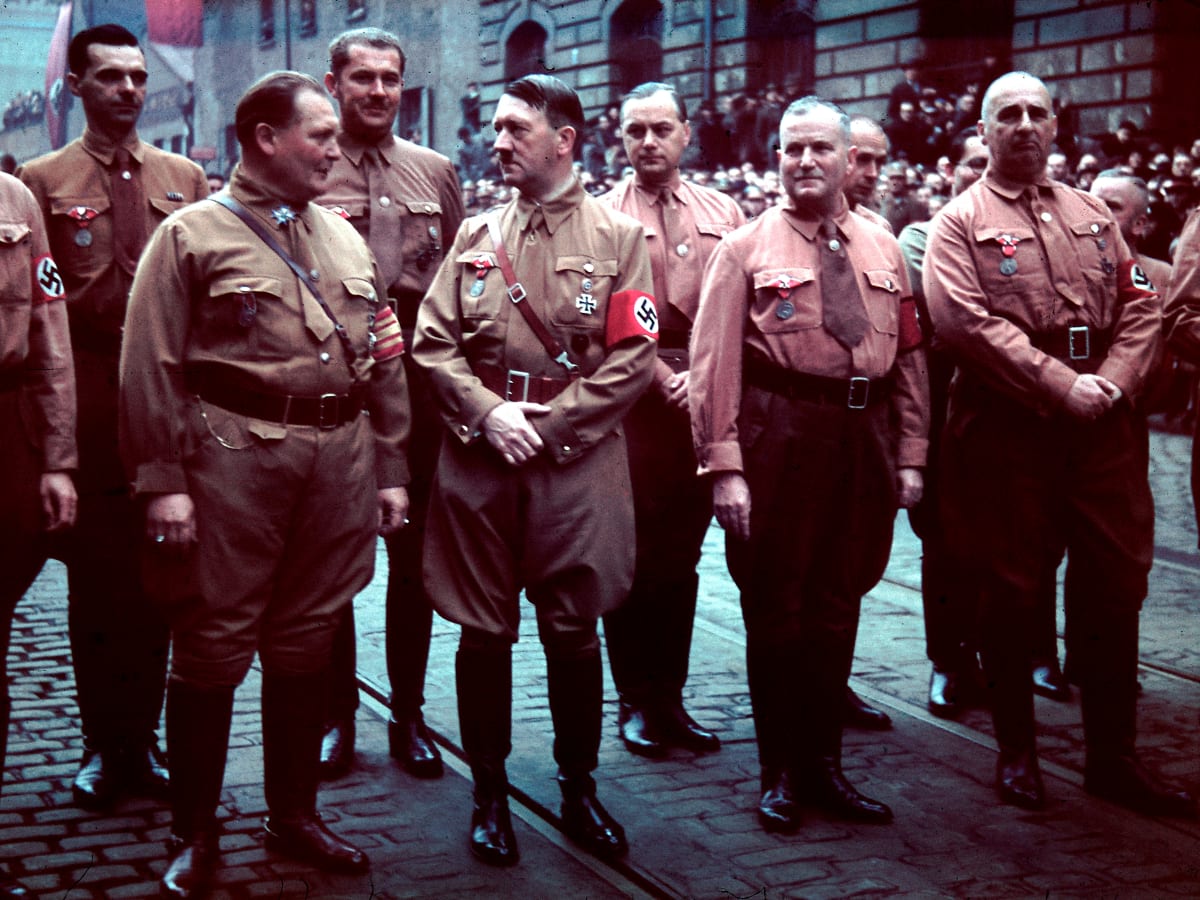
The Beer Hall Putsch was a failed coup attempt launched by Adolf Hitler and the Nationalsozialistische Deutsche Arbeiterpartei (NSDAP) in November 1923. It marked the party’s first major bid for power in Bavaria, and although unsuccessful, it became a pivotal moment in the Party's long-term political influence.
In the aftermath of World War I, Bavaria was a hotbed of radical politics, with the Velvet Revolution in full swing. The NSDAP, founded in Munich, had grown rapidly under the leadership of Hitler, drawing on disillusioned veterans, anti-communists, and volkisch societies such as the Thule Society. Inspired by Mussolini’s March on Rome, Hitler sought to replicate a similar seizure of power. His target was the Kingdom of Bavaria’s government, headed by Prime Minister Gustav von Kahr, who was delivering a speech in the Bürgerbräukeller beer hall in Munich on the 8th of November 1923.
Hitler, flanked by Hermann Göring, Ernst Röhm, and Heinrich Himmler, stormed the beer hall with armed NSDAP supporters. Declaring the beginning of a “national revolution,” he attempted to coerce von Kahr and his associates into supporting the overthrow of the Bavarian civil government and, ultimately, a march on Berlin. The plan relied on securing the loyalty of the Deutsches Heer garrison in Munich and rallying the city to the NSDAP’s banner. Instead, confusion and hesitation followed. Von Kahr and the Bavarian authorities withdrew their feigned support once free, while the army, police and anti-nazi freikorps quickly moved to contain the insurrection.
On the 9th of November, Hitler and about 2,000 followers marched through Munich in an attempt to seize key points in the city. They were met by a cordon of soldiers, policemen and freikorps militiamen at the Feldherrnhalle. A brief firefight ensued, killing 16 NSDAP supporters and 4 anti-nazis, with the NSDAP column dissolving into the streets.
Hitler was later arrested and charged with high treason against the Kingdom of Bavaria. The trial, held in early 1924, gave him a national platform to broadcast his ideas. His defiant speeches framed the putschists as patriots betrayed by weak politicians and communists. Though sentenced to five years in Landsberg Prison, the sentence was mysteriously reduced to less than one year, using the time to dictate Mein Kampf and strengthen his ideological hold on the NSDAP. The failed putsch discredited the NSDAP in the short term, but it also elevated Hitler to national attention. Importantly, the party reoriented its strategy away from reckless uprisings and toward legal participation in politics.
The putsch drew the attention of Kaiser Willhelm II, who though officially condemning the coup, is widely believed to have influenced in the courts' later decision to shorten Hitler's sentence. Willhelm's hostility to both communism and liberalism, as well as his sympathy for völkisch groups, created a tacit environment where the NSDAP could survive. By 1928, with continued funding from nationalist industrialists and sympathetic nobles, the NSDAP established itself as Bavaria’s dominant political force.