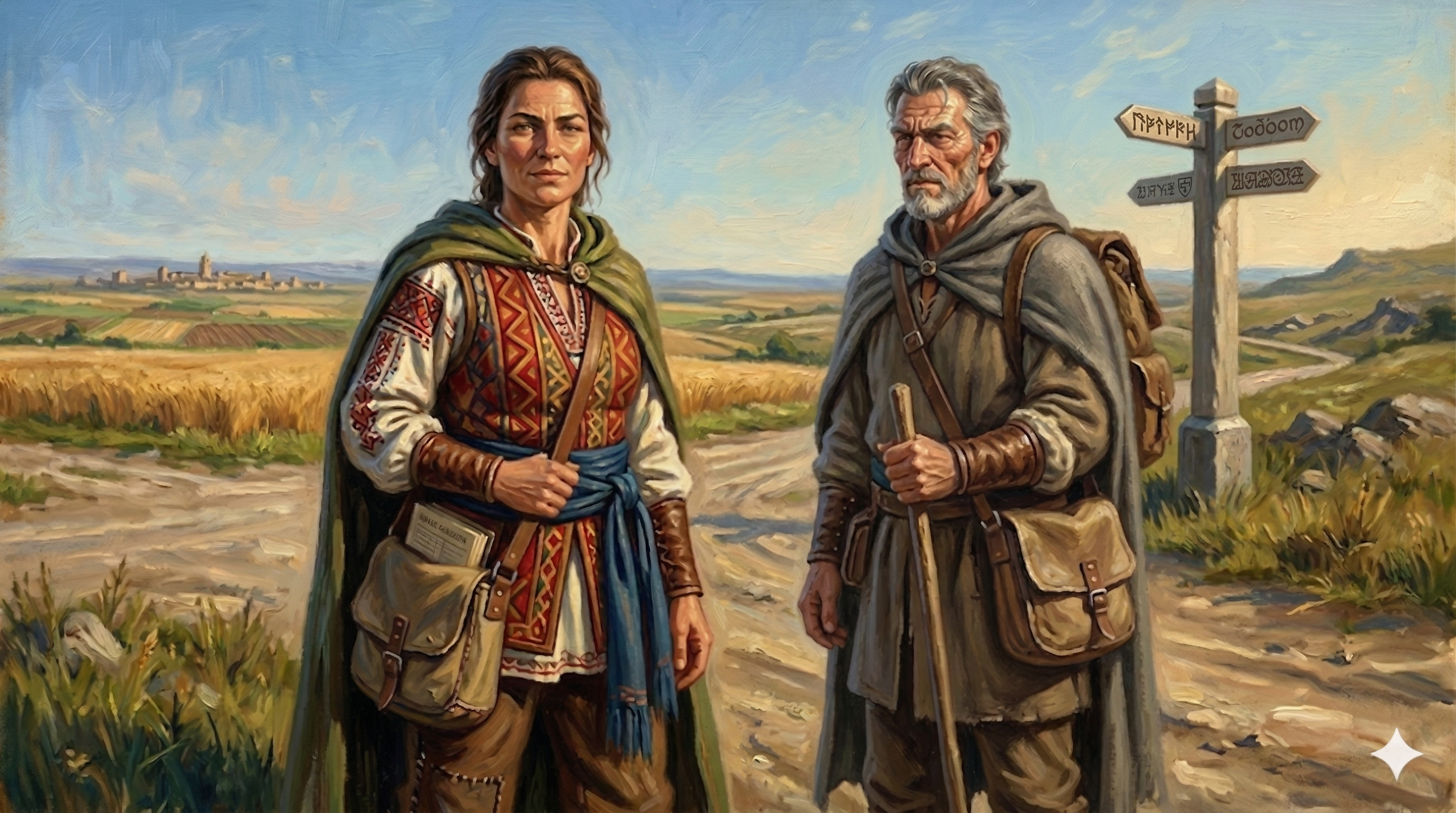
"Humans don't live long enough to learn patience, so they learned ambition instead. Give a human fifty years and they'll build an empire. Give them a hundred and they'll burn it down and start over."
— Archdruid Sylvanus, on why elves drink
Humans are Golarion's most numerous, most adaptable, and most exhausting race. They are everywhere — ruling kingdoms, digging ditches, starting religions, starting wars, and occasionally doing both at the same time. What they lack in lifespan they make up for in sheer, relentless drive. A human who lives to seventy has usually accomplished more (and destroyed more) than an elf who lives to seven hundred, which is either inspiring or terrifying depending on your perspective.
Physical Description
Humans come in every shape, size, and color Golarion has to offer. Height ranges from under five feet to well over six. Skin tones span from the pale Ulfen of the north to the deep brown Mwangi of the south, with every shade between. Hair texture, eye color, and build vary wildly by ethnicity and region. The only physical constant is that humans always look like they're in a hurry.
Major human ethnicities in the Inner Sea include Chelaxian (dark hair, pale skin, common in Cheliax and Molthune), Taldan (olive skin, proud bearing, common in Taldor and Andoran), Kellid (hardy, rugged, common in the north), Varisian (dark hair, colorful dress, common in Varisia), Garundi (dark skin, common in Garund), and Mwangi (dark skin, diverse cultures, common in the Mwangi Jungle).
Society
Humans don't have a society — they have dozens, all convinced the others are doing it wrong. Molthune is a military oligarchy. Andoran is a democracy. Cheliax is a devil-worshipping empire. Nirmathas is a guerrilla state held together by spite. Absalom is a trade hub that considers itself the center of the world. Every human nation is a different answer to the same question: "What do we do with all this ambition?"
The one constant is adaptability. Drop a human in a jungle and they'll build a village. Drop them in a desert and they'll dig a well. Drop them in a dwarven city and they'll open a shop. It's not that humans are better than other races — it's that they refuse to acknowledge limitations long enough to accidentally succeed.
Relations
- Elves: Humans admire elves and resent them in equal measure. The admiration comes from elven grace and longevity. The resentment comes from elves knowing it.
- Dwarves: Practical allies. Humans and dwarves understand work ethic, even if dwarves think humans are sloppy and humans think dwarves are slow.
- Kender: Humans find kender charming for about ten minutes, then check their pockets. Urban kender and human merchants have a complicated relationship built on "I know you took it" and "I have no idea what you're talking about."
- Mul (Iron-Blood): Most humans in Molthune view mul as useful labour. The rare human who sees them as people earns loyalty that outlasts lifetimes. Most don't bother.
Alignment and Religion
Humans span every alignment. Their gods are equally varied: Abadar, the Master of the First Vault (civilization, law), Sarenrae, The Dawnflower (healing, redemption), Iomedae, the Inheritor (honour, justice), Erastil, The Old Deadeye (community, farming), Cayden Cailean, the Lucky Drunk (freedom, bravery), Desna, The Wandering Star (travel, dreams), and plenty of darker patrons for those inclined. In Molthune, Abadar and Erastil dominate. In Canorate specifically, the military chapel venerates Iomedae while the common folk pray to whoever might be listening.
Racial Traits
| Ability Scores | +2 to one ability score of your choice |
| Type | Humanoid (human) |
| Size | Medium |
| Speed | 30 ft. |
| Languages | Common + one additional language of your choice |
Core Abilities
- Bonus Feat: Humans select one extra feat at 1st level.
- Skilled: Humans gain 1 additional skill rank at each level (including 1st).
Adventurers
Humans become adventurers for every reason imaginable: glory, revenge, debt, curiosity, boredom, divine calling, a bad breakup, or because staying in one place felt like dying slowly. A Molthuni soldier who deserted after seeing something wrong in the ranks. A Chelaxian scholar fleeing the Thrune regime. A Nirmathi guerrilla who wandered too far south. Humans fit every class equally well — which is both their greatest strength and the reason nobody trusts them to specialize.