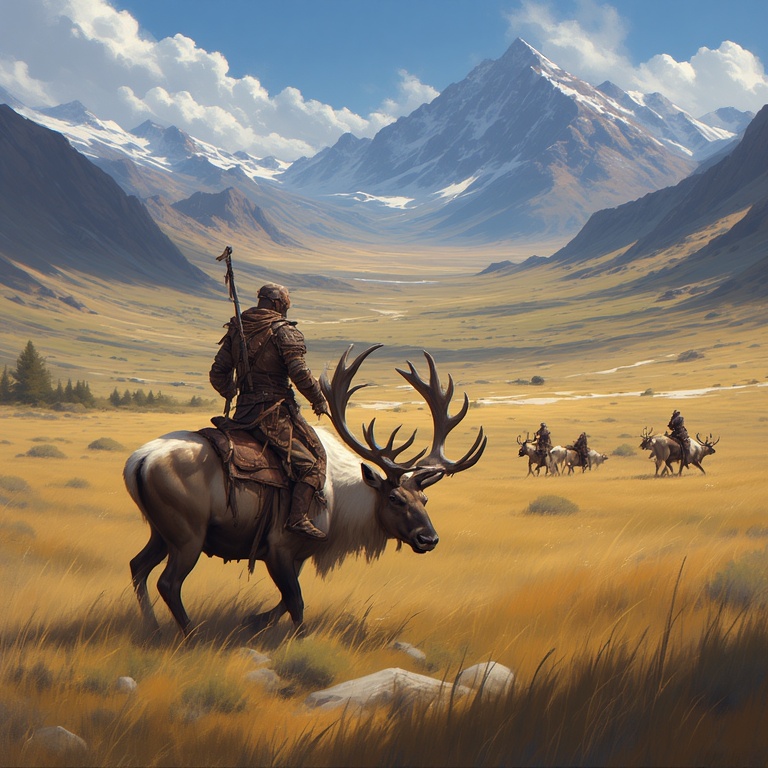
Encounters: Tundra & Migration Routes
Roll: 1d100 Primary Source: Gods of the Forbidden North (GFN) / Tibet RPG / Old-School Essentials (OSE)
Expected HD Range: 1–6+ HD Visibility: Very high; shelter scarce; weather decisive
| d100 | Encounter | Stats / HD | Source |
|---|---|---|---|
| 01–03 | Caribou migration (8d10 × 10) moving at speed | Herd Animal | GFN |
| 04–05 | Muskox herd (6d6) forming defensive ring | Herd Animal | GFN |
| 06–07 | Yak herd (2d6+4) ranging freely, no visible herder | Herd Animal | GFN |
| 08–09 | Steppe wolves (3d6) shadowing herds | Wolf | OSE |
| 10–11 | Dire wolves (1d3) ranging far from forest | Dire Wolf | OSE |
| 12–13 | Lynx (1d2) hunting ground-nesters | Giant Lynx | GFN |
| 14–15 | Great northern owl (1) circling silently | Great Northern Owl | GFN |
| 16–17 | Velkari herder (1) with yak herd (3d6+6), grazing slowly | Nomad / Herd Animal | GFN |
| 18–19 | Velkari travelers (2d4) on foot, heading somewhere specific | Nomad | GFN |
| 20–21 | Trader caravan (1d6 Merchants, 1d4 guards) | Merchant / Bandit | OSE |
| 22–23 | Wandering Tantrika (1) alone on the road, moving by prostration | NPC | GFN |
| 24–25 | Goblin scouts (1d6) moving openly | Goblin | OSE |
| 26–27 | Beastmen outriders (1d4) | Gnoll | OSE |
| 28–29 | Cold night exposure — fatigue saves required | Weather | OSE |
| 30–31 | Dust or snow-powder storm, visibility to 30 ft for 1d6 turns | Weather | OSE |
| 32–33 | Velkari nomad village on the move (3d6 people, 2d6 yaks, 1d4 dogs, camp gear on sled-frames) | Community | GFN |
| 34–35 | Wild boars (1d6) crossing the route | Wild Boar | OSE |
| 36–37 | Scattered bones and trampled ground — predator active nearby | Sign | Referee |
| 38–39 | Abandoned camp, stripped but not burned — departure was fast | Sign | Referee |
| 40–41 | Bandits (2d6) mounted or with carts | Bandit | OSE |
| 42–43 | Mercenaries (1d4+1, leader = Veteran) | Bandit / Veteran | OSE |
| 44–45 | Warp beasts (1d3) hunting in open ground | Warp Beast | GFN |
| 46–47 | Saber-toothed tigers (1d2) stalking at distance | Titherion | GFN |
| 48–49 | Owlbear (1) far from forest, aggressive | Owlbear | OSE |
| 50–51 | Convicted Velkari criminal (1) walking alone in ankle stocks, bound for the next settlement | NPC | GFN |
| 52–53 | Goblin warband (2d6 with carts and animals) | Goblin | OSE |
| 54–55 | Beastmen warband (1d6+2) | Gnoll | OSE |
| 56–57 | Taiga wights (1d6) haunting an old road or battlefield | Taiga Wight | GFN |
| 58–59 | Will-o-wisps (1d4+1) leading travelers astray | Will-o-Wisp | OSE |
| 60–61 | Hungry ghost — invisible, spoiling food, increasingly aggressive if ignored | Hungry Ghost | GFN |
| 62–63 | Dire wolf pack (2d6 Wolves + 1 Dire Wolf) | Wolf / Dire Wolf | OSE |
| 64–65 | Grizzly bears (1d2) following migration | Grizzly Bear | GFN |
| 66–67 | Polar bear (1, 6 HD) roaming unusually far south | Polar Bear | OSE |
| 68–69 | Trolls (1d4) moving openly across the plain | Troll | OSE |
| 70–71 | Tsen — red-armored spirit riders visible as silhouettes against the sky; anyone who meets their gaze must save vs. disease | Tsen (see note) | GFN |
| 72–73 | Velkari pilgrim camp (1d4+2 people) — fire lit, butter-tea offered, hospitable but not forthcoming with names | NPC | GFN |
| 74–75 | Black unicorns (1d2) hostile, territorial | Black Unicorn | GFN |
| 76–77 | Poison bearer (1) — a lone traveler who offers hospitality and shelter; food touched by them poisons guests by morning | NPC | GFN |
| 78–79 | Taiga dragon (1) visible from miles away | Taiga Dragon | GFN |
| 80–81 | Migration collision — two herds converging with predators behind both | Event | Referee |
| 82–83 | Mad wanderer (1) — appears deranged, offers an impossible or offensive task; is in fact an advanced practitioner testing travelers | NPC | GFN |
| 84–85 | Ancient road collapse or sinkhole — fall rules apply | Hazard | OSE |
| 86–87 | Steppe lightning storm — random strikes, morale checks | Weather | OSE |
| 88–89 | Shrine remnant guardian (1 Taiga Wight) | Taiga Wight | GFN |
| 90–91 | Saber-tooth matriarch (1, 6+ HD) | Titherion | GFN |
| 92–93 | Named steppe horror tied to a migration route | Unique | Referee / GFN |
| 94–95 | War host on the move (Beastmen or Goblins, hundreds visible) | Army-scale | Referee |
| 96–97 | Bleed from adjacent region (Taiga, Hills, Ruins) | — | GFN |
| 98–99 | Escalated encounter — reroll and double numbers | — | Referee |
| 100 | Campaign-level intrusion crossing the steppe | Referee's choice | Referee |
Encounter Notes
07 — Yak Herd (no herder)
2d6+4 yaks ranging freely, no herder in sight. They are not wild — they have ear-marks and some have cord remnants on their horns — but whoever owns them is not present. The herd is calm and not immediately hostile unless threatened. Possible explanations: the herder is dead or injured nearby, the herd escaped, the herder is sheltering from weather, or this is a test by a Velkari clan to see who finds them and what they do. A character who drives the herd or takes animals without investigation will have made an enemy of someone they have not met yet.
17 — Velkari Herder with Yak Herd
A single Velkari (use Nomad stats) moving with a herd of 3d6+6 yaks across the migration route. The herder does not stop unless the party stops first. If approached correctly — road bow first, no immediate questions about destination or name — the herder will acknowledge the party and continue walking. If the party falls into step beside them without demanding conversation, the herder will eventually offer butter-tea from a skin flask. Names come after the tea.
The herder knows this stretch of tundra well and will share weather signs, route conditions, and the locations of Velkari camps ahead if they judge the party trustworthy. They will not share information about specific clan movements or the location of the nomad village (33).
18–19 — Velkari Travelers
2d4 Velkari on foot, moving with purpose. They road-bow if the party road-bows first. If the party does not bow, they pass without acknowledgment. If engaged in conversation, they are polite but brief. They do not give their names unless asked after some conversation has passed, and even then offer only their trail name. They are not hostile. They are simply not interested in people who do not know how to meet them.
If the party has previously behaved badly toward Velkari — violated hospitality, gone counter-clockwise around a standing stone, failed to bow — there is a 2-in-6 chance this group has heard of it. They will be noticeably cooler and will not offer any information about the road ahead.
22–23 — Wandering Tantrika
A lone figure in worn saffron or deep red, moving along the road by prostration — throwing themselves to the ground, rising, moving to where their body last lay, repeating. They carry a hand drum, a rolled cloth painting, and prayer beads. They do not speak unless spoken to, and do not stop unless the party physically blocks their path. If spoken to respectfully they will pause and converse briefly before continuing. They know things about the ley lines in this area that no map records. They will not volunteer this information. If asked directly, they will answer with something true that is not quite an answer to the question asked.
33 — Velkari Nomad Village on the Move
The entire community — 3d6 people including children and elders, 2d6 yaks carrying loads, 1d4 dogs, sled-frames piled with gear — crossing the tundra between seasonal camps. This is not a raiding party or a fleeing group. It is an ordinary migration.
The village is not hostile and will not stop moving unless the party offers a genuine reason. If the party road-bows to the lead elder and waits rather than approaching, the elder will eventually come to them. The community will share the road for a day if the party is heading the same direction and behaves correctly. They will share butter-tea and dried meat at the evening camp. They will not share the name of where they are going.
If the party has been respectful to Velkari in the past, there is a 3-in-6 chance the village includes a Rootstone Keeper of the appropriate hat-color for this ley territory who will speak privately with any Druid in the party.
51 — Convicted Velkari Criminal
A Velkari (use Bandit stats, no weapons) walking alone, wearing carved wooden ankle stocks that make movement slow and audible. The stocks are a Velkari judicial sentence — the convicted person walks to the nearest settlement of another clan to deliver news of their own crime and its judgment, carrying the stocks as evidence. They cannot run. They cannot fight effectively. The sentence requires them to accept shelter from any clan they pass through, because refusing shelter to someone in stocks would dishonor the clan doing the refusing.
The crime and the judgment are carved in abbreviated symbols on the stocks. A character who can read Old Velkari can learn both. The criminal is not required to answer questions about themselves but will answer direct questions about the road ahead — they have been on it for a while and have seen things.
Roll 1d6 for the crime: 1–2 theft within the clan, 3–4 breaking a hospitality oath, 5 wasting meat, 6 a kinship violation the criminal will not describe.
60–61 — Hungry Ghost
The encounter begins as signs: food spoiling faster than it should, water tasting wrong, animals refusing to eat from their own packs. The ghost is invisible and intangible and does not know it has crossed into the living world. It is trying to reach food it can smell but cannot eat.
If the party investigates rather than moves on, they may find the ghost by what it touches: frost forms around it in a specific shape, or a thin film of ice appears on surfaces near where it has been. A Cleric can turn it as a Ghost. A character with relevant knowledge (Mystic, or someone who has spent time with Rootstone Keepers) may be able to offer it food and drink formally, which will not satisfy it but will keep it from becoming aggressive for 1d4 hours. A Rootstone Keeper (Druid) can perform a ceremony that releases it to the bardo properly — this takes one turn and requires quiet.
If ignored for more than a day of travel, the ghost becomes desperate and attacks, draining Constitution.
70–71 — Tsen
Red-armored figures visible against the sky, moving too fast for cavalry, following no road. There are 1d4+1 of them. They are not attacking anything — they are traveling. Anyone who makes direct eye contact with a Tsen must save vs. Spells or contract a wasting disease (–1d4 Constitution, progressive). They cannot be outrun. They can be avoided by not looking at the sky for 1d6 turns, which the party may not know is the correct response without relevant lore.
A character who knows the correct Rootstone Keeper warding gesture can make it, and the Tsen will angle away from the party without acknowledging them. The gesture involves pressing the back of one hand to the forehead and extending two fingers downward — it signals that the party is under Keeper stewardship and not available prey.
A Cleric who turns undead may treat the Tsen as Wights for this purpose. If the party has a Rootstone Keeper or a character with the Keeper tradition, the Tsen may instead veer close and leave a mark — a burned sigil in the snow nearby — which means something the Keeper can read.
72–73 — Velkari Pilgrim Camp
1d4+2 Velkari around a fire, butter-tea already on. They road-bow to anyone who approaches correctly. They have set up a small windbreak with their packs and are clearly planning to stay the night. They do not ask where the party is going. They offer tea and dried cheese without preamble.
These are pilgrims visiting a shrine or standing stone the party may or may not have found yet. They know where it is. They will not lead anyone there who has not already demonstrated basic knowledge of how to behave at a Velkari shrine, but they will describe it in terms that give enough information to find it.
One of them (2-in-6 chance) is an elder who has walked this route many times and knows the ley behavior in this area — which stones are currently active, which are suppressed, where the ground feels wrong. This person will not volunteer any of this. They will answer direct questions from a Druid character with careful, precise answers.
77 — Poison Bearer
A lone traveler — appears to be a Reisan or Velkari of middle age, a little worn, a little too eager to offer hospitality. They have a camp nearby and will invite the party to shelter with them. The food they prepare is real food. The shelter is real shelter. They are not a bandit. They are a poison bearer — someone carrying a hereditary curse that causes anything they touch to poison those who consume it.
They do not know they are doing it. Or they know and cannot stop. Or they know and have stopped caring. Roll 1d6: 1–3 they are unaware, 4–5 they know and are trying to warn the party indirectly through comments that could be interpreted as strange, 6 they know and have been doing it deliberately for a long time and have grown cold.
Poison onset is 6–8 hours after consuming anything they have touched. Constitution damage, progressive, requires Neutralize Poison or equivalent. A Poison Sensing Bowl (see equipment) will rattle visibly if brought near their food. Any character who makes the Tasting skill roll notices that the food has a faint wrong quality they cannot identify.
If the curse is identified and named to the poison bearer's face, they will either be devastated (1–4) or relieved that someone finally said it aloud (5–6). A Rootstone Keeper can perform a partial binding that suppresses the curse for 1d6 months. A Wandering Tantrika, if one can be found, knows a method of resolving it permanently that requires the bearer to make a significant sacrifice.
83 — Mad Wanderer
Appears deranged. Wearing mismatched clothing, speaking in incomplete sentences, performing actions that seem pointless (counting rocks, speaking to the wind, walking backward for a dozen steps, then stopping). Has no visible weapons and does not threaten anyone.
If the party engages, they will be given a task. The task will seem offensive, dangerous, pointless, or impossible: bring me a stone from the highest place you can reach before sunset. Tell me what you are most afraid of losing. Take off your boots and leave them here. Walk backward to that hill and come back.
This is an advanced practitioner — a near-enlightened person using a teaching method that looks like madness from the outside. If the party completes the task in good faith, the wanderer will tell them one true thing about the road ahead that no other source could provide, then leave. If the party refuses or mocks the task, the wanderer will say something quietly that turns out to be accurate about each party member's most significant current problem, and then walk away.
They cannot be identified as a practitioner by any divination spell of 3rd level or lower. A Mystic who observes them for a full turn without speaking to them will make an Intuition check — on a success, they know.