Kalorand
The Mandala City
Kalorand is the place adventurers come to prepare, recover, disappear, and get hired. It still works. That alone makes it valuable.
What You Need to Know
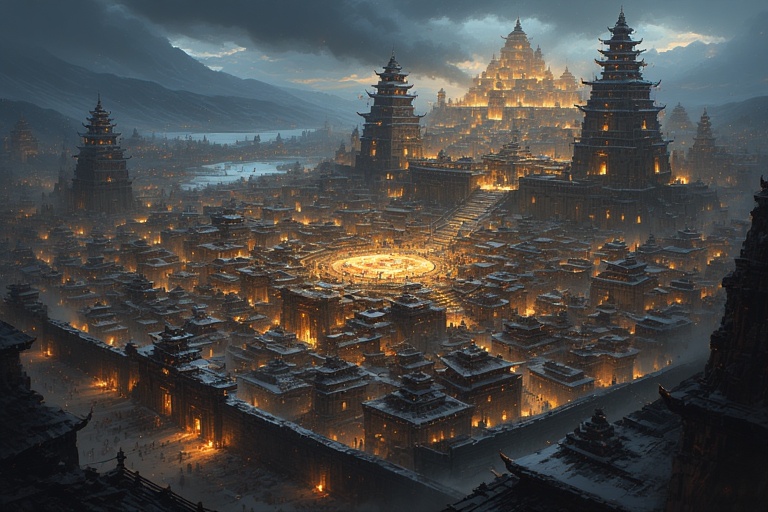
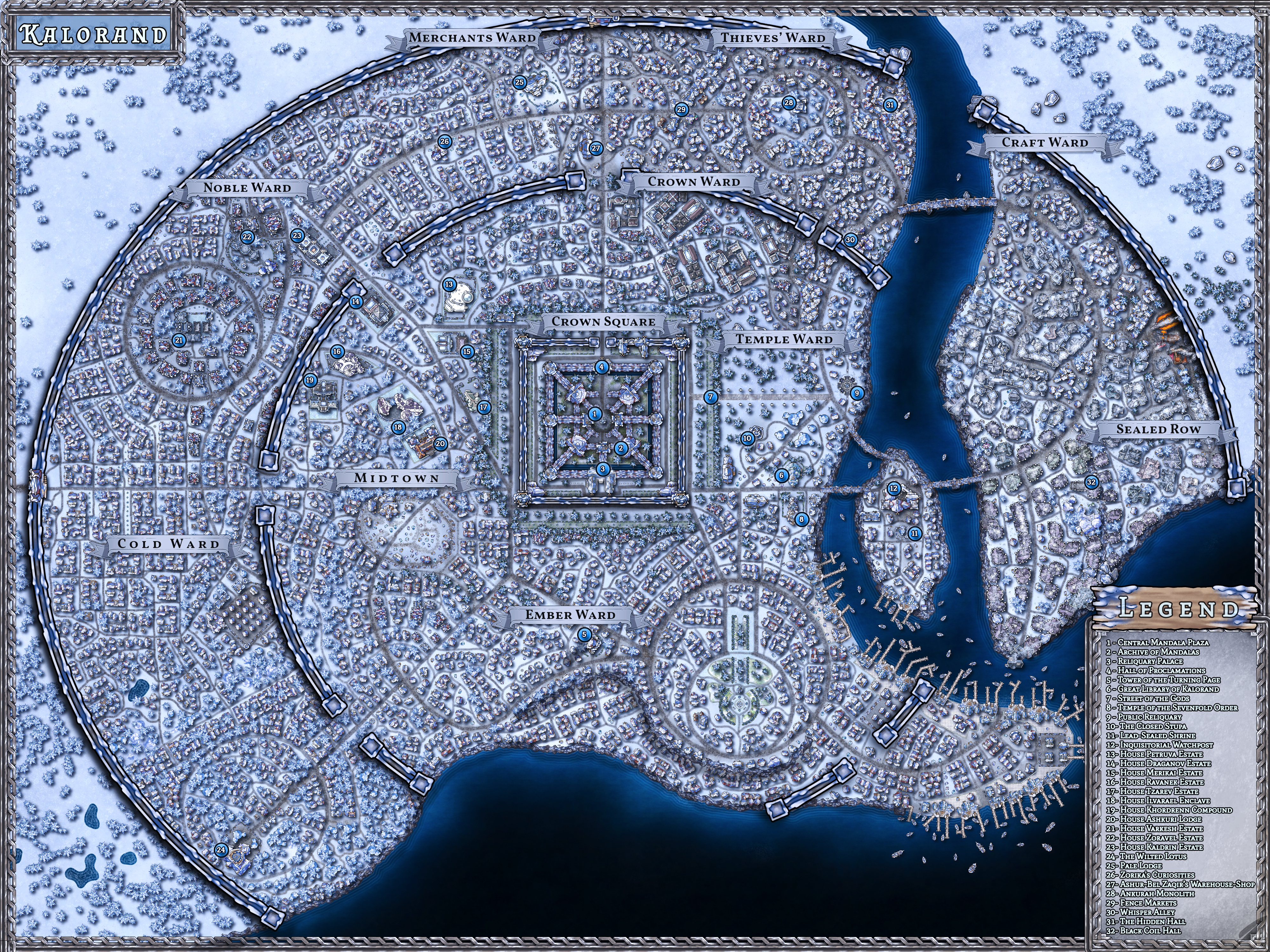
Kalorand is a large, cold city built around a functioning mandala complex. Roads, markets, and laws radiate outward from that center. The closer you are to the mandala, the warmer, safer, and more expensive things become. Farther out, the city grows crowded, cheaper, and less supervised.
You do not need permission to enter. You do need to mind your behavior.
One thing surprises most visitors: for a city built on doctrine and containment, Kalorand is alive in ways that other mandala cities are not. It smells like a city. It argues with itself. Things grow in the cracks. The outer wards bloom with enterprises that were not planned. The dead are buried quickly and their shops are open within a season.
Other mandala cities hold. Kalorand turns over.
The Church explains this as the cost of being the capital — too much traffic, too many people, too many foreign customs to keep out. This is not wrong. But experienced ritual engineers who have worked all three great cities know the difference between the kind of instability that comes from crowds and the kind that comes from the ground. Kalorand's ground does not want to hold still. It has never wanted to hold still. The mandala has been arguing with it for two thousand years, and the mandala is tired.
Why Adventurers Come Here
Work is always available. Caravan guard jobs, ruin recon, winter escorts, relic recovery, quiet muscle, and deniable tasks circulate constantly. If you can survive the road, someone will pay you.
Supplies are reliable. Cold-weather gear, rations, mounts, hirelings, and replacement equipment can all be found here year-round. So can unusual supplies. Things find their way here from distant places and end up for sale without clear histories.
Information flows. If something is happening in the north, someone in Kalorand knows. Possibly several someones who disagree. The city has an unusually good memory for a place that officially encourages selective forgetting.
Recovery is possible. Healers, mundane or otherwise, can be found. Healing seems to work better here than its practitioners can consistently explain. Most attribute this to the density of medical expertise. A few attribute it to something else.
Law and Trouble
Kalorand enforces order where it must and ignores it where doing so keeps the city running.
- Open violence draws attention fast.
- Quiet violence is someone else's problem.
- Crimes that disrupt trade are taken seriously.
- Crimes that do not are negotiated.
If you steal, make sure you know who controls the area. If you kill, make sure someone has already approved it.
Adventurer Etiquette
- Do not interfere with mandala rituals. Ever.
- Do not start fights in hiring halls or caravan courts.
- Pay beggars if you want to hear things early.
- Ask before selling relics. Some objects are watched.
- If someone offers protection you did not ask for, think carefully before refusing.
Getting Work
Most contracts are not posted publicly. They circulate through hiring halls near the inner markets, caravan courts by the gates, licensed mercenary brokers, and certain taverns where stories are traded carefully.
If you stay long enough, work will find you.
Where Adventurers Stay
Inner Rings: Safer, warmer, expensive. Better contacts.
Middle Rings: Most adventurers stay here. Inns, guild halls, outfitters.
Outer Wards: Cheap, crowded, flexible. Good for disappearing or hiring muscle.
Magic in the City
Magic is allowed, watched, and judged after the fact. Useful magic is tolerated. Disruptive magic is remembered. Powerful magic attracts attention whether you want it or not.
Reputation matters more than licenses.
Practitioners with experience in more than one city notice that certain kinds of magic work differently here. Spells that move or change living things — healing, compulsion, transformation, growth — tend to run longer and reach further than they should. The Sorcerers' Guild attributes this to Kalorand's concentration of experienced casters and the accumulated resonance of the mandala. Experienced practitioners are skeptical of this explanation but rarely say so publicly.
Final Advice
Kalorand will not save you. But it will give you a chance to prepare, recover, and choose your next mistake carefully.
Most adventurers leave richer or wiser. Some leave with both.
Nuts and Bolts
Population
38,000 in fair seasons. Contracts to ~31,000 in deep winter as outer wards empty and itinerant labor vanishes. Swells sharply during caravan season, tribunal cycles, and ritual maintenance periods.
The seasonal swing is larger than in other mandala cities. Kalorand breathes. Its population is not fixed — it expands when conditions allow and contracts when they don't, then expands again. The Tribunal finds this useful. The Church finds it difficult to document.
Alignment
Neutral. Law exists, but only where it can still be enforced.
Military
- 5,800 City Watch (Kalorand Watchers) — Walls, gates, markets, and mandala precincts
- 2,200 Auxiliaries — Caravan guards, river patrols, seasonal wardens, and hired muscle during unrest
The Watch is competent, overworked, and selectively blind.
Demographics
| Group |
Share |
| Reisans |
44% |
| Velkari (Hill Folk) |
18% |
| Harudjin (Foreigners) |
12% |
| Elves |
9% |
| Dwarves |
7% |
| Halflings |
6% |
| Ratlings and others |
4% |
Kalorand is the most ethnically mixed city in the Mandala Kingdom, and the most tolerant — not by principle, but by exhaustion, and by something harder to name. Other mandala cities sort. Kalorand accumulates. Groups arrive, compress against what was already there, and produce something new in the friction. The city does not assimilate its populations so much as compost them into something unplanned.
The Church considers this a management problem. The city's residents consider it Tuesday.
Overview
Kalorand is a mandala city sustained by ritual infrastructure, trade flow, and selective memory. It is not stable because it is strong. It is stable because every group understands that removing any other group would cause the whole structure to fail faster.
Power in Kalorand is not centralized. It is layered, negotiated, and cyclic. Organizations rise, overreach, contract, and make room for what comes next. Criminal enterprises that grew too visible have collapsed and been replaced by quieter successors. Trade guilds that monopolized too aggressively found themselves absorbed into new arrangements. Even the Church's authority in the outer wards has waxed and waned across generations, ceding ground and recovering it, ceding a little more each time.
This is not decline. It is how Kalorand works.
The mandala complex anchors the city physically and symbolically, but authority radiates outward through guilds, brotherhoods, cults, markets, and criminal institutions that have learned how to coexist without triggering collapse. Each layer compensates for the others. When ritual shortfalls threaten stability, trade covers the gap. When trade disrupts, criminal regulation absorbs it. When crime escalates, enforcement contracts. The system does not prevent failure. It metabolizes it.
The Church's phrase for Kalorand — the compromise city, where purity was traded for survival — is intended as criticism. The city has quietly accepted it as a description of why it still exists while other mandala cities have not.
Kalorand still functions. That fact alone makes it dangerous.
City Structure
Kalorand is laid out in concentric mandala rings, intersected by trade arteries rather than rigid geometry. The geometry has never been as clean as the original design specified. The city has grown in the spaces between the lines, pressed outward, and filled gaps that the plan did not account for.
Inner Mandala Precinct: Ritual engines, grain accounting halls, relic vaults, and tribunal chambers. The warmest part of the city. Also the most expensive, most surveilled, and most formally maintained. The architecture here is exact and unyielding. The Church works very hard to keep it that way.
Middle Rings: Markets, guild halls, workshops, caravan courts, and shrines. The city's productive core. Messier than the precinct but functional. Repair happens here faster than decay.
Outer Wards: Dense housing, river docks, winter yards, and semi-legal districts. Poorly mapped, frequently reconfigured. Businesses open in spaces that were residences a season ago. Residents occupy structures that were businesses before that. The ward does not stay the same shape from year to year.
The Unfinished Ring: A broken outer expansion that never fully stabilized. The mandala's reach ends somewhere in the middle rings. Beyond it, the city has continued anyway, without ritual reinforcement, powered by commerce and necessity. Poorly patrolled. Heavily exploited. And, against all planning assumptions, stubbornly persistent. The Church's engineers declared it unsustainable decades ago. It remains.
Roads are maintained obsessively near the mandala and progressively neglected farther out. Everyone knows which streets still receive ritual reinforcement. Everyone also knows which streets in the outer wards get repaired anyway, by residents who have stopped waiting for the Watch to manage it.
Governance
Center of Power: The Mandala Tribunal of Kalorand
Kalorand has no singular ruler. It is governed by a rotating tribunal of senior Church functionaries, civic adjudicators, and trade representatives.
They do not rule. They balance.
Decisions are slow, documented, and rarely reversed. This frustrates outsiders and reassures everyone else. The Tribunal does not try to prevent change. It tries to ensure that change happens slowly enough to be absorbed rather than fast enough to cascade.
Five years ago, a partial mandala failure forced the Tribunal to quietly authorize multiple unsanctioned solutions. None were recorded. All worked just well enough. Everyone involved understands the precedent. No one wants to repeat it openly. The Tribunal considers this a success. Critics of the Tribunal consider it an illustration of the problem.
Church Authority
The Great Church maintains ritual supremacy within the mandala core but does not directly police the city. It prefers systems that regulate themselves.
Kalorand is the Church's compromise city. A place where purity was traded for survival.
The Church's relationship with Kalorand's ley situation is one of studied silence. The ritual engineering corps knows that the mandala complex is working against its substrate rather than with it. The Church knows they know. No official document acknowledges this. Maintenance logs record anomalous readings as calibration drift. Senior functionaries describe the extra ritual labor required as the natural cost of managing a population center of this size.
The inner mandala is, in fact, suppressing something. The suppression works. It is getting more expensive.
Major Organizations
The Thieves' Guild of Kalorand
The unofficial regulator of crime. Everyone knows where its headquarters are. No one admits it.
The Guild enforces territorial boundaries, acceptable targets, and restitution for violations. Independent theft is treated as economic disruption, not rebellion. The Guild exists because uncontrolled crime would collapse trade confidence.
Their ethic is simple: "Chaos is bad for business."
The Guild is older than several of its official counterparts in city governance. It has survived leadership transitions, Watch crackdowns, and at least two attempts by outside criminal organizations to absorb it. Each time, it contracted, reorganized, and continued. Its longevity in a city that turns over as much as Kalorand does is either a tribute to its discipline or evidence of something in the city's character that makes such institutions persistent.
Relationship to Authority: Officially condemned. Unofficially tolerated. Quietly coordinated with Watch patrols.
The Beggars' Guild
An omnipresent, underestimated information network. Members are ignored, tolerated, and deeply informed. They collect rumors, social temperature, and early warnings.
In Reisa terms, the Beggars' Guild functions as an oral archive. They remember what the city prefers to forget. Given how much Kalorand officially forgets, they remember a great deal.
They are technically subordinate to the Thieves' Guild. In practice, they know things no one else does.
The Slayers' Brotherhood
A guild of legitimate violence. Members include bodyguards, caravan guards, duelists, and sanctioned enforcers. They wear their marks openly.
Hidden within the Brotherhood is the Assassins' Order, which the city officially denies exists. Contracts are ritualized, documented, and binding. A sanctioned killing is not murder. It is procedure.
"Violence does not disappear. It becomes bureaucratic."
The Sorcerers' Guild of Kalorand
A licensed association of minor magic. Astrologers, alchemists, seers, and ritual technicians. They issue plaques and certifications that mean very little.
True magic users rarely join. The Guild exists so the city can say: "Magic is regulated." The Church tolerates them as a pressure valve for curiosity, watching carefully for signs of ambition.
The Guild's membership is aware, in a vague collective way, that magic behaves unusually in Kalorand. Their official explanation — accumulated resonance, population density, decades of mandala proximity — is the explanation they have agreed upon. It satisfies everyone who does not press on it.
The White / Black Magician Paradigm
There are no orders, no robes, no councils. Only reputation.
White Magicians preserve, stabilize, and contain. Black Magicians exploit, weaponize, and bypass safeguards. The truth is retrospective: a magician is called White if the system survives, Black if it destabilizes. The same act may be judged differently depending on outcome.
This is not alignment. It is historical judgment.
The practical consequence is that in Kalorand, magic that accelerates change is always under suspicion — even when the change is beneficial, even when it succeeds. The city has a long memory for magicians who made things grow faster than expected and were later blamed for what the growth became.
Economy
Primary Industries: Caravan trade and tariffs, river traffic and ferries, ritual maintenance contracts, storage, accounting, and redistribution, mercenary services, relic containment and evaluation.
Gear Availability: Plate mail (5:6 chance available). Cold-weather gear (always available). Exotic spell components (licensed only).
Annual Taxes: 10 gp per adult resident. Additional levies for merchants, casters, and guild members.
Religion
| Faith |
Share |
| Great Church (Mandala Orthodoxy) |
52% |
| Ancestor Cults |
14% |
| Velkari Rites |
12% |
| Minor and Hidden Cults |
10% |
| Unaffiliated / Private Practice |
12% |
Public worship is controlled near the mandala core and increasingly tolerated farther out. The Church controls what is officially practiced. It does not control what is quietly practiced in the outer wards, and it has learned not to press too hard on the question.
The Green ley line produces an unusually strong undercurrent of ancestor reverence and cyclical belief in Kalorand — faiths oriented toward continuity, return, and the relationship between the living and the dead. The Ancestor Cults here are larger and more active than in comparable cities. The Velkari rites practiced in the city include traditions around seasonal return and the proper acknowledgment of endings. Minor cults oriented toward growth, change, and natural cycling maintain a quiet presence in the outer wards that the Inquisitorial Watchpost monitors without quite being able to suppress.
The Church suspects there is something in the ground that encourages these tendencies. It is not wrong.
The Pale Lodge (Kalorand Chapter)
A neutral, trusted mercenary and escort fellowship maintaining inter-city movement and regional stability. They guard caravans, map winter roads, and quietly monitor destabilizing threats.
Officially mundane. Unofficially indispensable. The Church prefers not to ask what else they watch.
Tone and Use in Play
Kalorand is a city where everything has a price but few prices are listed. It is a hub of rumors, contracts, and quiet compromises. It is a place where PCs gain reputations quickly, and a city that still works and is terrified of stopping.
It is not decadent. It is exhausted.
And beneath that exhaustion, something in the ground is still running — patient, slow, and aimed at something no one in the city would choose if they understood what it was. The mandala suppresses it. The city metabolizes it. The outer wards grow in its direction without knowing why.
Kalorand has survived by learning to absorb change rather than prevent it. The question the city cannot answer — the one the Church has successfully prevented anyone from asking officially — is whether two thousand years of absorbing and cycling has been the city working against the ground, or slowly, without realizing it, learning to work with it.
The land does not forgive. It rebalances.
Kalorand, more than any other city in the Mandala Kingdom, is the place where that rebalancing will first become visible.
Word count: 2,594