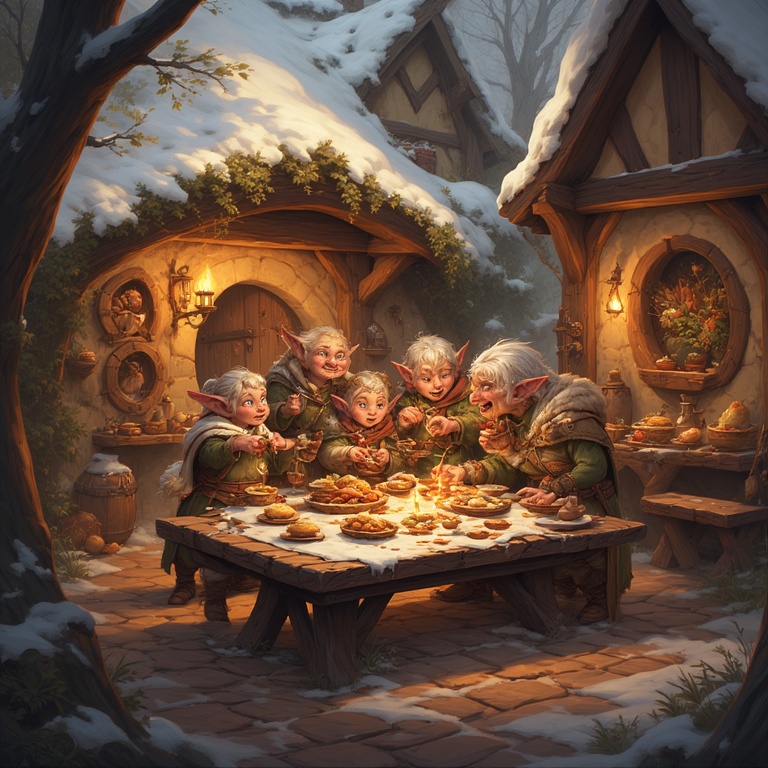
Halflings
Halflings in Reisa use the standard rules from Old-School Essentials with no mechanical changes. What sets them apart is not how they fight, but how they endure.
Where others respond to collapse with denial, withdrawal, or control, halflings respond with connection.
Cultural Position in Reisa
Halflings are the social glue of a failing world. They are not powerful enough to enforce stability, not numerous enough to dominate it, and not insulated enough to ignore it. Instead, they learn to move between people, smoothing edges, carrying news, sharing meals, and keeping relationships alive when institutions fail.
They are peace makers by necessity rather than ideology. Halflings understand that when systems break down, survival depends on who still talks to whom.
They value:
shared meals
stories told more than once
favors remembered longer than debts
laughter as a form of resistance
In a world obsessed with relics, rituals, and endings, halflings insist that small continuities still matter.
Halfling Communities
Halflings rarely build cities of their own. Instead, they live:
in the margins of mandala cities
along caravan routes and river crossings
within mixed neighborhoods where cultures overlap
in satellite villages that depend on trade rather than walls
Their homes are modest, warm, and deliberately inviting. A halfling dwelling is designed for visitors, not defense. Doors open easily. Tables are large. Food is always being prepared, even in lean seasons.
This makes halfling neighborhoods unusually resilient. When shortages come, halflings are often the last to starve, not because they hoard, but because they share early and widely.
Relationship to Other Cultures
Halflings maintain good relations with nearly everyone.
They are welcomed by:
Reisans, who rely on them as mediators and facilitators
Velkari, who respect their adaptability and memory
dwarves, who appreciate their reliability and refusal to overcomplicate
elves, who find in halflings a reminder of what the world felt like before withdrawal
They are mistrusted only by those who fear:
unguarded conversation
remembered promises
questions asked gently, but persistently
Halflings have an uncanny ability to be present without seeming threatening. This allows them to hear truths others speak carelessly.
Curiosity in a Tired World
When most of Reisa has stopped asking questions because the answers feel dangerous, halflings keep asking because not asking feels worse.
Their curiosity is not academic or revolutionary. It is personal.
Why did this stop working?
Who used to live here?
What happened to the people who left?
What do you miss most?
These questions reopen doors that ideology has sealed. Halflings do not demand answers. They simply refuse to let silence become normal.
Halflings as Adventurers
Halfling adventurers often begin as:
caravan assistants
innkeepers’ kin
riverfolk scouts
messengers who went one mile too far
They rarely seek glory. They seek understanding, connection, or the return of something lost and personal.
In a party, halflings are often the ones who:
remember names
negotiate when blades are drawn
notice when morale breaks
insist on resting, eating, and speaking before things fall apart
How Others See Halflings
To the powerful, halflings are:
pleasant
harmless
easy to overlook
To those on the edge, halflings are:
trusted intermediaries
keepers of stories
the reason a truce held
the reason help arrived
In Reisa, halflings are not the ones who save the world.
They are the ones who make it worth saving, one small kindness at a time.