Two-Band Model
| Hex Distance from Kalorand | Road Band | In-World Name | Lion Markers | Patrol Presence | Mandala Influence | Travel Modifier | Losing Direction | Wandering Monsters |
|---|---|---|---|---|---|---|---|---|
| 0–1 | Band I | Snow Lion Road | Regular, intact | Regular, visible | Strong | +50% | Impossible while markers visible | 1/day, 2:6 |
| 2–3 | Band I | Snow Lion Road | Regular, intact | Regular but thinner | Strong | +50% | Impossible while markers visible | 1/day, 2:6 |
| 4 | Band I | Snow Lion Road | Present but spaced | Infrequent | Moderate | +50% | Impossible while markers visible | 1/day, 2:6 |
| 5–6 | Band II | The Fading Road | Rare, broken, half-buried | Irregular, delayed | Weak | Normal | Normal rules in bad weather | 1/day, 3:6 |
| 7–8 | Band II | The Fading Road | Only at major points | Rare or absent | Minimal | Normal | Normal rules apply | 2/day, 3:6 |
| 9 | Special | Crossroads | One true Snow Lion | None beyond | Localized only | Normal | Prevented within sight of the Lion | 2/day, 3:6 |
| 10+ | Beyond | Old Route | None | None | Absent | Normal or worse | Normal | 2/day, 3:6 or higher |
The Snow Lion Road
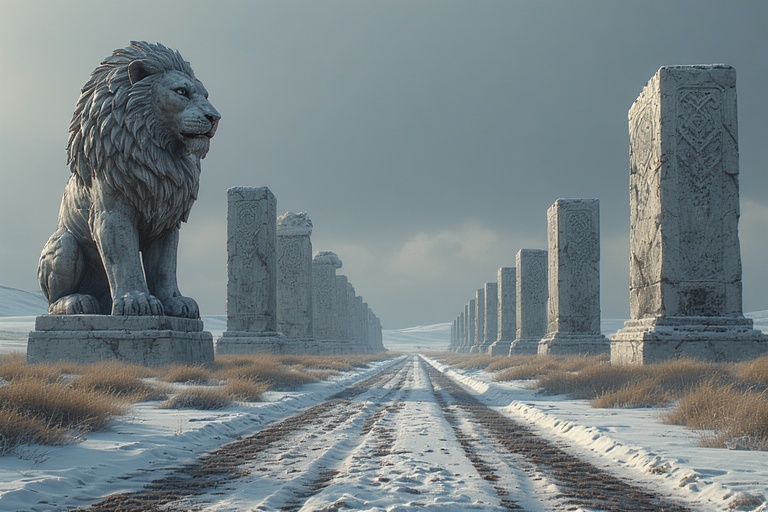
The Snow Lion Road is the primary southern artery of the Mandala Kingdom, running from the Snow Lion Gate of Kalorand toward Trushandar, the City of Towers. All sanctioned overland traffic once passed along this route, and in the Crown’s own telling, it remains the spine that binds the south to the capital.
The road began as a ritual processional way during the early Mandala Age. Stone lions, carved in archaic style and aligned with solar and geomantic points, marked places of ceremony rather than distance. As Kalorand grew and trade increased, the path was widened into a packed-earth road, its twin ruts cut deep by centuries of pilgrims, wagons, and marching feet.
In the Age of Decline, repeated winters buried long stretches of the road. King Zorikan the Stone Setter ordered the repair and re-marking of key nodes rather than the full restoration of the route. New lion markers were raised at bridges, forks, and trouble points. Later kings claimed the gaps were filled, but most never were.
Outside of Kalorand, the Snow Lion Road remains well kept. Patrols are visible. Markers are frequent. The Mandala’s influence is felt in predictable weather, reliable travel, and the quiet sense of being observed. Maps, sermons, and officials describe the entire road as if it still behaved this way.
Farther north, the character of the road changes. After the Open Sky stone marker, lion markers become rare, broken, or half-buried. Patrols arrive late or not at all. The Mandala’s influence fades unevenly, sometimes holding firm in one place and failing entirely in the next. Travelers continue to call it the Snow Lion Road, though often in a lowered voice.
At a lonely crossroads nine hexes from Kalorand stands the last true Snow Lion. Unlike the others, it is not merely symbolic. Within sight of this stone, travelers do not lose their way. Beyond it, the Crown’s protection does not extend. The road continues only by habit, memory, and stubbornness.
Most who travel this far understand what they are doing. They are not leaving the road. They are leaving the promise that the road once carried.
The Church teaches that the Snow Lion Road remains whole and guarded from end to end. Locals know better. They say the lions do not watch the road anymore.
Hex Type: Road terrain
Travel: 50% faster
Visibility: 3 miles in clear weather, 1 mile during snowfall
Losing Direction: No chance while markers are visible
Foraging: 1:6 chance; 1d4 rations
Hunting: 2:6 chance; 3d6 rations
Wandering Monsters: 1/day with 3:6 chance
Encounter Distance: 4d6 × 10 yards
Evasion Modifier: None
Snow Lion Road Encounters
Snow Lion Road Encounters
(Updated: Steppe & Migration Routes Integration)
Roll 1d100
01–03
Caribou migration (8d10 × 10 herd animals) crossing the road at speed, delaying travel
04–05
Muskox herd (6d6) forming a defensive ring near the road markers
06–07
Wild horses (2d10) spooking violently at lion statues or travelers
08–09
Steppe wolves (3d6) shadowing herds from downwind
10–11
Dire wolves (1d3) ranging far beyond forest cover
12–13
Lynx (1d2) stalking ground-nesting birds along the roadside
14–15
Great northern owl (1) circling silently above the markers at dusk
16–17
Nomad migration (2d6 nomads with wagons and animals) moving south before deep winter
18–19
Trader caravan (1d6 merchants, 1d4 guards using bandit stats)
20–21
Abandoned wagon or cairn, stripped clean by scavengers
22–23
Goblin scouts (1d6) moving openly and unconcerned with concealment
24–25
Beastmen outriders (1d4 gnolls) probing traffic patterns
26–27
Cult envoys (1d4 dervishes) traveling openly, marked by ritual symbols
28–29
Dust storm reducing visibility to 30 feet for 1d6 turns
30–31
Cold night exposure; fatigue saves required if shelter is poor
32–33
Ankheg (1) erupts beneath the packed roadbed
34–35
Wild boars (1d6 herd animals) crossing between snow lion markers
36–37
Steppe fire racing the wind across dry grassland
38–39
Scattered bones and trampled ground; predator nearby, unseen
40–41
Bandits (2d6), mounted or with carts, testing defenses
42–43
Mercenaries (1d4+1 bandits, leader is a veteran)
44–45
Warp beasts (1d3) hunting openly in daylight
46–47
Saber-toothed tigers (1d2 titherions) stalking at long distance
48–49
Owlbear (1) aggressive, displaced from forest territory
50–51
Giant mantis (1) camouflaged in tall roadside grass
52–53
Goblin warband (2d6 goblins with carts and animals)
54–55
Beastmen warband (1d6+2 gnolls) moving north with intent
56–57
Cult ritual site: 1d4 dervishes guarded by 1d6 gnolls
58–59
Taiga wights (1d6) haunting an old road spur or battlefield
60–61
Will-o-wisps (1d4+1) drifting between lion markers
62–63
Shambling mound (1) rising from a marshy low stretch
64–65
Black widows (1d3) nesting in wreckage or stone plinths
66–67
Dire wolf pack (2d6 wolves plus 1 dire wolf)
68–69
Grizzly bears (1d2) following southbound migration
70–71
Polar bear (1, 6 HD) roaming unnaturally far south
72–73
Trolls (1d4) crossing the road openly, unhurried
74–75
Black unicorns (1d2), hostile and territorial
76–77
Taiga dragon (1) visible for miles, shadow crossing the road
78–79
Migration collision: two herds plus predators converge simultaneously
80–81
Ancient road collapse or sinkhole; fall rules apply
82–83
Steppe lightning storm; random strikes and morale checks
84–85
Shrine remnant guardian: 1 taiga wight bound to a ruined marker
86–87
Saber-tooth matriarch (1, 6+ HD) asserting dominance
88–89
Steppe-wide disturbance: fire, blight, or mass animal flight
90–91
Named steppe horror, tied to an ancient migration route
92–93
War host on the move (beastmen or goblins), hundreds visible
94–95
Migration bottleneck, forcing a dangerous choice or detour
96–97
Bleed from adjacent region (taiga, hills, ruins)
98–99
Escalated encounter: reroll and double numbers
100
Campaign-level intrusion crossing the Snow Lion Road
Referee’s choice