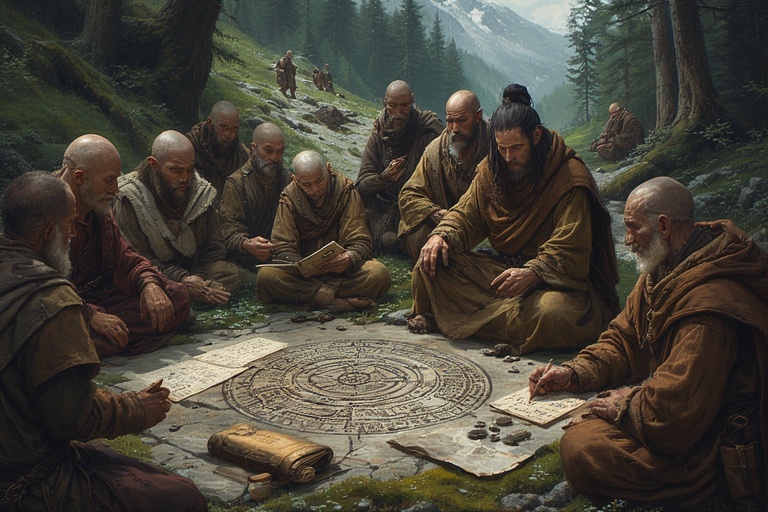
The Forest Sangha is a loose reform movement within the Great Church, made up of wandering monks, translators, and ascetics who live outside the great monasteries without openly rejecting the Church.
They are known for:
-
strict personal discipline
-
constant travel
-
refusal of wealth and patronage
-
teaching in abandoned shrines, ruined mandala wards, and frontier villages
Forest Sangha monks do not argue doctrine in public. Instead, they ask unsettling questions:
-
Does this ritual still do anything?
-
What happens when a mandala fails quietly?
-
Why are old maintenance logs copied but never read?
They study what they call the Old Way: fragments of older practices, obsolete rituals, and abandoned disciplines that predate modern mandala systems. These teachings are scattered, incomplete, and often recorded in dead or foreign languages.
The Forest Sangha is known to have members who:
-
translate ancient texts
-
track obsolete trade rituals
-
search foreign lands for lost teachings
-
collect incense formulas, diagrams, and marginal notes
They are not revolutionaries. They do not call for rebellion. They do not denounce the King or the Church.
Yet they are watched.
It is an open secret that the Dharmasena quietly track the spread of Old Way practices. When a Forest Sangha monk becomes too influential, too certain, or too vocal, that monk may be detained “for clarification” or “for the preservation of order.”
Sometimes these monks vanish for weeks.
Sometimes for years.
And then, eventually, they are released.
The official explanation is always reconciliation.
Everyone understands it is containment.
Most people believe the Forest Sangha will eventually fade.
Others believe it is already too late.