1. Notes

Cold Weather Gear and Transport

Equipment Descriptions

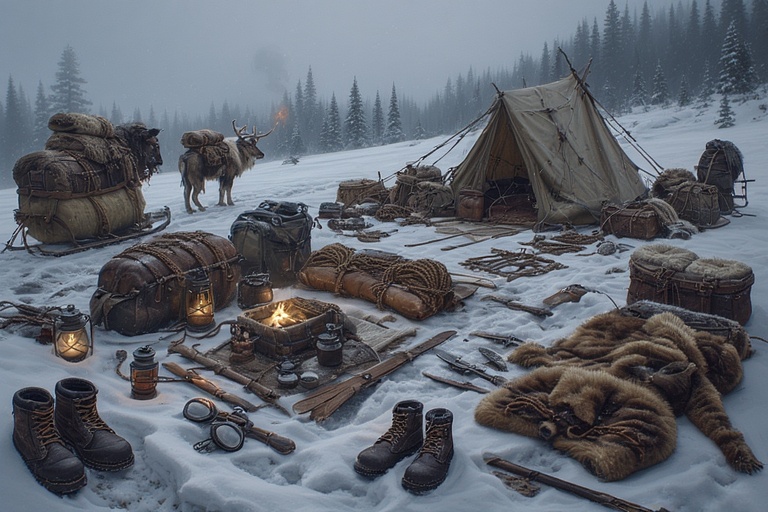
Cold-Weather Clothing

Travel Furs
Cost: 25 gp
Bulky layered hides and wool suitable for cold forests, sheltered roads, and short winter trips. Prevents mild cold penalties but offers poor wind resistance. Insufficient for open tundra, prolonged exposure, or storms.

Arctic Furs (Expedition Grade)
Cost: 90 gp
Sealskin or thick caribou furs with hood and wind layers. Required for multi-day winter travel beyond settled routes. Without expedition-grade furs, exposure checks increase in frequency and severity.

Extreme Cold Gear (Northern Outfit)
Cost: 180 gp
Heavy layered furs, insulated boots, face coverings, and wind cloaks designed for deep winter and exposed terrain. Mandatory for glacier travel, whiteout conditions, and severe storms. Availability is limited to specialist traders.

Snow Goggles
Cost: 5 gp
Bone or leather frames with narrow slits. Prevent snow blindness during prolonged travel in snow glare. Without goggles, characters risk temporary blindness after extended daylight exposure in snowfields.


Footwear and Movement

Insulated Arctic Boots
Cost: 25 gp
Fur-lined, waterproofed boots required for extended snow travel. Without insulated boots, exposure and frost injury checks are more likely, regardless of other clothing. Can be worn with snowshoes.

Snowshoes (Pair)

Cost: 10 gp

Snowshoes are broad wood-and-hide frames strapped over boots. They distribute weight across loose snow and ice, preventing deep sinking and reducing exhaustion during winter travel. Snowshoes do not increase speed beyond normal winter movement, but they significantly reduce penalties imposed by deep snow and similar terrain.

Snowshoes are common in Velkari lands and other northern regions. Travelers without them are quickly at the mercy of native creatures (without movement penalties) and the terrain itself.

Snowshoe Movement Reference

Normal MovementIn Snow (No Snowshoes)In Snow (With Snowshoes)
Exploration MV 120’, Encounter MV 40’Exploration MV 60’, Encounter MV 20’Exploration MV 90’, Encounter MV 30’
Exploration MV 90’, Encounter MV 30’Exploration MV 45’, Encounter MV 15’Exploration MV 60’, Encounter MV 20’
Exploration MV 60’, Encounter MV 20’Exploration MV 30’, Encounter MV 10’Exploration MV 45’, Encounter MV 15’

Notes

  • Snowshoes reduce movement penalties imposed by deep snow by one step.

  • Snowshoes do not increase speed beyond normal movement.

  • Creatures native to snow terrain sometimes ignore snow penalties.

Skis (Pair)
Cost: 40 gp
Long wooden skis for fast travel over open snow. Require training to use safely. Effective on tundra and frozen lakes, dangerous in forests, hills, or broken terrain.

Crampons
Cost: 15 gp
Iron spikes strapped to boots. Required for ice, glaciers, and steep frozen slopes. Without crampons, movement on ice is hazardous or impossible.


Tools and Survival Gear

Ice Axe
Cost: 10 gp
Used for climbing, anchoring, cutting steps, and emergency braking on slopes. Essential for glacier or alpine travel.

Cold-Weather Tent (4-person)
Cost: 50 gp
Double-layered hide tent with snow skirts and reinforced poles. Allows safe rest in sub-zero temperatures when combined with a fire or heat source. Standard tents are insufficient in severe cold.

Expedition Sleeping Roll
Cost: 15 gp
Thick furs wrapped in oilcloth. Required for safe rest in winter conditions. Without one, characters cannot fully recover fatigue outdoors, even with a fire.

Oil Heat Lantern
Cost: 12 gp
Enclosed oil lamp designed to provide sustained heat and light inside a tent or shelter. Burns one flask of oil per night. Prevents exposure during rest but provides no benefit outdoors.


Cold-Weather Equipment Table

CategoryItemCost (gp)Primary Function
ClothingTravel Furs25Prevents mild cold penalties
ClothingArctic Furs (Expedition)90Required for extended winter travel
ClothingExtreme Cold Gear180Mandatory for severe cold and storms
ClothingSnow Goggles5Prevents snow blindness
FootwearInsulated Arctic Boots25Prevents frost injury and exposure
MovementSnowshoes (pair)10Negates deep-snow penalties
MovementSkis (pair)40Fast travel over open snow
MovementCrampons15Safe movement on ice and slopes
ToolsIce Axe10Climbing and slope control
ShelterCold-Weather Tent (4p)50Safe rest in sub-zero conditions
BeddingExpedition Sleeping Roll15Enables recovery in winter camps
HeatOil Heat Lantern12Prevents exposure during rest


Sleds and Transport

Cargo Sled
Cost: 40 gp
Heavy wooden runners with reinforced leather lashings. Designed for hauling supplies, armor, and trade goods. May be pulled by people or animals. Slow, stable, and durable. Favored for freight and camp relocation rather than travel speed.

Dog Sled
Cost: 75 gp
Lightweight, flexible frame built for long-distance winter travel. Requires trained dogs and a handler to operate effectively. Unsuitable for heavy cargo but ideal for scouting, courier work, and expedition movement across open snow.


Sled Dogs and Teams

Snowtracker (Sled-Suitable Hound)
Cost: 30 gp
Lean, cold-bred hounds commonly used for sled work. Must be trained for harness and team travel before use.

Sled Training (per dog)
Cost: 15 gp
Conditioning, harness training, and voice-command discipline. Untrained dogs cannot operate safely in a sled team.

Standard Sled Dog Team (6 dogs)
Cost: 270 gp
Six Snowtrackers with full sled training. The minimum reliable team for long-distance winter travel. Requires careful handling and steady provisioning.

Heavy Cargo Team

Cost: 290 gp
A mixed team designed for hauling weight rather than speed. Typically composed of four Snowtrackers and two Ironjaws, all fully sled-trained. Slower than a standard travel team but far more stable on broken terrain, steep descents, and overloaded runs. Favored by merchants, fortress resupply crews, and expeditions moving camps rather than racing distances.

Heavy cargo teams reduce the risk of sled damage or loss on poor terrain and are less likely to panic under strain.


Elite Whiteveil Team
Cost: 510 gp
A rare and highly visible sled team composed entirely of Whiteveil Dogs, fully trained for coordinated travel. These teams are fast, disciplined, and eerily quiet, capable of sustained movement in whiteout conditions that would halt lesser dogs.

Elite teams are seldom sold openly. Ownership attracts attention from wardens, traders, and the Church alike. Losing such a team is a notable event, often remembered locally for years.

Feed and Maintenance

Winter Dog Feed
Cost: 1 gp per dog per day
Dried fish, fat, and grain supplements. Dogs consume full rations even when idle. Shorting feed causes fatigue, reduced speed, and morale loss within days.

A standard six-dog team requires 42 gp per week in feed alone.


Travel Services

Musher or Dog Handler (Hireling)
Wage: 3 gp per day
Knows routes, weather signs, and dog care. Refuses suicidal orders.

Winter Guide
Wage: 5 gp per day
Rare. Knows safe passes, shelter sites, and storm behavior. Often superstitious and cautious.


Referee Notes for Use in Reisa

  • Arctic gear is bulky. Encumbrance matters.

  • Availability is limited. Fort Stonejaw is likely the last place to acquire most of this.

  • Dogs are not vehicles. They are living creatures with morale, fatigue, and fear.

  • Losing gear in the wild is often worse than losing hit points.

  • Extreme cold does not care about heroism.


    TeamDaily RateSpeedCapacity
    Light Scout Sled (4 dogs, 1 retainer)3 gp/day30 mi300 lb safe
    Standard Sled Team (6 dogs, 2 retainers)6 gp/day24 mi600 lb safe
    Heavy Cargo Sled (8 dogs, 3 retainers)9 gp/day18 mi1,200 lb safe
    Elite Whiteveil (8–10 dogs, 4 retainers)12 gp/day36 mi800 lb safe
    Reindeer Pack (4 reindeer, 2 retainers)6 gp/day18 mi400 lb safe
    Reindeer Haul (6 reindeer, 3 retainers)9 gp/day18 mi900 lb safe

Animal Based Transport

Winter Transport Capacity, Cost, and Speed

All speeds are miles per day in snow


Dog Sled Teams

Transport TypeTypical CompositionCost (gp)Safe Load (lbs)Max Load (lbs)Speed (mi/day, snow)Notes
Light Scout Sled4 Snowtrackers18030040030Fast scouting, fragile under strain
Standard Sled Team6 Snowtrackers27050065024Expedition baseline
Heavy Cargo Team4 Snowtrackers, 2 Ironjaws29070090018Stable, forgiving, slow
Elite Whiteveil Team6 Whiteveil Dogs51055070036Extremely fast, highly visible

Costs include dogs and mandatory sled training.
Sled frame itself (75 gp) purchased separately.


Human-Powered Winter Transport

Transport TypePullersCost (gp)Safe Load (lbs)Max Load (lbs)Speed (mi/day, snow)Notes
Cargo Sled2 humans402003006Exhausting, daily fatigue checks
Cargo Sled4 humans4035050012Emergency relocation pace

Human labor costs not included. Assume standard hireling wages.


Mounted Transport in Snow

MountCost (gp)Safe Load (lbs)Max Load (lbs)Speed (mi/day, snow)Winter Performance
Riding Horse7520025012Poor footing, panic-prone
Mule9025035012Best non-sled option
Pack Horse1003004506Requires packed trail
Draft Horse1505007006Powerful, feed-intensive
Ox1206008006Slow, steady, cold-sensitive

Horses and oxen require cleared routes, shelter, and heavy winter feed.


Cold-Adapted Transport Animals

Reindeer (Domesticated Northern Stock)

Animal

Cost (gp)

 Safe Load (lbs)

 Max Load (lbs)

 Speed (mi/day, snow)

 Notes

Reindeer

120

300

450

18

Excellent footing, low panic

Reindeer may pull light sleds or carry pack loads. Easier to sustain than horses, slower than dog teams, culturally restricted.


Yak (Velkari Highland Stock)

Animal

Cost (gp)  

Safe Load (lbs)

  Max Load (lbs)

 Speed (mi/day, snow)

 Notes

Yak (pack)

150

200

300

12

No feed cost in highland terrain

Yak (draft)

180

400

600

9

Sled hauling; tireless in extreme cold

Yaks are the foundational transport animal of Velkari upland culture, preferred over horses and mules in terrain above the treeline and in sustained cold below –20°. They forage under snow for frozen grass and lichen, require no stabling, and navigate rocky and broken terrain on broad hooves without panic. Where horses need cleared paths and heavy feed, yaks simply continue.

The tradeoff is speed. A yak haul team moves slower than any sled configuration and slower than reindeer. In a situation requiring fast movement, yaks are the wrong choice. In a situation requiring sustained load-carrying across terrain that has defeated every other option, they are the only choice.

Yaks require no purchased feed in any highland or tundra hex with ground cover. In stabled conditions or terrain without forage, they eat dried grass at 2 cp per day. They cannot digest grain-based horse feed.

Sourcing yaks requires Velkari connections. They are not available from city outfitters or the Pale Lodge standard inventory. A party that wants yaks needs to have established enough relationship with a Velkari camp that the offer is made, or know someone who can broker the introduction. Attempting to simply purchase one from an unfamiliar Velkari herder is a social negotiation, not a market transaction.

Personal Transport

Human Snow Travel Chart

ModeEncumbranceGear RequiredGear Cost (gp)Miles per Day (Snow)Hex Movement
On FootLightNone0122 hexes
On FootNormalNone061 hex
On FootHeavyNone03½ hex
SnowshoesNormalSnowshoes10122 hexes
SnowshoesHeavySnowshoes1061 hex
Skis (trained)LightSkis40183 hexes
Skis (trained)NormalSkis40122 hexes
Skis (trained)HeavySkis4061 hex
Cargo Sled2 humansSled4061 hex
Cargo Sled4 humansSled40122 hexes

Adventurer Movement in Snow

Miles per day in snow

These figures assume:

  • unmounted travel

  • daylight movement

  • carried gear at or below normal encumbrance

  • packed snow or open tundra

  • no forced march

Deep powder, storms, or over-encumbrance reduce these numbers further.


Referee Guidance

  • Foot travel in snow is viable for local exploration, not logistics.

  • Any party attempting multi-week snow travel without sled support is making a desperation play.

  • Forced marching in snow should require saves vs. exhaustion, cold injury, or morale.

  • Snow turns distance into a resource drain, not just a clock.

Snow Transport Comparison

Snow Transport Comparison

Speed (mi/day, snow)Transport TypeTypical CompositionCost (gp)Safe Load (lbs)Max Load (lbs)Notes
36Elite Whiteveil Team6 Whiteveil Dogs510550700Extremely fast, highly visible
30Light Scout Sled4 Snowtrackers180300400Fast, fragile
24Standard Sled Team6 Snowtrackers270500650Expedition baseline
18Heavy Cargo Team4 Snowtrackers, 2 Ironjaws290700900Stable, forgiving
18Reindeer1 animal120300450Quiet, enduring
18Skis (trained, light enc.)Adventurers40personal gearOpen terrain only
12Mule1 animal90250350Best non-sled mount
12Riding Horse1 animal75200250Poor footing
12Snowshoes (normal enc.)Adventurers10personal gearPrevents sinking
12Cargo Sled4 humans40350500Emergency hauling
6On Foot (normal enc.)Adventurerspersonal gearTypical party pace
6Pack Horse1 animal100300450Needs packed trail
6Draft Horse1 animal150500700Feed-intensive
6Ox1 animal120600800Very slow
6Cargo Sled2 humans40200300Brutal labor
6Snowshoes (heavy enc.)Adventurers10personal gearRestores basic movement
6Skis (trained, heavy enc.)Adventurers40personal gearHigh risk

Stage 1 Winter Protection

Stage 1 Winter Protection

Advantages and Costs

Individual Gear (Per Person)

ItemCost (gp)Advantage in Play
Travel furs25Prevents mild cold penalties in forests, roads, and sheltered terrain. Allows normal winter travel without immediate exposure checks.
Insulated arctic boots25Prevents frost injury during daily travel and camp. Without these, exposure checks escalate quickly.
Expedition sleeping roll15Allows safe rest in cold weather. Enables fatigue recovery when combined with shelter and heat.

Individual Subtotal: 65 gp


Shared Party Gear (Split Among 5)

ItemCost (gp)Per-Person ShareAdvantage in Play
Basic tent (4-person)204 gpBlocks wind and snowfall. Reduces night exposure but does not eliminate it alone.
Oil heat lantern122.4 gpProvides enclosed warmth and light inside the tent. Prevents exposure during rest.
Oil flask (1)20.4 gpPowers the heat lantern for one night. Without oil, the lantern provides no protection.

Shared Subtotal: 34 gp
Shared Cost per Person: ~7 gp


Total Cost Per Person

CategoryCost (gp)
Individual winter gear65
Share of party gear~7
Total per person~72 gp


Stage 2 Winter Protection

Stage 2 Winter Protection

Additive Upgrades Only
(Party already owns Stage 1 equipment)

Intent:
Move off the road, manage fatigue, survive mistakes, and operate for multiple days in winter terrain.


Individual Additions (Per Person)

Item AddedCost (gp)What It Adds Beyond Stage 1
Arctic furs (expedition grade)90Upgrades Travel Furs. Prevents routine exposure checks off-road and in wind. Makes multi-day winter travel viable.
Snow goggles5Prevents snow blindness during long daylight travel and storms. Enables safe travel on open snowfields.
Crampons15Allows safe movement on ice, frozen slopes, and hard-packed snow. Without these, such terrain is hazardous or impassable.

Individual Stage 2 Subtotal: 110 gp per person


Shared Party Additions (Split Among 5)

Item AddedCost (gp)Per-Person ShareWhat It Adds Beyond Stage 1
Cold-weather tent (4-person)5010 gpReplaces basic tent. Prevents exposure during rest when combined with heat. Withstands wind and snowfall.
Additional oil flasks (3)61.2 gpExtends safe night operations to multiple days without resupply.
Snowshoes (pairs, 3)306 gpPrevents movement collapse under heavy encumbrance. Enables hauling loot and armor off-road.
Ice axe102 gpEnables safe slope travel, anchoring, and emergency braking.

Shared Stage 2 Subtotal: 96 gp
Per-Person Share: ~19 gp


Stage 2 Additive Cost Summary (Per Person)

CategoryCost (gp)
Individual additions110
Share of party additions~19
Total Stage 2 add-on per person~129 gp

Combined Spend So Far (Reference Only)

StageApprox. Cost per Person
Stage 1 (starter winter kit)~72 gp
Stage 2 (additive upgrades)~129 gp
Stage 1 + Stage 2 total~201 gp

What Stage 2 Enables (That Stage 1 Could Not)

  • Multi-day off-road winter travel

  • Fatigue recovery without cascading failure

  • Heavy encumbrance without speed collapse

  • Safe ice and slope movement

  • Survival through moderate storms if shelter is prioritized


What It Still Does Not Solve

  • Sustained blizzards

  • Glacier crossings

  • High-speed winter travel

  • Long-range logistics

Those remain firmly Stage 3 problems, requiring sleds, reindeer, or extreme cold gear.


Design Payoff

This additive structure makes progression feel earned:

  • Stage 1: “We can survive if careful.”

  • Stage 2: “We can explore and recover.”

  • Stage 3: “We can operate regardless.”

Stage 3 Winter Protection

Stage 3 Winter Protection

Additive Upgrades Only
(Party already owns Stage 1 and Stage 2 gear)

Intent
Operate beyond patrol lines, travel during storms, move supplies, recover from mistakes, and choose speed or endurance as needed.

Stage 3 is about mobility, redundancy, and resilience, not just warmth.


Individual Additions (Per Person)

Item AddedCost (gp)What It Adds Beyond Stage 2
Extreme cold gear (northern outfit)180Upgrades Arctic Furs. Allows travel and rest in severe cold, high wind, and whiteout conditions without escalating exposure checks. Mandatory for glaciers and deep winter storms.

Individual Stage 3 Subtotal: 180 gp per person


Shared Party Additions (Split Among 5)

Item AddedCost (gp)Per-Person ShareWhat It Adds Beyond Stage 2
Second cold-weather tent (4-person)5010 gpRedundancy. Allows split camps, rotating rest, or survival after tent loss.
Second oil heat lantern122.4 gpRedundant heat source. Prevents total collapse if one lantern fails.
Additional oil flasks (6)122.4 gpEnables extended field operations without resupply.
Dog sled team (standard)27054 gpEnables high-speed winter travel, shifts fatigue from people to animals, and allows serious hauling capacity.
Dog feed (1 week, 6 dogs)428.4 gpKeeps the team functional. Without feed, the sled is a liability.

Shared Stage 3 Subtotal: 386 gp
Per-Person Share: ~77 gp


Stage 3 Additive Cost Summary (Per Person)

CategoryCost (gp)
Individual additions180
Share of party additions~77
Total Stage 3 add-on per person~257 gp

Combined Spend Reference (All Stages)

StageApprox. Cost per Person
Stage 1~72 gp
Stage 2~129 gp
Stage 3~257 gp
Total (Stages 1–3)~458 gp

This fits cleanly under your earlier 500 gp per character benchmark while still leaving a little margin.


What Stage 3 Enables (That Stage 2 Could Not)

  • Reliable travel during storms

  • Multiple-day whiteout survival

  • Fast response and pursuit in winter

  • Heavy logistics and treasure hauling

  • Recovery from equipment loss without total failure

  • Choice between speed, stealth, or endurance


What Still Remains Dangerous

Even at Stage 3:

  • Reckless forced marches still kill

  • Losing dogs or feed still matters

  • Terrain still constrains movement

  • Winter still punishes arrogance

Stage 3 does not remove danger.
It moves danger from inevitability to consequence.


Design Signal

Stage progression now reads cleanly:

  • Stage 1: survive winter if cautious

  • Stage 2: explore winter terrain competently

  • Stage 3: operate in winter on your own terms