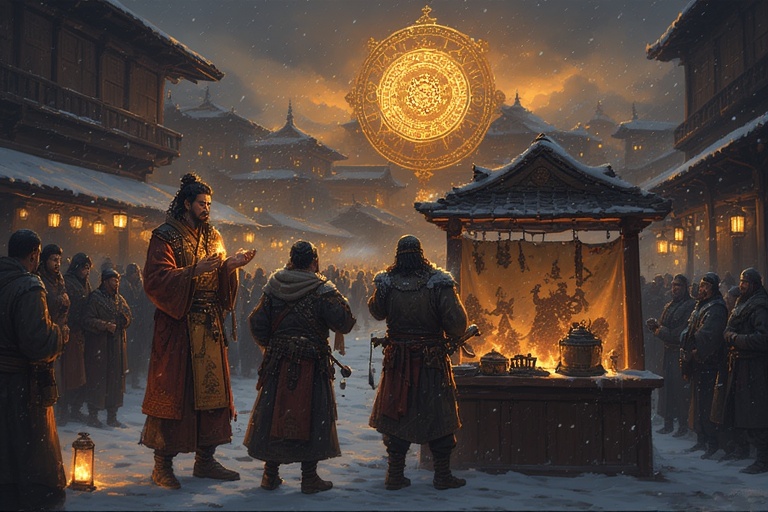
Bard (Mandala Tradition)
Divine Bard
Bards of the Mandala Tradition are sacred performers, ritual singers, and keepers of social memory. They serve the mandalas much as druids serve the land, preserving warmth, order, and continuity through correct performance of inherited forms. Their songs are not entertainment alone but ritual acts that reinforce the patterns holding the world together.
Mandala Bards are found at festivals, funerals, shrine days, and civic rites. They lead chants, direct folk dramas, and recite moral histories that remind communities who they are and how they are meant to live. Their magic is divine in origin, granted through lineage, proper training, and adherence to tradition. Each performance is a form of prayer, whether sung openly or woven subtly into conversation.
In play, Mandala Bards use the normal Bard class rules and spell access as presented in Old-School Essentials. Their spells are expressed as chants, sutras, ritual songs, or formally sanctioned performances. A Mandala Bard who abandons ritual propriety may find advancement difficult or lose social protection, though their magic does not vanish outright.
Mandala Bards are welcomed in most settlements and are entitled to hospitality where the mandala still burns. As the world declines, they are increasingly relied upon to hold communities together, even as they are pressured to deny or soften uncomfortable truths.
Bard (Screen Sage Tradition)
Arcane Bard
Screen Sages, also called Lam Masters, are traveling storytellers, puppetmasters, and epic singers whose power comes not from blessing but from understanding pattern, symbol, and audience. They perform in marketplaces, caravan camps, border villages, and forgotten shrines, carrying stories that are incomplete, contradictory, or quietly dangerous.
Their magic is arcane. It arises from structure rather than sanctity, from rhythm, repetition, and the shaping of perception. A Screen Sage learns spells as scripts, verses, puppet movements, or song cycles, refined through performance and memory. Where a Mandala Bard preserves what should be, a Screen Sage reveals what was, or what might be.
In play, Screen Sages use the Bard class chassis but cast Magic-User spells instead of divine spells. Their spell texts are not kept in books but embodied in performance materials such as scrolls, scripts, instruments, masks, or screens. Casting typically requires voice, motion, or an audience, and magic performed in isolation is weaker and riskier.
Screen Sages are tolerated but seldom trusted. They are watched by authorities and sometimes blamed when unrest spreads or old failures are remembered too clearly. In a failing world, their stories travel faster than official doctrine, making them both valuable and dangerous companions.