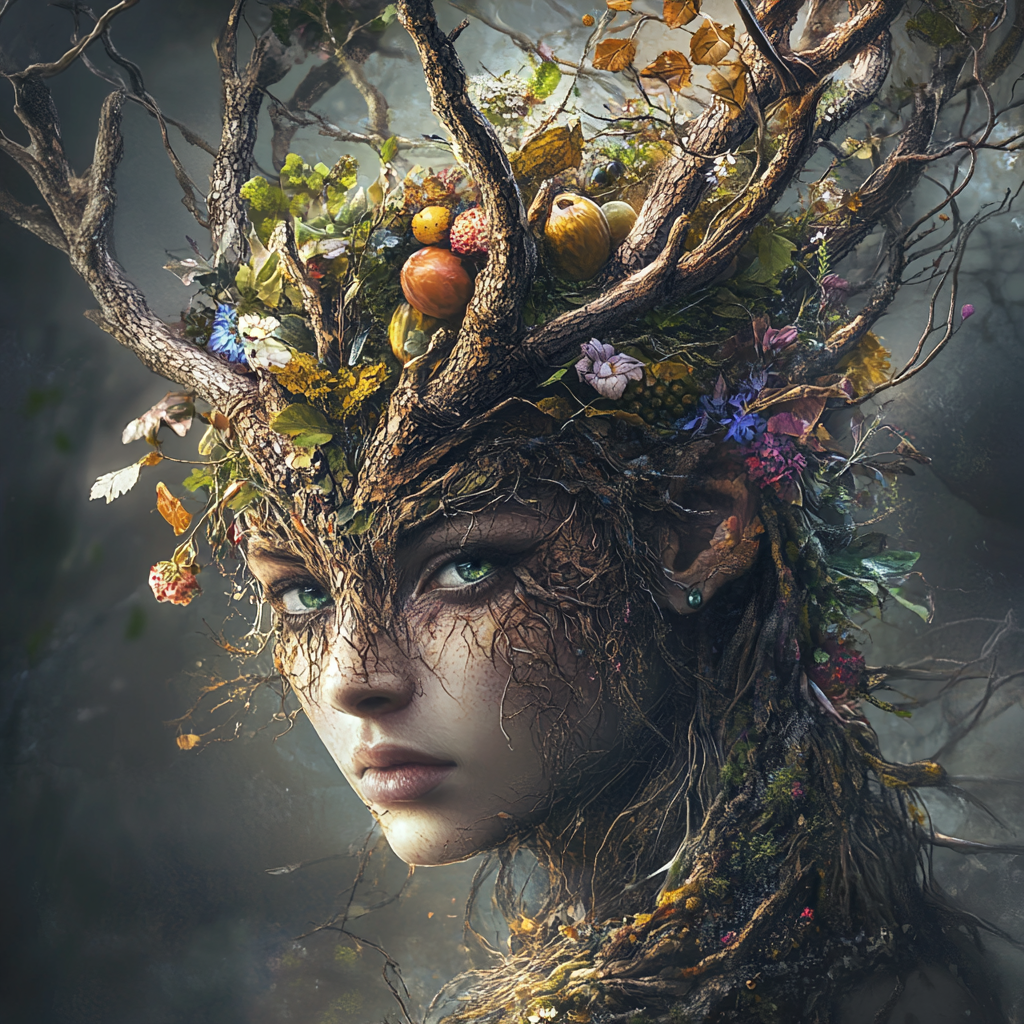
Laia
Major Aspect of Life
Under Laia's touch, the seasons shift, under her gaze, we're borne and fade
Laia's appearance is ever-changing. She might be seen as a young woman with vine-woven hair, or an aged figure with bark-like skin, or in wonderous beastial forms, such as a stag with fruit-laden antlers, or in natural features like a flowing river or gusts of wind. In all forms, her eyes change color with the seasons, showing both the vibrancy of growth and the quiet acceptance of decay. When in humanoid form, her clothing is depicted as made from natural materials: leaves, feathers, stone, and bone. An aura, subtly changing with the time of day and year, surrounds her, suggesting warmth, coolness, or the soft light of the Cayn Sun. This variability reflects her connection to the shifting patterns of the natural world.
Laia is both serene and wild, reflecting nature's duality. She is wise and ever patient, yet can be fierce or brutal. She offers stoicism in the face of grief, reminding mortals that death is part of life's cycle, which will only lead to eventual renewal.
Rites
The Rite of Safe Trails: A rite that was commonly performed before or during a perilous trail (or before every trail for those faithful). A traveler might tie a piece of colored cloth (usually green or blue) to a tree branch or leave a small offering of stones or flowers. They would then pray for safe passage, asking Laia to guide their steps and calm the elements.
The Rite of Return: Creatures are all part of nature, and in their death, the Rite of Return deems that they are returned to nature. This Rite could take different forms in different cultures. While in most civilized cultures, this would include prayer and interment in the ground, with a garden or a tree planted over the deceased, in other, wilder cultures, this could mean leaving the deceased to be devoured by beasts, or other methods of returning the body to nature.
The Rite of Blossom: In most cultures, though not all, this Rite was performed mainly by young women to celebrate the transition into adulthood. The ceremony usually takes place in a natural place (a serene grove or a blooming meadow) and is adorned with flowers, leaves, and vines. The family or community celebrates with the youth, focusing on the beauty of life, both childhood and adulthood and the connection to the natural world. Prayers and hymns are shared, and the rite is usually concluded in a large feast.
Celebrations
Festival of Flowers: Held during the spring equinox, the joyous festival celebrates the arrival of spring and the awakening of nature. It includes flower garlands, dancing, singing, and feasting. People plant trees, hunt, and decorate homes with fresh greenery. Traditionally, it was a time of marriages, civil unions, and celebrating good news.
Effigy: A carved antler, a figurine of one of Laia's shapes made of vines, a mask of the seasons, depicting the four seasons in each corner of the mask.
Domains: Nature, Natural Cycles, Beauty, Rivers.
Legends: By legend Laia curved the great Gagular River into the Great Rise Mountain and led the mighty river into the Edge Basin Wilds, essentially creating the flourishing ecosystem into what it is today.
Goals: Preserving nature and the natural world.
Draws Strength From: The thriving of the natural world and observance of its natural cycles, adherence to her principles, and guidance, and expressions of natural beauty.
Rivels: Moros, who is ever eager to destroy, and Diavola, who wishes to disrupt the natural cycles, are natural rivals of Laia, though Axiom and Hefren also managed to raise her ire occasionally.
Originating Culture: The MnSobek, the natural inhabitants of the Edge Basin, were known to revere Laia above all.