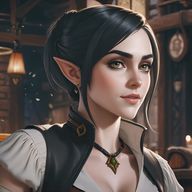
Physical Description:
Half-Elves embody the duality of their parentage, bearing the grace and ethereal features of their Elven heritage while maintaining the robust build and adaptability of humanity. They typically stand between 5’5” and 6’2” in height, with a build that is more solid than their elven kin yet leaner than the average human. Their skin tones span a wide spectrum, ranging from the sun-kissed hues of Wood Elves to the ashen pallor of Dark Elves, depending on their parentage.
Half-Elves are distinguished by their slightly pointed ears—less pronounced than a full-blooded elf’s—and eyes that shimmer with faint traces of magic, often carrying an otherworldly glimmer. Their hair colors are equally varied, reflecting the diversity of their lineage, from autumnal reds and forest browns to silvery whites and deep blacks. Despite their mixed blood, Half-Elves often possess an undeniable charm and striking beauty that sets them apart in both human and elven societies.
History:
The emergence of Half-Elves was a subject of great controversy, particularly among the Valarith, who saw such unions as a corruption of elven purity. In the early days of human expansion across Lunora , alliances were forged through necessity, and love often blossomed across cultural lines. Despite initial resistance and whispers of scandal, the union of elves and humans became more commonplace, particularly after the Treaty of Sunsfall, which established lasting peace between human kingdoms and elven enclaves.
Over time, Half-Elves carved out a place for themselves, proving to be capable diplomats, traders, and explorers due to their understanding of both cultures. Their dual nature granted them versatility, and as the world became more interconnected, the stigma of their heritage began to fade. In modern times, Half-Elves are respected in many regions, although some elven purists still regard them with disdain.
In the Vache Kingdom, Half-Elves hold unique status, often serving as mediators and emissaries. In Rivermond, they are seen as symbols of unity and peace, while in the shadowy ports controlled by the Umbraith, they navigate between light and dark with uncanny ease. Their adaptability has allowed them to thrive in diverse societies, making them one of the most widespread of the elven kin.
Society:
Half-Elves navigate a complex social existence, walking the line between the transient nature of humanity and the ageless wisdom of elves. This duality often instills in them a sense of wanderlust and adaptability. They are natural diplomats and negotiators, capable of seeing multiple perspectives and understanding cultural nuances. Many Half-Elves find themselves drawn to cosmopolitan cities where diverse cultures intermingle, thriving as merchants, scholars, and adventurers.
Their communities, when established, are typically melting pots of different races, embracing diversity and celebrating the melding of traditions. They are known for hosting grand festivals that reflect both elven elegance and human revelry, drawing visitors from all corners of Midora.
Despite their fluidity, Half-Elves sometimes struggle with belonging. Among humans, they may be seen as ethereal and strange; among elves, as diluted and impure. This lingering bias drives many Half-Elves to seek adventure, forging their own destinies beyond societal constraints. Their resilience in the face of prejudice has earned them respect among those who value strength of character over bloodline.
Racial Names & Language:
Half-Elves typically bear names reflective of their mixed heritage. Some are given traditional elven names by their elven parent, such as Elandra, Faelar, Arannis, or Thalia, while others receive more human-centric names like Maric, Helena, Darius, or Livia. In some cases, their names blend the phonetic beauty of Elvish with the simplicity of human naming conventions, resulting in unique hybrids such as Aricorin or Elowyn.
Half-Elves are often bilingual, learning both Common and common Elvish (Valari) as they grow. Depending on where they are raised, they may also learn regional dialects or additional languages like Sylvan among the Therannis or Undera if raised near Umbraith communities. Their natural linguistic talent allows them to pick up new tongues with relative ease, a skill that often aids them in their cosmopolitan lifestyles.
Relations with Other Races:
Half-Elves are generally well-received in human communities for their charm and adaptability. Among elves, their reception is more mixed; the Valarith view them with a touch of disdain, a lingering remnant of ancient prejudices, while the Therannis are far more accepting, seeing them as kin of the natural world. The Umbraith are divided—some admire their versatility, while others see them as weak for mingling with humankind.
In dwarven communities, Half-Elves often find unexpected camaraderie, respected for their adventurous spirit and ingenuity. Gnomes and Halflings appreciate their wanderlust and charm, making Half-Elves popular trading partners and travel companions.
Culture & Beliefs:
Half-Elves are known for their adaptability, a trait reflected in their open-mindedness toward different cultures and traditions. They are natural bridge-builders, able to find common ground between disparate factions. While they lack the rigid traditions of their full-blooded kin, they are often drawn to artistic expression, storytelling, and the pursuit of knowledge.
Many Half-Elves maintain their parents faith but is typically less rigid. Some gravitate towards other gods, while others worship local spirits or none at all, valuing their own agency above divine intervention. This freedom of belief is a hallmark of their diverse culture.