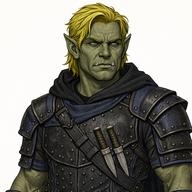
Golgothazar Starvekoyne
  1. Characters

Golgothazar Starvekoyne

Golgothazar Starvekoyne header image

Species: Half-Orc (Human/Orc)

Background: Criminal (Smuggler)
Classes & Levels: Rogue (Arcane Trickster) lvl 3, Artificer lvl 3 (Artillerist)

Place of Birth: Dark Arrow Keep
Date of Birth: 27 Tarsakh, 1478 DR (Year of the Dark Circle)
Star Sign: The
Harpy (Astrology)
Life Cycle: Year of the Dog (Astrology - Kara-Tur)

Imgur album: https://imgur.com/a/3sTxmYo
Family tree: https://www.familyecho.com/?c=rw448m6axf97wmul&f=895026552746156677

Unassigned Ability Points: 3 (as of level 6)

Appearance

Height
6'1"

Weight
195 lb

Eyes
Green

Hair
Black

Skin
Deep Olive

Background Features

Criminal Contact (Criminal) - Background Feature

You have a reliable and trustworthy contact who acts as your liaison to a network of other criminals. You know how to get messages to and from your contact, even over great distances; specifically, you know the local messengers, corrupt caravan masters, and seedy sailors who can deliver messages for you.

Criminal Specialty (Criminal) - Background Feature

There are many kinds of criminals, and within a thieves' guild or similar criminal organization, individual members have particular specialties. Even criminals who operate outside of such organizations have strong preferences for certain kinds of crimes over others. Choose the role you played in your criminal life, or roll on the table below.

d8Specialty
1Blackmailer
2Burglar
3Enforcer
4Fence
5Highway robber
6Hired killer
7Pickpocket
8Smuggler

Class Features

Class Table (Rogue)

You must have a Dexterity score of 13 or higher in order to multiclass in or out of this class.

The Rogue
LevelProficiency BonusSneak AttackFeatures
1st+21d6Expertise, Sneak Attack, Thieves' Cant
2nd+21d6Cunning Action
3rd+22d6Roguish Archetype, Steady Aim (Optional)
4th+22d6Ability Score Improvement
5th+33d6Uncanny Dodge
6th+33d6Expertise
7th+34d6Evasion
8th+34d6Ability Score Improvement
9th+45d6Roguish Archetype feature
10th+45d6Ability Score Improvement
11th+46d6Reliable Talent
12th+46d6Ability Score Improvement
13th+57d6Roguish Archetype feature
14th+57d6Blindsense
15th+58d6Slippery Mind
16th+58d6Ability Score Improvement
17th+69d6Roguish Archetype feature
18th+69d6Elusive
19th+610d6Ability Score Improvement
20th+610d6Stroke of Luck

Cunning Action (Rogue) - Class Feature

Starting at 2nd level, your quick thinking and agility allow you to move and act quickly. You can take a bonus action on each of your turns in combat. This action can be used only to take the Dash, Disengage, or Hide action.

Note: 2nd Level Feature

Expertise (Rogue) - Class Feature

At 1st level, choose two of your skill proficiencies, or one of your skill proficiencies and your proficiency with thieves' tools. Your proficiency bonus is doubled for any ability check you make that uses either of the chosen proficiencies.

At 6th level, you can choose two more of your proficiencies (in skills or with thieves' tools) to gain this benefit.

Note: 1st Level Feature

Sneak Attack (Rogue) - Class Feature

Beginning at 1st level, you know how to strike subtly and exploit a foe's distraction. Once per turn, you can deal an extra 1d6 damage to one creature you hit with an attack if you have advantage on the attack roll. The attack must use a finesse or a ranged weapon.

You don't need advantage on the attack roll if another enemy of the target is within 5 feet of it, that enemy isn't incapacitated, and you don't have disadvantage on the attack roll.

The amount of the extra damage increases as you gain levels in this class, as shown in the Sneak Attack column of the Rogue table.

Note: 1st Level Feature, 2d6

Thieves' Cant - Class Feature

During your rogue training you learned thieves' cant, a secret mix of dialect, jargon, and code that allows you to hide messages in seemingly normal conversation. Only another creature that knows thieves' cant understands such messages. It takes four times longer to convey such a message than it does to speak the same idea plainly.

In addition, you understand a set of secret signs and symbols used to convey short, simple messages, such as whether an area is dangerous or the territory of a thieves' guild, whether loot is nearby, or whether the people in an area are easy marks or will provide a safe house for thieves on the run.

Note: 1st Level Feature

Mage Hand Legerdemain (Arcane Trickster) - Subclass Feature

Starting at 3rd level, when you cast Mage Hand, you can make the spectral hand invisible, and you can perform the following additional tasks with it:

  • You can stow one object the hand is holding in a container worn or carried by another creature.
  • You can retrieve an object in a container worn or carried by another creature.
  • You can use thieves' tools to pick locks and disarm traps at range.

You can perform one of these tasks without being noticed by a creature if you succeed on a Dexterity (Sleight of Hand) check contested by the creature's Wisdom (Perception) check.

In addition, you can use the bonus action granted by your Cunning Action to control the hand.

Note: 3rd level feature

Spellcasting (Arcane Trickster) - Subclass Feature

Arcane Trickster SpellcastingSpell Slots per Spell Level
Rogue LevelCantrips KnownSpells Known1st2nd3rd4th
3rdMage Hand + 232---
4thMage Hand + 243---
5thMage Hand + 243---
6thMage Hand + 243---
7thMage Hand + 2542--
8thMage Hand + 2642--
9thMage Hand + 2642--
10thMage Hand + 3743--
11thMage Hand + 3843--
12thMage Hand + 3843--
13thMage Hand + 39432-
14thMage Hand + 310432-
15thMage Hand + 310432-
16thMage Hand + 311433-
17thMage Hand + 311433-
18thMage Hand + 311433-
19thMage Hand + 3124331
20thMage Hand + 3134331

Spellcasting

When you reach 3rd level, you augment your martial prowess with the ability to cast spells.

Cantrips

You learn three cantrips: Mage Hand and two other cantrips of your choice from the wizard spell list. You learn another wizard cantrip of your choice at 10th level.

Spell Slots

The Arcane Trickster Spellcasting table shows how many spell slots you have to cast your wizard spells of 1st level and higher. To cast one of these spells, you must expend a slot of the spell's level or higher. You regain all expended spell slots when you finish a long rest.

For example, if you know the 1st-level spell Charm Person and have a 1st-level and a 2nd-level spell slot available, you can cast Charm Person using either slot.

Spells Known of 1st Level and Higher

You know three 1st-level wizard spells of your choice, two of which you must choose from the enchantment and illusion spells on the wizard spell list.

The Spells Known column of the Arcane Trickster Spellcasting table shows when you learn more wizard spells of 1st level or higher. Each of these spells must be an enchantment or illusion spell of your choice, and must be of a level for which you have spell slots. For instance, when you reach 7th level in this class, you can learn one new spell of 1st or 2nd level.

The spells you learn at 8th, 14th, and 20th level can come from any school of magic.

Whenever you gain a level in this class, you can replace one of the wizard spells you know with another spell of your choice from the wizard spell list. The new spell must be of a level for which you have spell slots, and it must be an enchantment or illusion spell, unless you're replacing the spell you gained at 3rd, 8th, 14th, or 20th level from any school of magic.

Spellcasting Ability

Intelligence is your spellcasting ability for your wizard spells, since you learn your spells through dedicated study and memorization. You use your Intelligence whenever a spell refers to your spellcasting ability. In addition, you use your Intelligence modifier when setting the saving throw DC for a wizard spell you cast and when making an attack roll with one.

Spell save DC = 8 + your proficiency bonus + your Intelligence modifier

Spell attack modifier = your proficiency bonus + your Intelligence modifier

Note: cantrips: Minor Illusion, Encode Thoughts
1st level: Disguise Self, Silent Image, Sleep

3rd level feature

Faction Features

Shadow Reputation (Nightblades) - Faction Feature

Creatures who know or suspect your Nightblade ties have advantage on Wisdom (Insight) checks made to determine if you are hiding something or withholding information. In addition, lawful authorities begin attitudes toward you one step more hostile than they normally would.

Note: Nightblade Flaw

Silent Network (Harpers) - Faction Feature

You gain proficiency in one of the following skills of your choice: Insight, Deception, Persuasion, or Stealth.

In addition, when exchanging written messages, you can hide a secret meaning in otherwise normal text. A creature must succeed on an Intelligence (Investigation) check vs. your passive Deception to notice the hidden message.

Note: Rank 1 Feature

Smuggler's Instinct (Nightblades) - Faction Feature

You gain proficiency in either Stealth or Sleight of Hand (your choice). In addition, when you attempt to hide a small object on your person, you have advantage on Dexterity (Sleight of Hand) checks made to conceal it.

Note: Rank 1 Feature

Web of Secrets (Harpers) - Faction Feature

When you attempt to persuade an NPC who knows or suspect your Harper ties to trust you with sensitive information, you have disadvantage on the check unless you reveal at least one truthful secret of your own. If you refuse, the check automatically fails.

Note: Harper Flaw

Feats

Fey Touched (Feat) - Feat

Source: Tasha's Cauldron of Everything

Your exposure to the Feywild's magic has changed you, granting you the following benefits:

  • Increase your Intelligence, Wisdom, or Charisma score by 1, to a maximum of 20.
  • You learn the Misty Step spell and one 1st-level spell of your choice. The 1st-level spell must be from the Divination or Enchantment school of magic. You can cast each of these spells without expending a spell slot. Once you cast either of these spells in this way, you can't cast that spell in this way again until you finish a long rest. You can also cast these spells using spell slots you have of the appropriate level. The spells' spellcasting ability is the ability increased by this feat.

Note: +1 Wisdom

Keen Mind (Feat) - Feat

You have a mind that can track time, direction, and detail with uncanny precision. You gain the following benefits:

  • Increase your Intelligence score by 1, to a maximum of 20.
  • You always know which way is north.
  • You always know the number of hours left before the next sunrise or sunset.
  • You can accurately recall anything you have seen or heard within the past month.

Lucky (Feat) - Feat

Source: Player's Handbook

You have inexplicable luck that seems to kick in at just the right moment.

You have 3 luck points. Whenever you make an attack roll, an ability check, or a saving throw, you can spend one luck point to roll an additional d20. You can choose to spend one of your luck points after you roll the die, but before the outcome is determined. You choose which of the d20s is used for the attack roll, ability check, or saving throw.

You can also spend one luck point when an attack roll is made against you. Roll a d20 and then choose whether the attack uses the attacker's roll or yours.

If more than one creature spends a luck point to influence the outcome of a roll, the points cancel each other out; no additional dice are rolled.

You regain your expended luck points when you finish a long rest.

Species Features

Darkvision (Half-Orc) - Species Feature

Thanks to your orc blood, you have superior vision in dark and dim conditions. You can see in dim light within 60 feet of you as if it were bright light, and in darkness as if it were dim light. You can't discern color in darkness, only shades of gray.

Relentless Endurance (Half-Orc) - Species Feature

When you are reduced to 0 hit points but not killed outright, you can drop to 1 hit point instead. You can't use this feature again until you finish a long rest.

Savage Attacks (Half-Orc) - Species Feature

When you score a critical hit with a melee weapon attack, you can roll one of the weapon's damage dice one additional time and add it to the extra damage of the critical hit.

Spells

Encode Thoughts - 0 Level

Source: Guildmaster's Guide to Ravnica

Enchantment cantrip

Casting Time: 1 action
Range: Self
Components: S
Duration: 8 hours

You pull a memory, an idea, or a message from your mind and transform it into a tangible string of glowing energy called a thought strand, which persists for the duration or until you cast this spell again. The thought strand appears in an unoccupied space within 5 feet of you as a Tiny, weightless, semisolid object that can be held and carried like a ribbon. It is otherwise stationary.

If you cast this spell while concentrating on a spell or an ability that allows you to read or manipulate the thoughts of others (such as detect thoughts or modify memory), you can transform the thoughts or memories you read, rather than your own, into a thought strand.

Casting this spell while holding a thought strand allows you to instantly receive whatever memory, idea, or message the thought strand contains. (Casting detect thoughts on the strand has the same effect.)

Spell Lists. Wizard

Mage Hand - 0 Level

Casting Time: 1 action
Range: 30 feet
Components: V, S
Duration: 1 minute A spectral, floating hand appears at a point you choose within range. The hand lasts for the duration or until you dismiss it as an action. The hand vanishes if it is ever more than 30 feet away from you or if you cast this spell again.
You can use your action to control the hand. You can use the hand to manipulate an object, open an unlocked door or container, stow or retrieve an item from an open container, or pour the contents out of a vial. You can move the hand up to 30 feet each time you use it.
The hand can't attack, activate magic items, or carry more than 10 pounds.

Minor Illusion - 0 Level

Source: Player's Handbook

Illusion cantrip

Casting Time: 1 action
Range: 30 feet
Components: S, M (a bit of fleece)
Duration: 1 minute

You create a sound or an image of an object within range that lasts for the duration. The illusion also ends if you dismiss it as an action or cast this spell again.

If you create a sound, its volume can range from a whisper to a scream. It can be your voice, someone else’s voice, a lion’s roar, a beating of drums, or any other sound you choose. The sound continues unabated throughout the duration, or you can make discrete sounds at different times before the spell ends.

If you create an image of an object—such as a chair, muddy footprints, or a small chest—it must be no larger than a 5-foot cube. The image can’t create sound, light, smell, or any other sensory effect. Physical interaction with the image reveals it to be an illusion, because things can pass through it.

If a creature uses its action to examine the sound or image, the creature can determine that it is an illusion with a successful Intelligence (Investigation) check against your spell save DC. If a creature discerns the illusion for what it is, the illusion becomes faint to the creature.

Spell Lists. Bard, Sorcerer, Warlock, Wizard

Disguise Self - 1st Level

Casting Time: 1 action
Range: Self
Components: V, S
Duration: 1 hour

You make yourself--including your clothing, armor, weapons, and other belongings on your person--look different until the spell ends or until you use your action to dismiss it. You can seem 1 foot shorter or taller and can appear thin, fat, or in between. You can't change your body type, so you must adopt a form that has the same basic arrangement of limbs. Otherwise, the extent of the illusion is up to you.
The changes wrought by this spell fail to hold up to physical inspection. For example, if you use this spell to add a hat to your outfit, objects pass through the hat, and anyone who touches it would feel nothing or would feel your head and hair. If you use this spell to appear thinner than you are, the hand of someone who reaches out to touch you would bump into you while it was seemingly still in midair.
To discern that you are disguised, a creature can use its action to inspect your appearance and must succeed on an Intelligence (Investigation) check against your spell save DC.

Silent Image - 1st Level

Casting Time: 1 action
Range: 60 feet
Components: V, S, M (a bit of fleece)
Duration: Concentration, up to 10 minutes

You create the image of an object, a creature, or some other visible phenomenon that is no larger than a 15-foot cube. The image appears at a spot within range and lasts for the duration. The image is purely visual; it isn't accompanied by sound, smell, or other sensory effects.
You can use your action to cause the image to move to any spot within range. As the image changes location, you can alter its appearance so that its movements appear natural for the image. For example, if you create an image of a creature and move it, you can alter the image so that it appears to be walking.
Physical interaction with the image reveals it to be an illusion, because things can pass through it. A creature that uses its action to examine the image can determine that it is an illusion with a successful Intelligence (Investigation) check against your spell save DC. If a creature discerns the illusion for what it is, the creature can see through the image.

Sleep - 1st Level

Casting Time: 1 action
Range: 90 feet
Components: V, S, M (a pinch of fine sand, rose petals, or a cricket)
Duration: 1 minute

This spell sends creatures into a magical slumber. Roll 5d8; the total is how many hit points of creatures this spell can affect. Creatures within 20 feet of a point you choose within range are affected in ascending order of their current hit points (ignoring unconscious creatures).
Starting with the creature that has the lowest current hit points, each creature affected by this spell falls unconscious until the spell ends, the sleeper takes damage, or someone uses an action to shake or slap the sleeper awake. Subtract each creature's hit points from the total before moving on to the creature with the next lowest hit points. A creature's hit points must be equal to or less than the remaining total for that creature to be affected.
Undead and creatures immune to being charmed aren't affected by this spell.

At Higher Levels. When you cast this spell using a spell slot of 2nd level or higher, roll an additional 2d8 for each slot level above 1st.

Tasha's Hideous Laughter - 1st Level

Source: Player's Handbook

1st-level enchantment

Casting Time: 1 action
Range: 30 feet
Components: V, S, M (tiny tarts and a feather that is waved in the air)
Duration: Concentration, up to 1 minute

A creature of your choice that you can see within range perceives everything as hilariously funny and falls into fits of laughter if this spell affects it. The target must succeed on a Wisdom saving throw or fall prone, becoming incapacitated and unable to stand up for the duration. A creature with an Intelligence score of 4 or less isn’t affected.

At the end of each of its turns, and each time it takes damage, the target can make another Wisdom saving throw. The target has advantage on the saving throw if it’s triggered by damage. On a success, the spell ends.

Spell Lists. BardWizard

Misty Step - 2nd Level

Casting Time: 1 bonus action
Range: Self
Components: V
Duration: Instantaneous

Briefly surrounded by silvery mist, you teleport up to 30 feet to an unoccupied space that you can see.