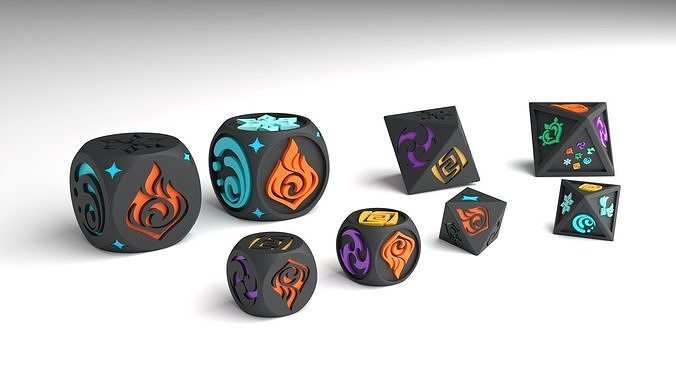
In GITAW's version of Cortex, there are 5 main types of Dice conflicts that require rolls. If a dice roll is not required to advance the narrative, then they typically will not be required. In other special situations, the GM may explain additional situational mechanics. Dice rolls do not have to be made for every single torch in a puzzle, every door, opening a chest, etc. In the same vein, you won't have to roll persuasion to get a better result from a market vendor. Instead, you'll need to make an actual Roleplay convincing argument to accomplish that. Only difficult challenges, conflicts, or narratively important tasks will require dice rolls. So in the given example, if the shopkeep is hiding an important quest item, then a skill check or contest may be required to get him to disclose it. Also, note that succeeding in a dice roll does not necessarily mean that the outcome will be exactly as you desire it to be.
1. Skill Checks
Whenever a character is trying to light an elemental totem, break a giant pile of rocks, follow a Seelie, etc they will need to roll their dice pool against a Gm's chosen difficulty DC set. This is usually a set of two static values of the GM's choosing. One for the minimum total value required, and one for the effect dice. In the case of unpredictable or living elements, (Seelies, animals, Timmie's birds, etc) these may be dynamically rolled by the GM. Generally, the effect dice won't matter too much, but certain skills will require elemental types like (pyro for torches, physical for rock piles, etc), or a certain value depending on how difficult the task will be to accomplish (ex: d8 for large rock piles, d6 for small rock piles). If you have a question about what you need to roll, it is better to ask than guess.
2. Contests
A contest is the purest and most intricate back-and-forth type of combat in Cortex Prime. It involves 2 participants engaging in a duel with one person being the instigator and another being the defender. Depending on the circumstances, the attacker will assemble their dice pool using their ATK or EM attribute (If attempting to trigger certain reactions) as well as one of each of their other applicable traits. If their opponent is currently suffering from any complications, the attacker may add those to their dice pool under certain conditions. Briefly, if you roll EM as your main stat then you may roll using applicable elemental complications while rolling ATK will allow you to use enemy physical or tactical complications [See Elemental Reactions For details]. The attacker then rolls their dice pool, selecting two dice to act as a total score, and one dice to act as their effect die. At this point, the defender does the same process except they roll DEF as their main stat while selecting their dice pool.
A unique opportunity occurs at this point in the contest after both parties have done their first set of rolls, where a third party may attempt to stop the contest. Doing so will cost at least one point of Elemental Energy per contestant with scaling depending on the GM ruling. This third party then rolls either ATK or EM and has to beat both total scores (the original attacker and defender) in order to stop the contest. If they fail, the contest continues as normal and the third party acquires complications from BOTH the attacker and defender according to their original dice pools rolled. If they succeed, they may describe how they successfully stop the contest from occurring.
If the attacker's total is higher than the Defender, they apply a complication to the defender according to their effect die and trigger any EM-inspired Elemental Reactions or SFX. If the battle situation is Dire or Critical, it may be the case that the attacker immediately wins the contest. In this scenario, the attacker gets to determine the terms of their opponent's failure and describe how they achieve victory over their opponent. If the Defender's total is higher than the Attacker two outcomes can occur:
1. The attacker forfeits the contest.
2. The attacker spends an elemental energy point to attempt a second roll to best the existing defender's roll.
If the attacker forfeits the contest, they get to narrate the terms of their own failure. This can include but is not limited to: surrendering away items/weapons/artifacts, applying complications or traumas to themselves, agreeing to perform an action for the defender an action, etc. If the attacker attempts a second attack and still fails to beat the original roll, or does not have enough elemental energy, they step up their trauma die in addition to the original consequences as if they forfeited. However, in this case, the defender narrates the terms of the attacker's failure. If you push your luck even with your advantage, you risk losing multiple valuable items your character can own to the person you failed to attack.
The contest ends when a character is forced out of a scene by complications stepping up beyond max HP, or there is a surrender/forfeit scenario from the original attacker. A contest between players cannot be used to abuse gaining Elemental Energy during sessions. If Celestia believes that you are initiating contests in bad faith, your visions may betray you and cause an elemental disaster that harms both players.
3. Mob Battles
Mob battles occur when multiple enemies combine together to form one large entity. If you think of boss battles as big powerful enemies with a few large powerful attacks, then a Mob is the inverse of that; Mobs are small, numerous weak enemies with numerous weak attacks that they will stack together. Mobs have a large pool of dice similar to enemies in mass combat that act as both HP and dice they can use to act. These mobs also gain several emergent abilities & SFX from the fact that they are a large Mob that they can use in addition to their "HP" dice. They'll attack multiple people at once, but their weakness is that they are susceptible to large reactions since they are essentially one big target. As you deal damage to the MOB, the mob will lose their "HP" dice and grow weaker. As the HP dice are removed, the mob dissipates and grows smaller until the enemies are dispersed. When that happens, no more mob!
4. Boss Battles
Boss battles are designed to be mean, unfair, and brutal. Bosses get numerous HP dice, unique SFX, and area-of-affect disasters to apply in their boss areas. Not all bosses are built the same; they are meant to be a unique experience. Some boss battles are designed to be repeatable as part of a character-upgrade experience ritual (e.x. Hypostases), but even those will be challenging. Bosses are designed to be fought against by 8+ players using smart elemental reactions. They will call upon/summon/create miniature allies, they will heal themselves, and they will do everything in their power to win. Some more cruel bosses will malevolently try to kill downed players, and others will be purely chaotic. Buckle down, remember your contest & mass combat rules, and be ready to take advantage of any & all weaknesses you can find. Almost all bosses will have moments to allow players to be heroic and change the tide of the battle. No pressure.
5. Mass Combat / Group Combat
Mass combat abandons the fundamentals of a contest and starts a chain of attacks and defenses. Unless SFX are in effect, the only rule regarding who you can attack is that you have to be within their general proximity.