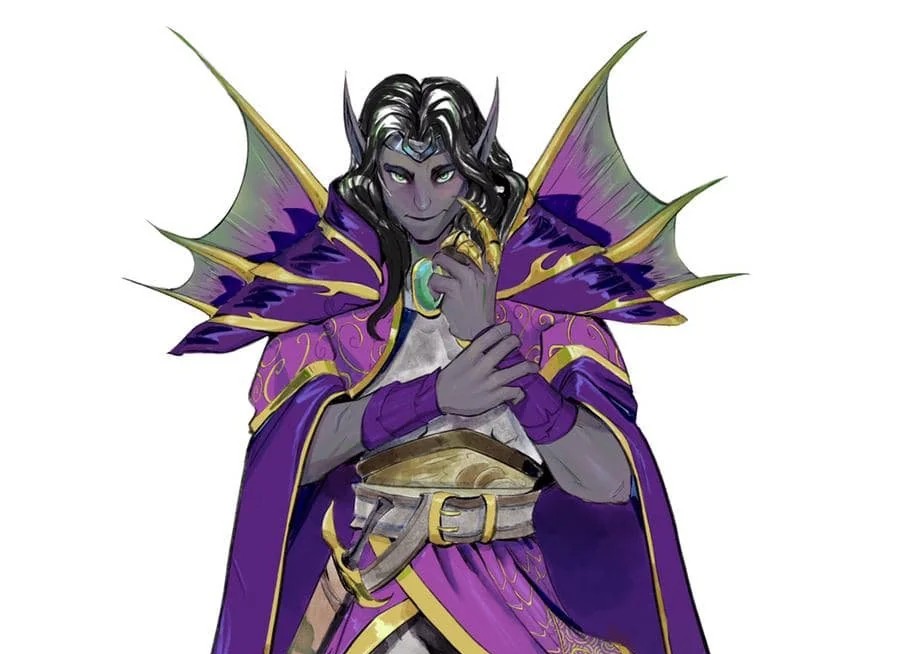
1. Characters

Neronvain

This character is dead.
The Jade Fang, The Forgotten Son, The Green Wyrmspeaker

“They say Neronvain could sing a truth so sweet you'd forget it was a lie. He died like he lived: smiling, apologizing, and slipping the dagger deeper.”
The Librarian

Neronvain, the Green Wyrmspeaker, was a creature of masks—courtly, divine, arcane, and mortal. Of all Severin’s inner circle, he was the most difficult to trace, the hardest to predict, and the last to be truly understood.

A bard of noble blood and abandoned legitimacy, Neronvain was the bastard son of King Melandrach of the High Forest, though unacknowledged by name. A child of scandal, he was reared in shadow and sent abroad in shame—gifted with education, but denied recognition. It was in this rejection that his heart soured. He turned his silver tongue into a serpent’s hiss, offering his talents to Tiamat in exchange for the one thing the elven courts never gave him: validation.

He received the Green Mask of Cunning and became one of the Cult of the Dragon’s most insidious weapons—its spy, its false diplomat, and, eventually, a sitting member of the Council of Waterdeep, unknown even to the Harpers.

Kanka is built by just the two of us. Support our quest and enjoy an ad-free experience for less than the cost of a fancy coffee. Become a member.

Early Life: The Unseen Prince

Little is officially recorded of Neronvain’s early years, save that he was educated in Silverymoon, apprenticed to a bardic college, and known in rumor as “the prince who performs in taverns.” He studied statecraft, religious ritual, and courtly subterfuge—skills which, when twisted, made him the perfect agent of sabotage.

Some believe his earliest contact with the Cult came through his studies of elven prophecy, and that it was he—not Severin—who unearthed the missing punctuation that reframed the Cult’s doctrine. Whether this is truth or legend, the fact remains: Neronvain was always three steps ahead.

Rise Within the Cult

Neronvain did not storm castles or rally armies. He infiltrated parliaments, temples, and private circles. His voice held divine resonance. His hands performed false miracles. With the Green Mask, he could charm dragons into compliance, infiltrate minds without detection, and impersonate nobles down to their handwriting.

During the early war years, he was responsible for:

  • Forging treaties with minor lords under false pretense
  • Orchestrating false-flag attacks between city-states
  • Recruiting Feywild denizens as scouts and saboteurs
  • Implanting sleeper agents in the courts of Baldur’s Gate and Neverwinter

His most insidious act came when he assumed the identity of a minor councilor and gained a seat on the Council of Waterdeep, listening to strategies meant to destroy his allies and leaking them to Severin.

He was unmasked during the Battle of Waterdeep, when his arcane disguise faltered amid Severin’s magical assault.

Confrontation and Death

Neronvain’s end came not in court, but on the battlefield.

During the assault on the Well of Dragons, he commanded a host of draconic shapeshifters and wyvern-mounted elites. There he faced his ideological counterpart: Valloth Dinvar, the Bronze Wyrmspeaker—whose sense of martial honor clashed violently with Neronvain’s endless sleight of hand.

Their battle was brutal, marked by illusion after illusion, trap after countertrap, until Valloth struck Neronvain with a divine burst that revealed every lie he had ever told in sequence, forcing the Green Wyrmspeaker to relive his own manipulations.

Broken and bleeding, he offered Valloth a final apology—whether sincere or another mask remains unknown—and died with a faint smile.

Legacy

Neronvain’s death was a public spectacle. King Melandrach, upon confirmation of his son’s actions, withdrew from court for over a year, and the High Forest remains deeply divided over Neronvain’s memory. Some blame the Crown for his fall. Others call him a demon in elven flesh.

His influence lingers in the blackmail archives of the Cult, many of which have still not been decrypted. Some fear his impersonations may continue posthumously—his face worn by others, his words never truly gone.

Closing Remarks

Neronvain never wanted a throne. He wanted to be known. Loved, perhaps, or even hated—but never ignored. In giving his voice to Tiamat, he found the audience his father denied him. It cost him his name. It cost Velkarn a generation of trust. And still, I wonder: when he said ‘I’m sorry,’ did he mean it?