Naniom Bridge
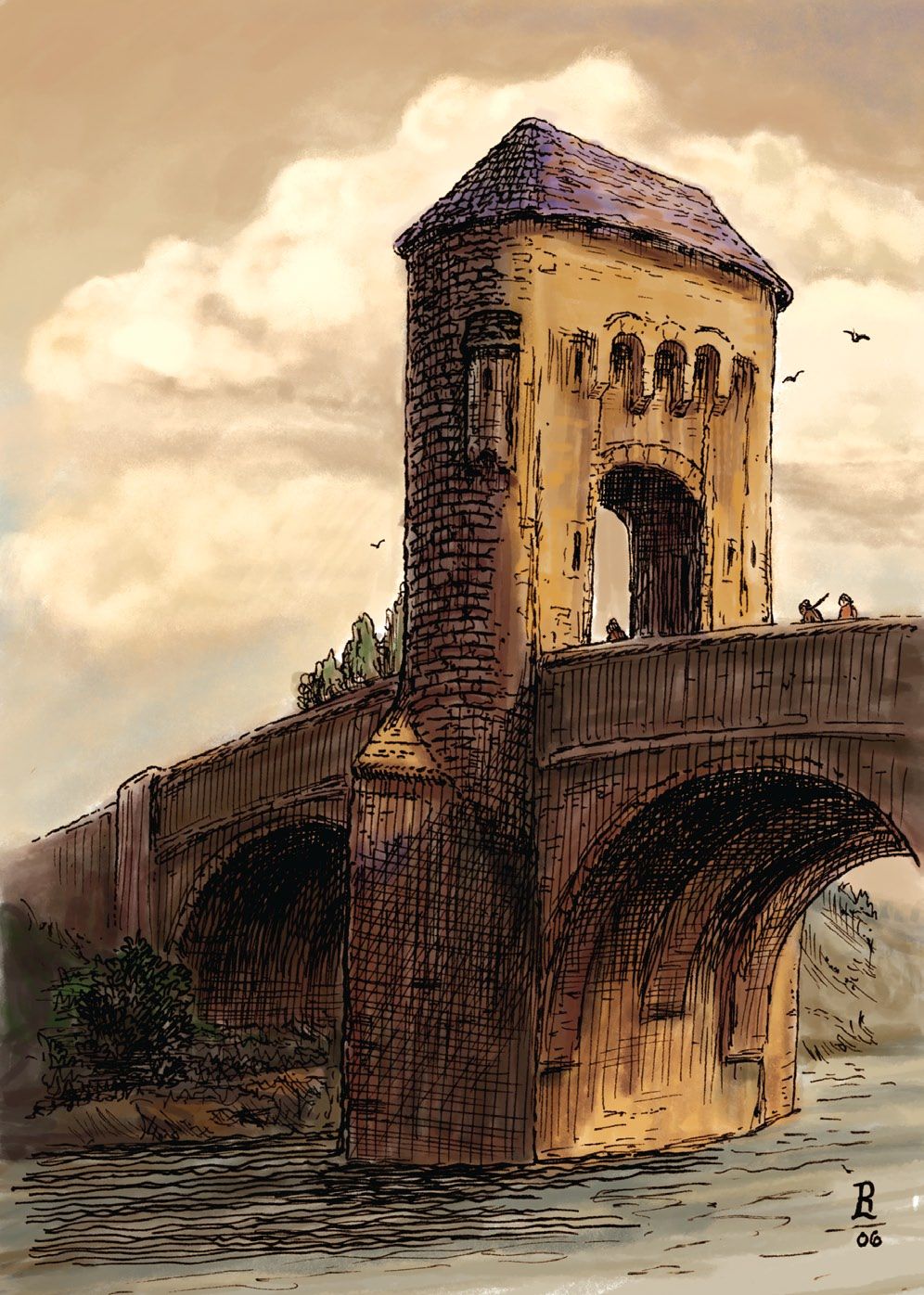
Naniom Bridge is the last safe stop until Zerhun. The bridge was built in the shadow of brooding, ancient forests and spans the deep, swift, glacier-fed Nephen. Two large commons for assembling caravans are on the east bank. Travel beyond Naniom Bridge by cart is impractical so goods are transhipped here to mule trains. Rumors of barbarians, brigands, and gargun have many teamsters unloading their carts as quickly as possible and hurrying back across the river. Tough, hard-bitten Silver Way veterans view these jittery lowlanders with scorn and often play cruel jokes on them.
The original bridge is of Khuzan origin, although parts have been rebuilt many times. Clan Curo of Gardiren nominally held the bridge until 603 but it is now held by the crown and administered by the Sheriff of Neph from Getha. The sheriff ’s control over the crossing is tenuous, although he has plans to fortify the site if the king allows it. The bridge is sometimes used by local nobility as a field of honor, generally at the ancient swordstone on the west side.
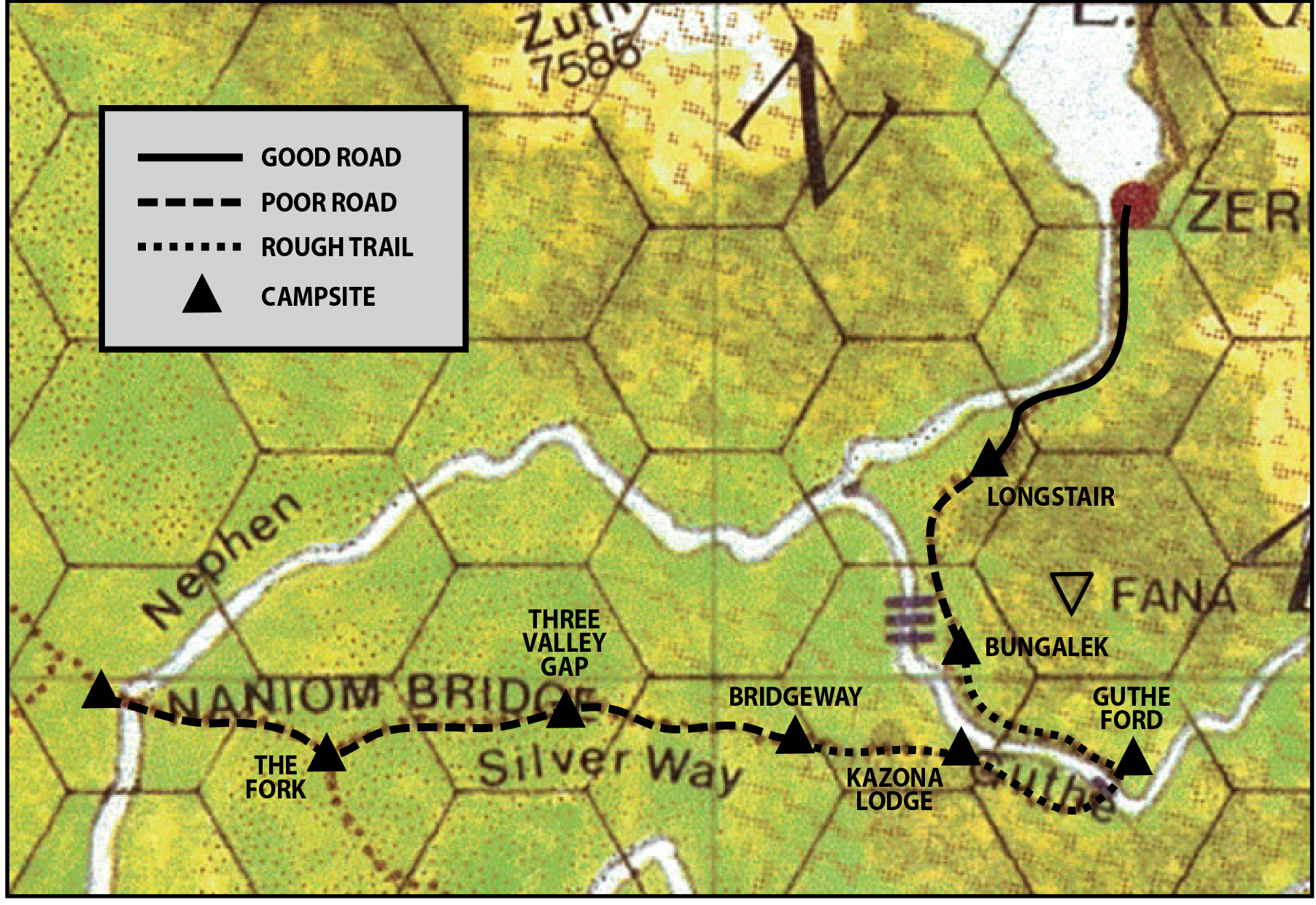
The trip from Naniom Bridge to Zerhun is 42 leagues. In good weather, the trip takes eight days but poor conditions can make it ten or more. Once the caravans have formed up at Naniom Bridge, they head east over the Khuza Gap. The first day’s goal is the Fork, where the Silver Way meets the Vemion Road.
The Fork
The first caravan stop is just under five leagues from Naniom Bridge, an easy two-watch trip for the pack animals. The trail ascends to cross the Khuza Gap then descends into the Doxandra Valley and halts at a road junction known simply as “the Fork.”
The southern trail is the Vemion Way, a shortcut to Vemionshire that has been used for centuries. This trail climbs over the Tzala Pass and crosses the Selene River by ford to Nenda Keep. The entire area east of the Nephen River and north of the Selene River comprises Vemionshire’s Thicesund Forest Hundred but the Sheriff of Vemion provides no protection. A small company of Uthriem Roliri watch over caravans traveling the lower portion of the route from the Fork to Guthe Ford.
There is often a smaller caravan from the south waiting at the Fork to join the main caravan. The road junction is near the Doxandra River, where a good ford with a solid gravel bottom provides clean water for the animals and men. It is passable almost year round. A large cleared campsite is located at the Fork. Years of passing caravans have cut down trees for firewood. The clearing is now a meadow, making ambushes difficult and providing fodder for the mules and horses.
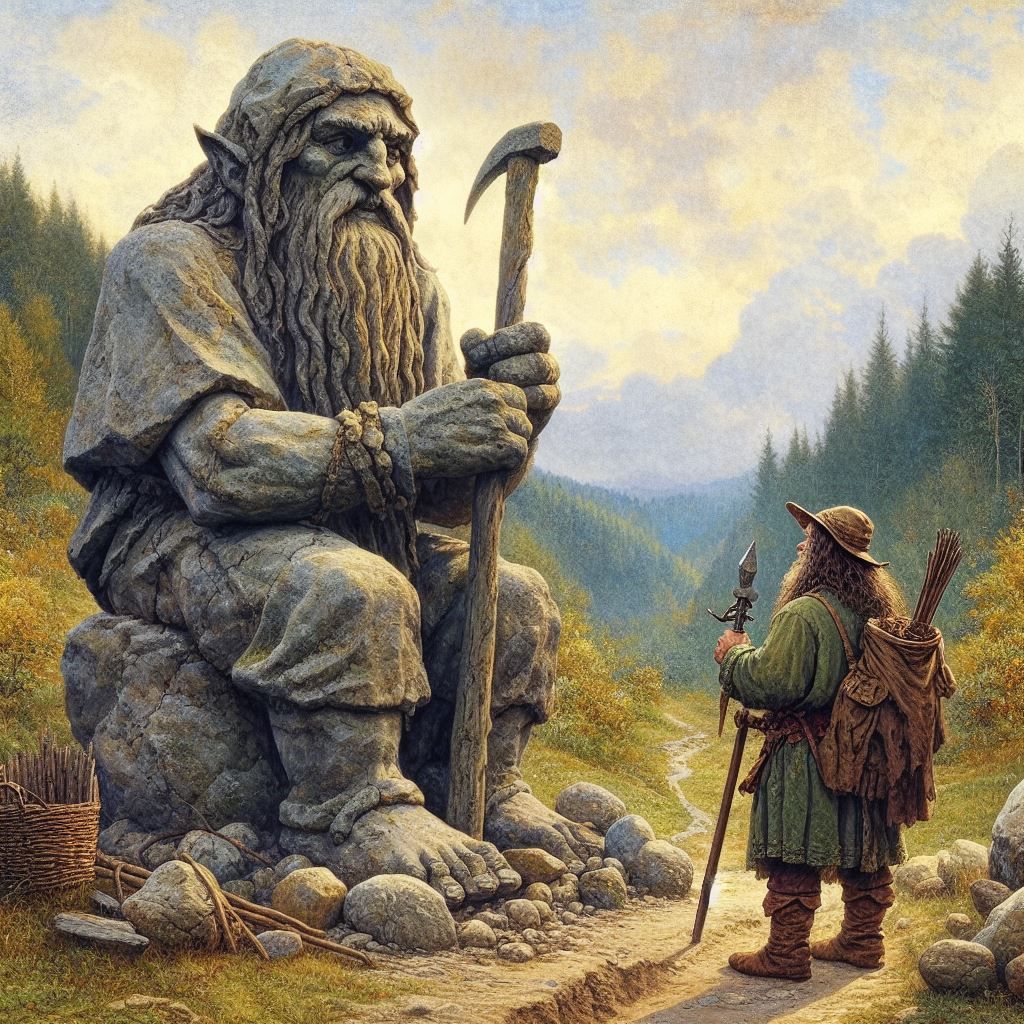
Marking the trail to Azadmere is a stone statue of a Khuzdul miner. Veterans call it “Digger” and often pat it for luck as they leave the campsite.
Three Valley Gap
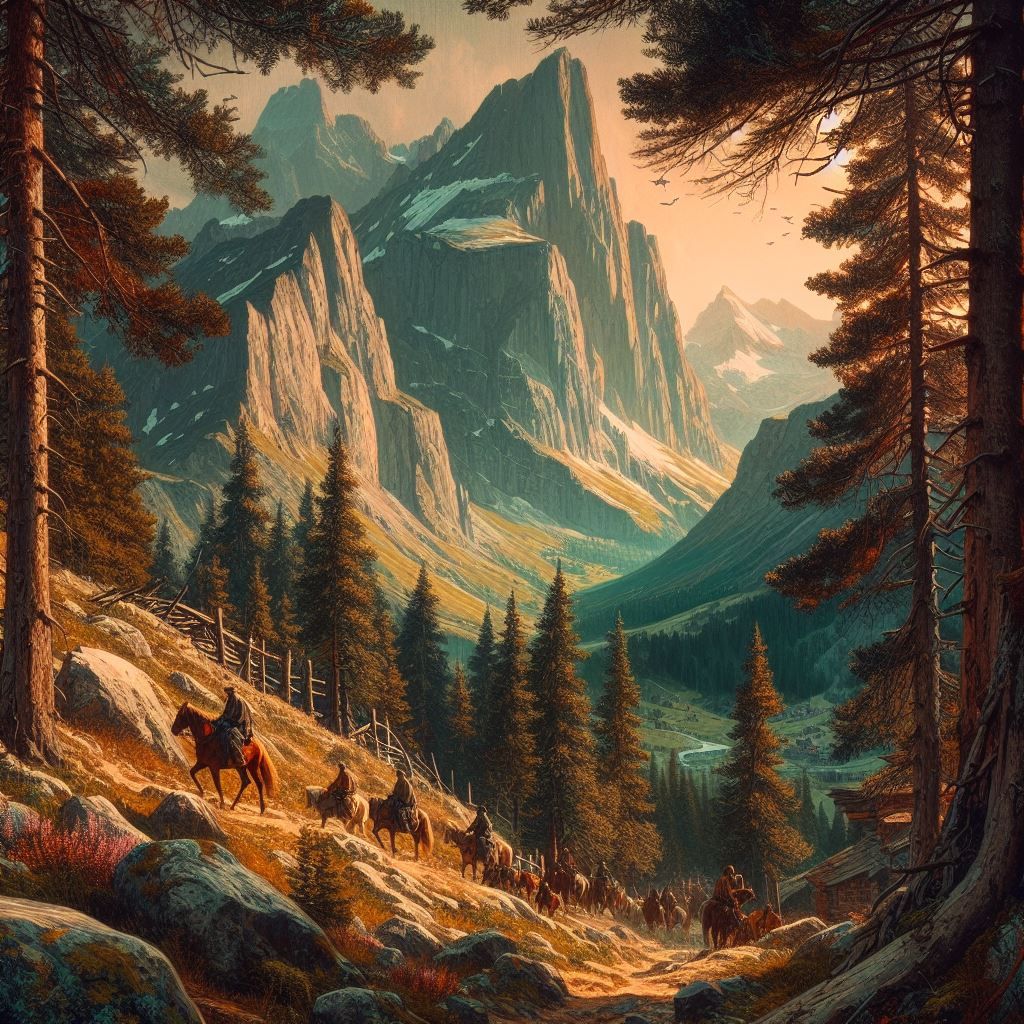
The next camp is six leagues east from the Fork along a well-maintained trail that rises up and over Jaza Pass. The pass is wide and relatively flat and has good pasture for a midday rest and meal. The trail then descends to a campsite named Three Valley Gap after the Belimar, Uzo, and Rozika valleys. This camp is a frequent target of brigands, who use darkness and forest cover to steal whatever is left unguarded. Caravan bosses insist on strict security and regular watches. The watches are often doubled during the darkest nights when the sky is overcast or moonless.
Bridgeway
The third stop on the eastbound trail is five leagues up and over the Hkada Pass. The campsite is set in a large meadow on the south bank of the Gola River. There is good water and grass early in the season but within two months the meadow is usually badly trampled and sometimes bare.
A trail leads north to a Taeldan village at the junction of the Nephen and Guthe rivers. Tribesmen often visit this camp to trade furs and rare herbs for metalwares. The abandoned old King’s Road continues straight ahead down the Gola Valley to the ruins of Guthe Bridge. The old road is now used only by the Taelda because the Guthe River is deep and impassable at this point.
Bridgeway is the end of the easy portion of the Silver Way. Known as the Low Road, the trail from Naniom to Bridgeway is relatively good. Grades never exceed one in ten. In several places, it is obvious that rock has been cut away to make the route straight and the slope gentle.
From here, the Silver Way now becomes a narrow, steep, and treacherous trail as it climbs into mountains the gargun of Fana consider their homeland. Mulejacks take the opportunity to do a final check of all loads and harnesses. The men call the stretch from Bridgeway to Longstair “the Gargun Gantlet.” Heavily guarded caravans are rarely attacked but small parties journey at considerable risk. Weapons are best kept close at hand at all times.
Kazona Lodge
The six-league trek from Bridgeway to Kazona Lodge is a hard day’s work. The trail winds its way southeast, rising through dense forest over the steep Guthe Gap. The rough terrain often divides the caravan into smaller groups that are more vulnerable to surprise attack. Guards are constantly on edge. Scouts from Fana shadow every caravan. Poorly defended caravans can expect a war party.
Kazona is a poor campsite, sited on a narrow stretch of level meadow along a swift river, closely surrounded by mountains. Forage is scant and a thirsty mule is sometimes swept away over the nearby Kazona Falls that plunge 130 feet into the Guthe torrent. Many incautious travelers have met a similar fate over the centuries. Mule picket lines must stretch along the river rather than form an easily guarded circle and the encroaching terrain and vegetation severely limit fields of view. To maintain security, half the men must be on guard at all times. Everyone sleeps with their weapons at the ready.
The campsite takes its name from an ancient Khuzan hunting lodge dug into the mountainside. Kazona Lodge has several large storerooms and connecting tunnels. Supplies for a mule train are stored here for retrieval on the way down, avoiding the need to carry everything all the way to Zerhun and back. The lodge’s two massive iron doors, scarred by repeated break-in attempts by gargun, are secured with a strong Khuzan lock. The lodge is used by the Uthriem Roliri, a mysterious brotherhood of Siemist rangers who have the only key. The Prince of Zerhun granted the lodge to the brotherhood in exchange for their monitoring of the Silver Way. The brothers rarely stay here in summer but ensure the lodge is open and ready for each caravan. Most veterans of the trail have heard of the Brotherhood of the Forest but very few have encountered them. Most travelers assume Kazona Lodge is still operated and maintained by the Prince of Zerhun.
Guthe Ford
From Kazona Lodge, the trail rises, traverses the north flank of Mount Harinal, then drops quickly on a switchback trail to the Guthe Ford. Several sections along the descending trail are only four feet wide.
The Guthe Ford is the lowest point where the bitterly cold Guthe River is fordable. The ford averages three feet deep during the summer and fall but is always several feet higher in the spring or after a very heavy rain. Due to the swift current, a strong rope must be strung across the river for the men to hold as they cross. The mulejacks also lash the animals together in long trains of 12 or even 18 mules. Every year, the current deposits rocks and debris that block the ford. The Order of the Lady of Paladins arranges for workers to clear the debris to open the ford in the early spring but the first few caravans are often delayed a day or two removing more debris.
The Gargu-viasal of Fana are a constant menace at the ford. The Baron of Habe’s mounted Jarin scouts patrol from Zerhun down to the ford and the Lady of Paladins patrols from Naniom Bridge to the ford. Both groups send outriders well ahead of the main force.
The campsite on the north bank of the ford is welcome after the tiring crossing. The Order of the Lady of Paladins keeps the trees and brush cut back for at least 200 yards, creating a large, open field with good grazing and visibility.
The wealthy Lady of Paladins chapterhouse at Jenkald (near Getha) regularly sends patrols along the Silver Way in search of gargun and brigands. In 704, with the help of chapters from Yaltako and Vadan, the order destroyed a large gargun swarm in a glorious battle near the Guthe River. Afterwards, the Earl of Balim made a large donation to the order in support of their efforts to keep the Silver Way open. Mounting an expedition against Fana to root out the gargun, perhaps with support from the Khuzdul, is a common subject for debate among knights deep in their cups.
Bungalek
The Guthe River is impassable below the ford, surging through a narrow gorge that is more than 600 feet deep. The Silver Way follows a narrow ledge along the north bank, gradually rising as the river descends, churning with whitewater. The ledge gets narrower as the mountain creeps closer to the canyon’s edge.
Opposite and overlooking Kazona Falls is Mulejack Leap, a granite bluff with a vertical face almost 1,600 feet high. The gargun of nearby Fana occupy an ancient Khuzan watchtower atop the bluff that gives them a commanding view up and down the Guthe Valley.
Two leagues beyond Mulejack Leap, a swift, shallow stream descends from Fana. Known by the Khuzdul as Dufana and by the orcs as Bungalek, this gargun sewer is always crossed with extreme caution. The Dufana crossing is a favorite point for a gargun ambush. They usually wait until about half the caravan has crossed before attacking the rear group. The gargun king Gravargetuk avoided bloodshed for a few years by simply demanding a toll of meaty draft animals that was willingly paid. This has not happened for three years; Silver Way veterans assume “Old Gravy” became a garnish in a Sorkin Blue stew. The Bungalek campsite has a remarkably lush pasture.
One league northwest of the campsite, the gorge narrows to just 40 yards. On either side of the narrows are the remains of bridge abutments. This was the site of the spectacular Guthe Bridge, a massive two-lane bridge that stood for more than five millennia, a great testament to the skill of its builders. Several large cut stones are still visible in the water below, where they constrict the river to produce a raging rapid. On the opposite side of the canyon are the remnants of a gatehouse. Campfire tales tell of a Khuzan complex below the gatehouse protected by a deadly guardian.
Rebuilding Guthe Bridge has been the dream of mercantylers for many years. This would shorten the trip to Zerhun by 12 leagues (two days) and significantly reduce losses to brigands and gargun. However, even if the huge cost of such a project could be financed, getting permission from the King of Azadmere to build a new bridge might be difficult.

Longstair
Except for the occasional storm and gargun raid, the next seven-league section of the Silver Way is relatively good traveling. After the ruined bridge, the road enters “The Cut,” the most spectacular part of the trip. The Silver Way clings to a ten-foot-wide ledge hewn into the wall of Guthe Gorge, 100 feet above the turbulent river. The Cut is almost two leagues long, built five millennia ago when it reputedly took 50 dwarven workers more than 100 years to build. The road is relatively safe but forms a dangerous choke point with no retreat after entering the Cut. In 708, a small caravan was ambushed when gargun attacked them from both ends at once. Only the arrival of the Baron of Habe’s mounted scouts prevented complete annihilation.
After leaving the Cut, the Silver Way fords Juryn Stream, where the midday rest and meal are generally taken. The trail then climbs up and over Kazhar Ridge on the Longstair. This two-league-long section consists of broad steps cut into the rock. The steps are four feet wide, two feet deep, and six inches high, making for easy climbing. The stairs have carved stone wheel ruts on either side, five feet apart, but these are now mostly filled with dirt and weeds. The Khuzdul know that these ruts were carved to fit the “King’s Carts.” The center of the steps now have shallow depressions worn by thousands of tramping mules. There are wider areas about every 500 yards to allow passing and resting. An alternate trail, longer but somewhat easier in wet weather, loops north to overlook the great Kazhar Gorge.
The northern end of the stairs has a camp on the Axxon River maintained and guarded by Jarin scouts. The scouts patrol the road to Zerhun daily and provide escorts from Guthe Ford in caravan season. They are always a welcome sight, especially for caravans that have been harried by the gargun. Arrival at Longstair Camp northbound is a cause for much celebration, as it heralds the last night on the trail.

Zerhun
The last day’s travel is from Longstair to Zerhun. The Axxon is crossed by Little Bridge, a ten-foot arch that represents the southern end of the good road maintained by the dwarves. This section of the Silver Way is constructed of hard-packed gravel and stone chips, compacted regularly with a stoneroller hauled by oxen. Every significant stream is crossed by a stone bridge or culvert. Although this stretch of the Silver Way is considered safe, prudent caravan masters relax only when the last mule is through the gates of Zerhun.
Deep in the woods along the road are overgrown ruins of once-thriving Jarin manors. This area was one of the kingdom’s most fertile farming regions until the fall of Fana in 135 forced the Jarin to retreat behind the defenses of Zerhun. The structures and fields vanished beneath a tangle of overgrowth and trees. If Fana were recaptured and the surrounding area cleared of gargun, the area would again be very valuable.
King’s carts are still used on this stretch of the road. Pulled by a single mule, they have a box four feet wide and six feet long between two huge wheels five feet apart. A dozen or more of these meet with each northbound caravan at Longstair Camp and loads are transferred from mules showing signs of lameness. If sufficient carts are available, caravan masters like to turn around at Longstair, which saves them two days on the trail.