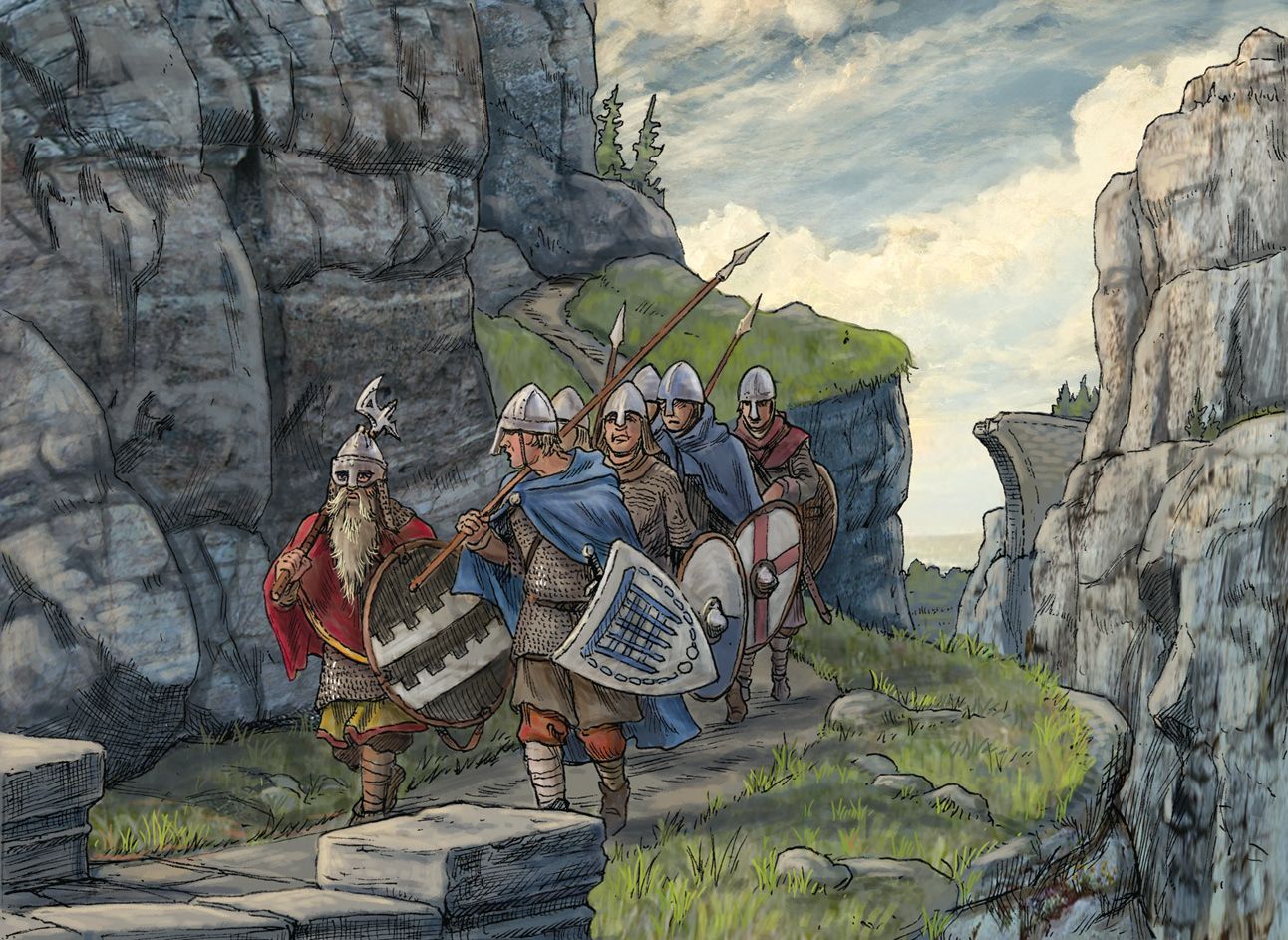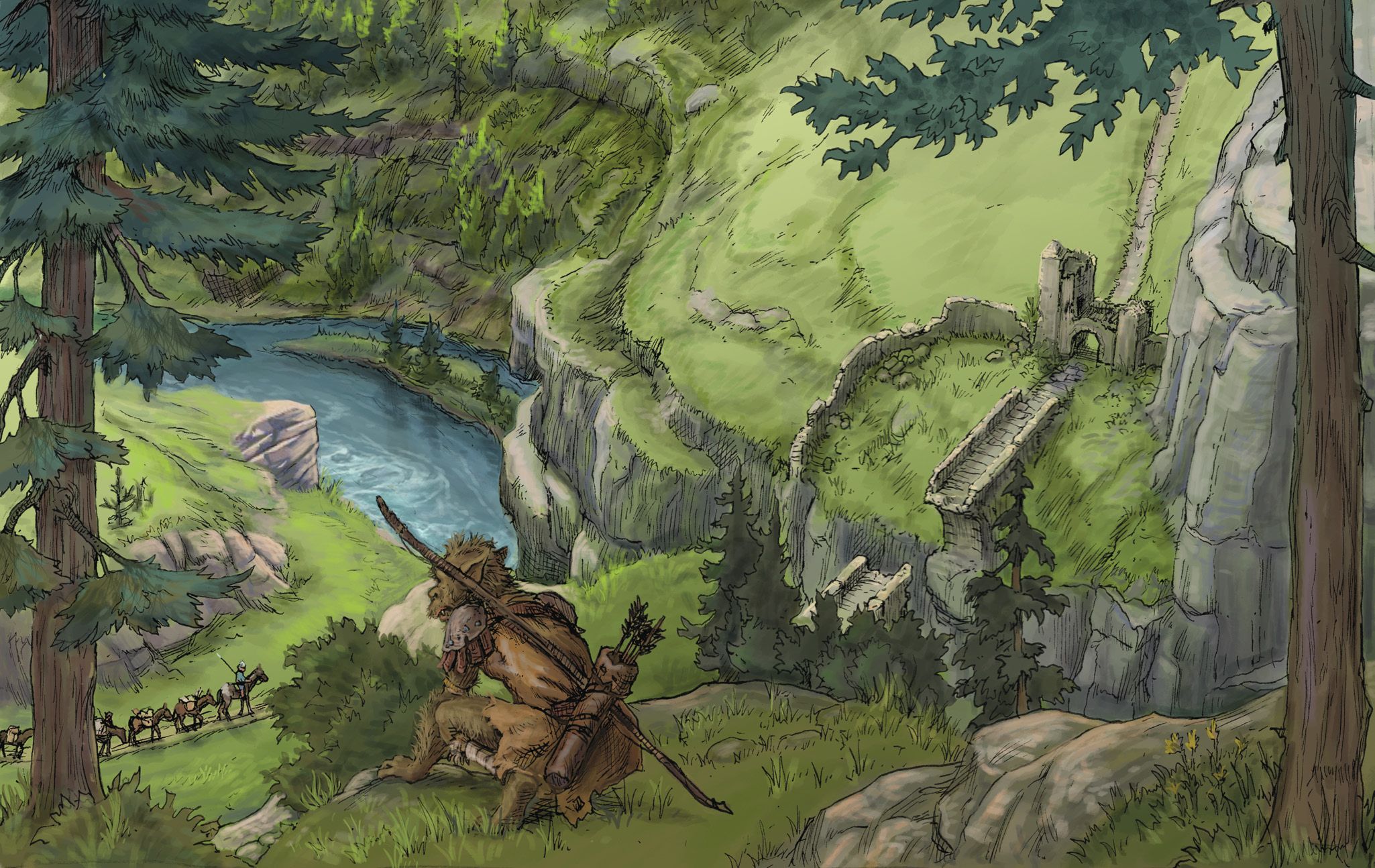
The Khuzdul of Hârn founded two large cities, Kiraz and Azadmere, around 7000 BT. The two were widely separated and travel between them was difficult and uncommon. Over time, Khuzdul scouts blazed a trail east from Kiraz, around the Rayesha Mountains, down the Kald valley, across the Shem and Nephen rivers, and finally up through the Sorkin Mountains to Azadmere. During the Codominium, the Khuzdul established mines, settlements, and outposts across much of Hârn, most near valuable ore deposits. The need to skirt the Guthe Gorge and ford the icy river impeded trade and restricted the import of valuable but heavy ores to Azadmere from the far-flung network of mines.
In 5000 BT, King Naruk III commissioned Clan Orinain to build a road suitable for carts from Azadmere to the lowlands. Construction of this “King’s Road” took 200 years, a moderately long project in Khuzan terms. The existing road was widened and several small bridges and culverts were built. Long, shallow staircases were built to ease the steeper grades along the Guthe Gorge. A ledge now known as “The Cut” was hacked into the wall of the gorge to reach the narrowest point of the canyon. It was there that the Khuzdul built the bridge.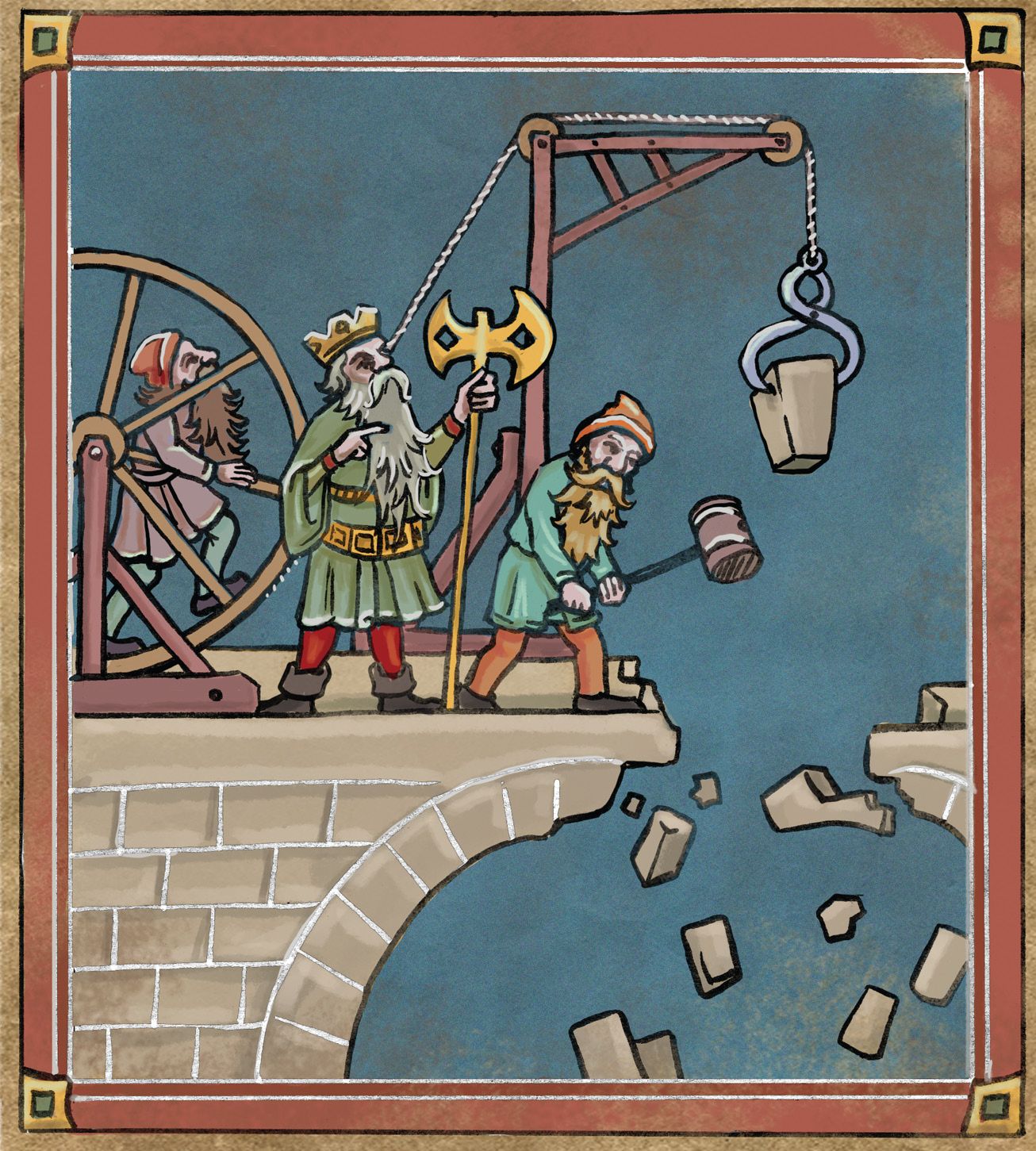 Guthe Bridge was a simple single-span stone arch roughly 100 feet above the river. It was about 120 feet long from cliff to cliff and two lanes wide. The bridge was built with local stone from quarries, now overgrown, on either side of the gorge. Its construction took 12 years.
The King’s Road continued down to the Nephen River, where the Khuzdul constructed Naniom Bridge. This second bridge was longer and had four arches, although each arch had a shorter span than Guthe. The completion of the two bridges and a road suitable for carts greatly eased access to Azadmere’s mountain fastness. Two hunting lodge waystations near Naniom
Bridge and an underground kyg (outpost) at Guthe Bridge provided accommodation for passing caravans.
After the Battle of Sorrows in 683 BT, the Sindarin King Aranath renounced sovereignty over Hârn. The Khuzdul withdrew into their mountain strongholds, destroying or concealing much of their network of settlements, mines, and outposts as they retreated.
In 663 BT, a large Lythian force, emboldened by the withdrawal of the Elder Races and enticed by tales of the riches of Azadmere, marched up the King’s Road. Although the kyg at Guthe Bridge was believed to be impenetrable, the recently completed outer defenses were not so secure. The barbican was protected only by a simple gatehouse and the 12-foot walls lacked even a basic moat. The Lythian leader realized he didn’t need to take the kyg, just the bridge. His forces swarmed the barbican, scaling the walls with ladders in dozens of spots. At the same time, men who had been sent around the back side of the hill containing the kyg were lowered from the top of the cliffs on ropes. They used large shields to block the arrow loops and prevented the defenders inside from supporting the barbican. After overwhelming the barbican, the victorious Lythians piled boulders in front of the kyg’s main entrance.
With the remnants of the Guthe Bridge garrison isolated and trapped, the Lythians charged up the King’s Road. Warned by their Jarin allies and using the time bought by the Guthe Bridge defenders, the Khuzdul evacuated their human subjects from the Barony of Axxon and marshaled a large force, mostly veterans of the Battle of Sorrows. Concealed in the mountains
outside Zerhun, the Khuzdul warriors waited for the enemy to pass. As the Lythians massed in front of Zerhun and prepared for battle, the hidden Khuzan army struck, pinning the invaders against the mighty fortification. The slaughter was complete.
After the victory, the king and his advisors debated at length whether to rebuild and strengthen the fortifications at Guthe Bridge. They decided instead to seal the kyg and collapse the bridge, knowing that doing so would make it extremely difficult for the Lythians to bring enough troops and supplies to seriously threaten Zerhun. The winding, narrow path via Guthe Ford would force attackers to spread out in long, vulnerable strings of men and mules, making them easy to attack.