The Nudelman-Rikhter NR-30 is a Soviet 30mm autocannon that was widely used in military aircraft of the Soviet Union and its COMINTERN allies. It was designed by A.E. Nudelman and A. A. Rikhter, entering service in 1954, essentially an enlarged version of the Nudelman-Rikhter NR-23. The NR-30 fired a new 30 mm round that weighed more than twice as much as the NR-23’s round, and had a higher muzzle velocity and rate of fire. This weapon was created to bridge the gap between its lightweight, rapid-firing predecessor and the hard-hitting Nudelman N-37 37mm cannon, thus preventing logistical issues derived from fielding two autocannons in the Soviet fighter fleet. Its performance, price and market demand is similar to that of contemporary hard-hitting autocannons such as the British ADEN Cannon.
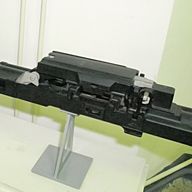
Nudelman-Rikhter NR-30
Abilities
Common Attributes - Mechanical
Auto
This weapon is fully automatic, either inherently so or by the presence of a selective-fire mechanism.
EFFECT:
This weapon can fire more than one shot each time it is used, specifically, in bursts. A penalty is applied depending on the burst size, to simulate recoil. The number of shots in a burst is different for certain types of weapons.
- Light Automatic Weapons (Handgun ⚡, Submachinegun ⚡, Assault Rifle ⚡, Battle Rifle ⚡, Carbine ⚡, Shotgun ⚡, Energy Weapon 💡, Bow 🏹, magazine-fed Light Machinegun ⚡)
- Heavy Automatic Weapons (belt-fed Light Machinegun ⚡, Heavy Machinegun ⚡, Autocannon ⚡, Grenade Launcher 💣, Anti-Air Gun 💥, Anti-Tank Gun 💥, Mortar 💥, Naval Gun 💥)
| Light Automatic Weapons | Heavy Automatic Weapons | Penalty | Penalty (Stable firing platform) |
| 5-round burst | 20-round burst | NONE | |
| 10-round burst | 50-round burst | ||
| 20-round burst | 100-round burst |
Automatic weapons are considered stable when they're mounted on a vehicle, tripod or turret. This is different from the Stabilised SA.
Do note that penalties from firing at long-range apply as per the Basic Rules (TBD).
It is impossible to perform automatic fire at a target that is at Very Long Range (VLR) or Extreme Range (EXR) without a stable firing platform.
Belt-Fed
EFFECT:
This weapon is not fed from fixed capacity magazines, but from belts which can be made as long or short as needed.
Most machinegun belts contain 50, 100, 200 or 250 rounds. Some vehicle belts, however, can be way longer.
Unless specified otherwise, assume all small arms belts to be of 100 rounds.