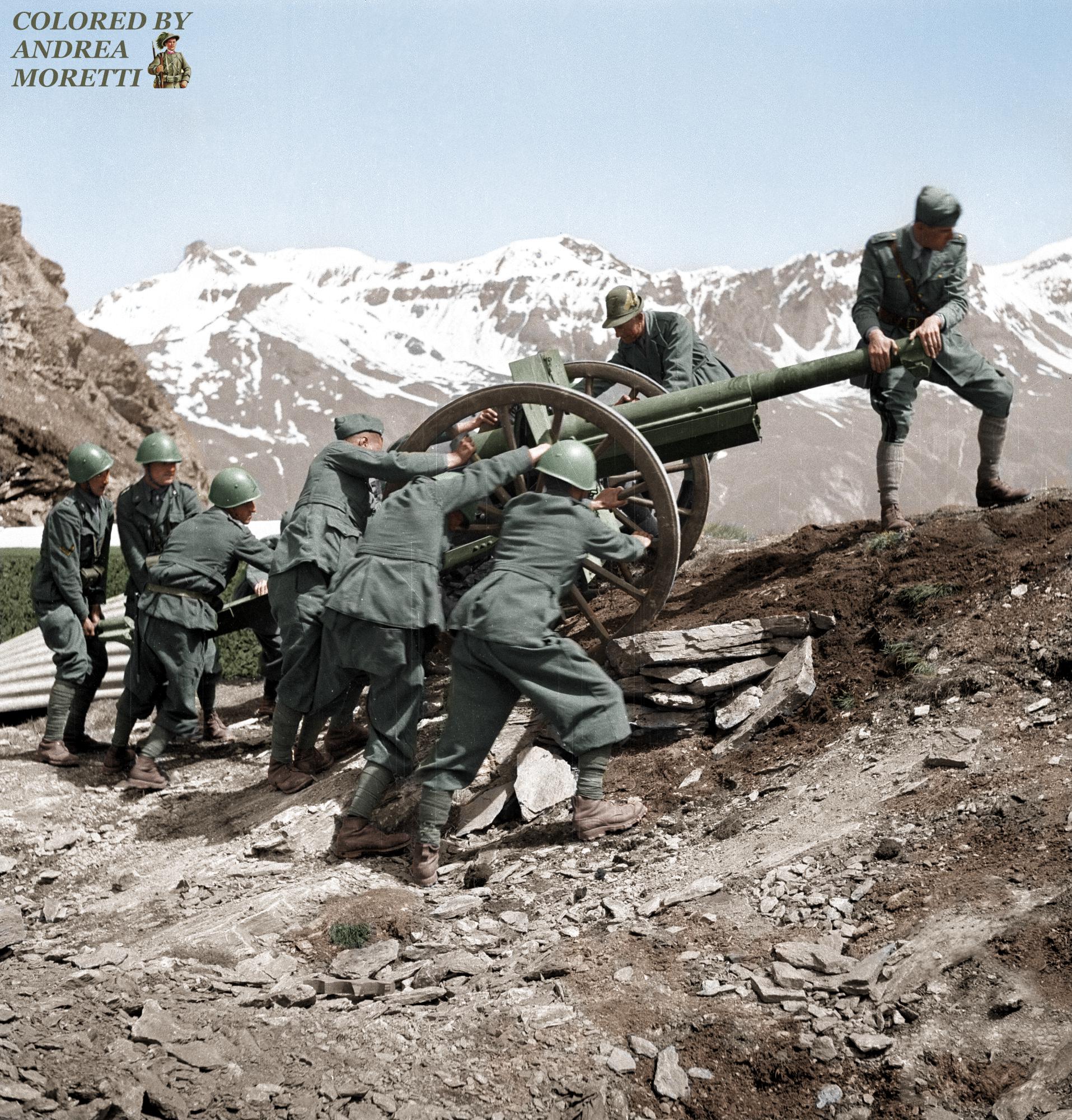
The Franco-Italian War was a short but politically transformative conflict fought between the The Kingdom of Italy and The Republic of France from November 1930 to January 1931. It marked the first military campaign of Neosocialist France under Marcel Déat and Jacques Doriot and the last war Italy would fight without the backing of a continental bloc.
By the late 1920s, Italy’s diplomatic position had eroded. German influence in Europe was overwhelming, yet Berlin’s strategic priorities lay in defending its industrial heartlands and consolidating its empire in Africa. Italy, under Benito Mussolini’s fascist regime, remained aligned with Germany out of necessity, but tensions simmered over Berlin’s unwillingness to guarantee Italian claims along the Franco-Italian border. Mussolini's government had also taken a firm stance against German corporate interests and pursued a policy of economic sovereignty that isolated it from Berlin's industrial tycoons, influential as ever over the Empire's politics.
The collapse of the French Hohenzollern monarchy in May 1930 fundamentally altered the strategic equation. The Fourth French Revolution replaced the German-aligned royal government with the ultranationalist, ultramilitarist neosocialists. While nominally socialist, Déat and Doriot’s movement fused revolutionary rhetoric with ultranationalist revanchism, proclaiming that “France shall reclaim her violated frontiers, no matter the cost.” The French government immediately identified the German occupation of Alsace-Lorraine and the Italian control of Dauphiné and Provence as intolerable violations of national sovereignty. With the French Red Army reorganising under a new neosocialist doctrine, Paris prepared for war.
On the 9th of November 1930, without a formal declaration, French forces crossed the border into Dauphiné. Italian border garrisons, understrength and poorly equipped for winter operations, were rapidly overwhelmed by seemingly suicidal mass infantry assaults, using new and novel tactics such as suicide bombers, troops dressed as civilians and a concurrent massed partisan uprising that, from the point of view of Italian command, materialised from nowhere.
Rome expected Berlin to intervene under the terms of the Triple Alliance. Instead, the German Foreign Office issued a vague statement urging “both parties to seek a negotiated settlement” and privately instructed the Deutsches Heer to remain at full readiness but not to commit forces. It was evidently obvious that they would not do anything, and they could not either way, for most of Germany's attention was tied in the First Colonial War and intervention would certainly mean Soviet invasion. Mussolini, blindsided and furious, realised that Germany would not risk war with France over Italy’s territorial holdings.
Through the winter of 1930, the Italians fought a series of defensive actions along the western Alps. The terrain slowed the French advance, but Italian supply lines were in chaos, made worse by relentless partisan attacks and terrorist bombings. Mussolini ordered the emergency mobilisation of reservists, while the Regia Aeronautica launched bombing raids on French supply depots. These raids caused disruption but did little to slow the French offensive. By January 1931, French forces had broken through the last Italian defensive lines in Dauphiné and Provence. The fall of Nice to French troops was the final blow to Italian hopes of holding the provinces. Public morale in Italy collapsed, and Mussolini, under pressure from the Grand Council of Fascism, authorised negotiations.
On the 29th of January 1931, Italy and France signed the Treaty of Geneva, where Dauphiné and Provence were formally returned to France. The treaty humiliated Rome and emboldened Paris, which now viewed itself as the vanguard of a new European revolution. Mussolini, however, recognised Italy's shortcomings during the war and that France was now an existential threat to the very concept of an Italian nation. As such, mass rearmament was ordered, with every man and woman in Italy sure that a new war of apocalyptic proportions would soon come, and that the Franco-Italian War had just been a brief rehearsal.