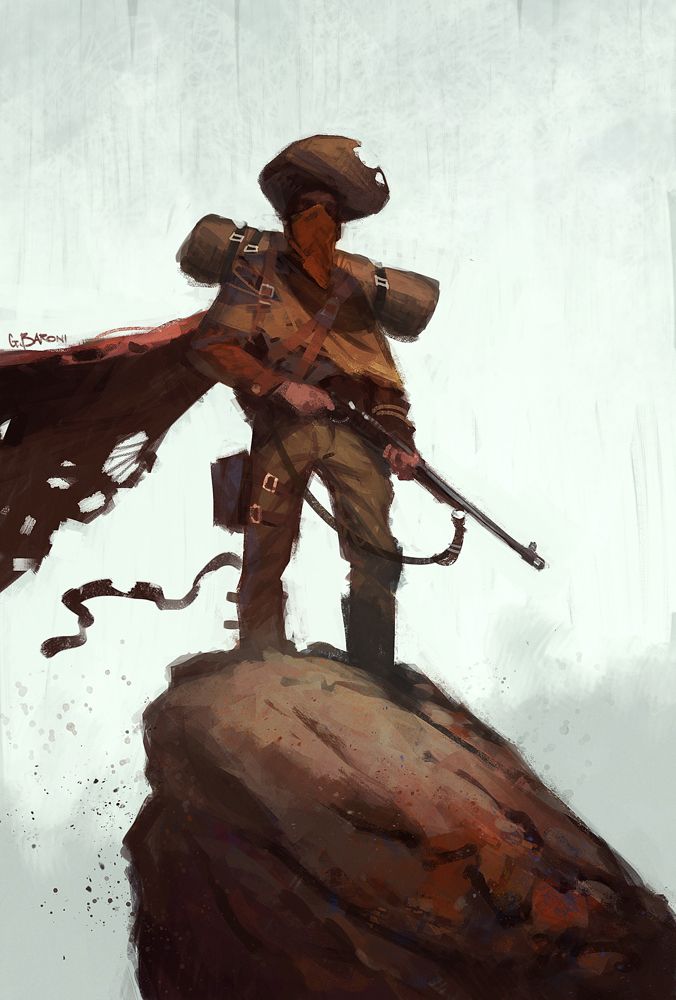
The Oceanykan Federation is a wild place. Borders change, great beasts migrate, new ruins are discovered and wars are waged. For as long as civilisation has existed on the continent, so have adventurers: at times scouts, mercenaries, archaeologists, detectives, guards, exterminators or bounty hunters, always ready to risk their lives for a day’s pay.
The traditional meeting place for these men has always been the guildhouse. Before British colonisation, there were many types of guilds, and there was a distinction between guildhouses; hence, it was referred to as an “adventurer’s guildhouse”. As the guild system collapsed and was replaced by free market capitalism, only the adventurer’s guild survived, and its establishments became the only guildhouses. Other contemporary "guilds" are, in reality, closer to worker-owned corporations, and are typically referred to as "cooperatives". These places act as pub, restaurant, inn, infirmary, bank and job listing site for adventurers, which can be either temporary or registered.
Temporary adventurers are not regulated and typically take up local low-paying jobs. Registered adventurers have signed up with the National Adventurer’s Guild, are subject to greater oversight and are typically offered riskier jobs which require institutional trust. They also have significant social benefits with access to cheap guild healthcare, food, beds and credit. The National Adventurer’s Guild claims to only act as a link between independent parties or individuals and private entities; as such, it is not uncommon for warring factions or competing interests to post up jobs or request temporary contracts with adventurers, which might face each other in combat. This is considered part of the job and rarely results in grudges. When facing each other in combat, adventurers typically spare each other’s lives and provide first aid. These niceties are not normally offered to other combatants, as the Geneva Convention is more of a checklist in Oceanyka.
Jobs listings are considered contractual under Oceanykan law; failure is typically due to death or grievous injury, but if not, fines are issued. Some jobs require the completion of one or more objectives; others simply require the services of adventurers for a specific period of time. Any completed job demands proof, which can be an object, a body part, a signed document or, preferably, a Polaroid photograph, and can be checked in at any guildhall in the country to receive the corresponding reward. The guild is extremely strict with job completion proof, which is why a Polaroid is preferred, but an analyst, a coroner or a notary is always at the ready to verify the validity of any submitted proof. Trying to trick the Guild in these matters will quickly result in a retaliatory quest for one's head. Quests are agreed upon and signed using the Adventurers' Guild Quest Contract Form.
All adventurer jobs are inherently dangerous, but some are far more so than others. Guild listings utilize a standardized visual shorthand for lethality, called the Quest Hazard Rating (QHR). Hazard Skulls (1-5) represent mundane threats: banditry, wildlife culling, or escort through contested territory. Beyond this lies the Red Hazard Skulls (6-10). A Red Hazard Skull job is essentially a small-scale war; the Guild mandates that registered parties must possess sufficient men, experience and war materiel before the contract is even released for signing.
Purple and Black Hazard Skulls are a similar classification, though jobs with these are only discretely offered to Secret Society Trackers, and they likely involve facing a monstrous Cryptid 🐲 or perhaps even an Eldritch Creature 👾. This metric is called Anomalous Quest Hazard Rating, and it also ranges from 1-10. To become part of the Secret Society Trackers, besides being a registered adventurer, an individual must be part of one of Oceanyka’s Anti-Paranormal Secret Societies devoted to the extermination of the supernatural. To most citizens, and even to most adventurers, these societies do not exist as more than myths, and they try to keep it that way. Jobs involving anomalous activity are never posted up in the main hall and are often offered by shady individuals hanging around in the lounge, by word of mouth.
Job rewards depend a lot on who offers them and their kind. Low level jobs offered by local associations might offer some ammo, a used gun, some food and a few Oceanykan Pounds. Most in a higher grade offer cold, hard cash, although some offer bulk products instead (explosives, produce, minerals, fuel, gold, ammunition, electronics, etc.) The highest grade jobs sometimes reward unique pieces of gear, including foreign prototypes, or Spielkarten, a type of elusive black-market currency. Most jobs include a number of secondary objectives or restrictions which might increase or decrease the reward respectively.
All adventurers are given a certain Adventurer Rank in accordance with their achievements and experience. To be promoted, an adventurer must be recommended by a superior and have their resume sent to the guild’s headquarters to be reviewed by committee. Higher rank adventurers are typically offered much higher-paying jobs.
- Unregistered
- Adventurer
- Prowler
- Tracker
- Scout
- Lancer
- Ranger
- Bushmaster
- Champion
Adventurers often operate in parties of 2-6 individuals, which themselves may be part of Adventurers' Associations. These Associations may be fraternal, syndical, corporate, religious, ethnic, paramilitary, or of any other nature, but all act as an additional layer of job security for their members. A few adventurers work alone, though only Rangers, Bushmasters and Champions possess the complex skillsets and ample experience to regularly pull off a solo job and survive. Otherwise, adventurers always work at the very least in pairs, or in “shadows”.
Adventurer guildhouses offer the following job types: