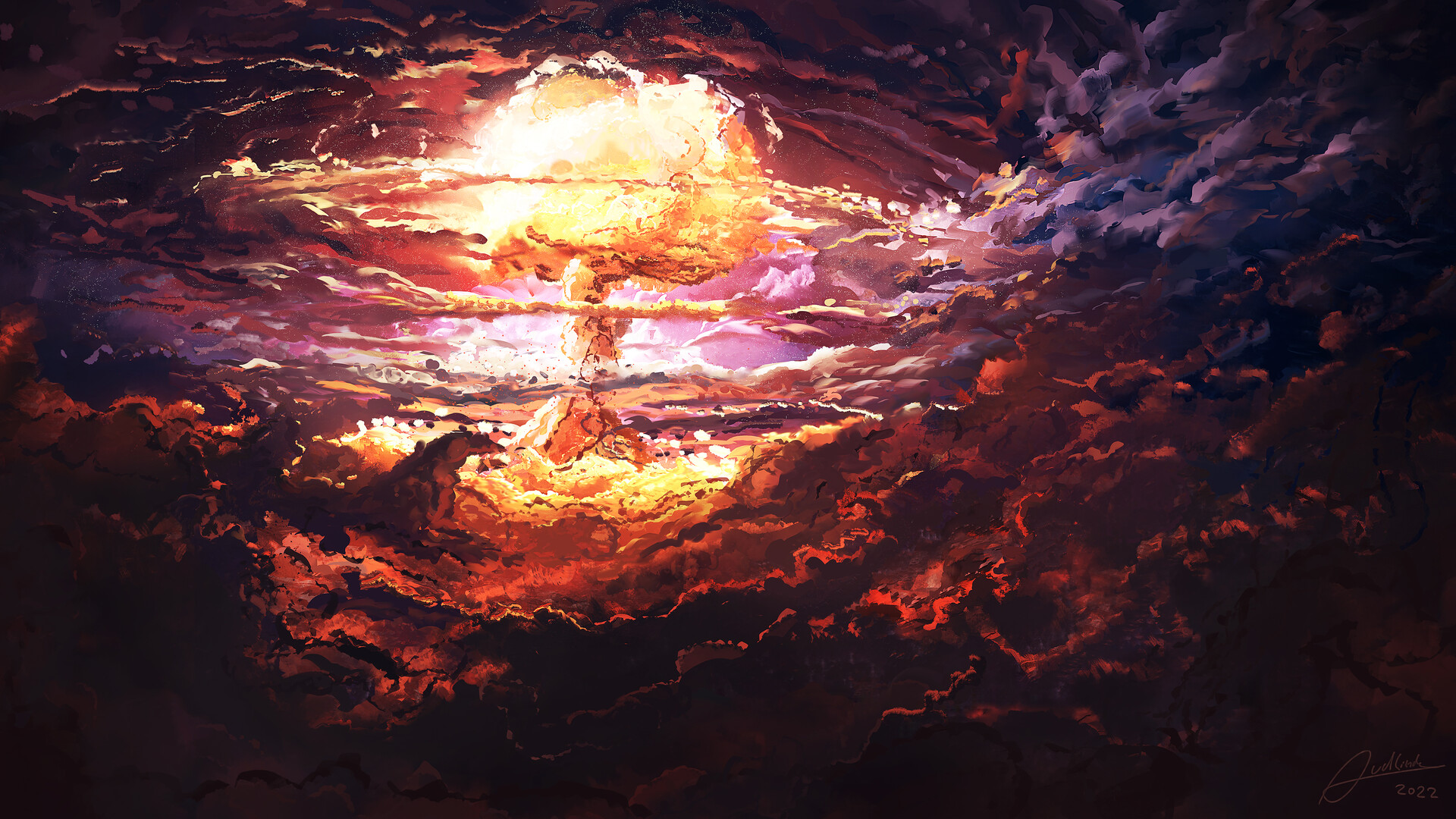
"We looked out across No Man's Land and saw only a flat, smouldering void. There were no trees, no bunkers, and no communists, just the ashes of men falling like snow. We stopped shooting because there was no longer anything to shoot at. Nothing worth fighting for."
- Recovered transcript from an American Signal Corps officer.
The night of February 1st, 1946, began like any other in the pale, yellow hell of the Eastern Front: frozen, toxic, and silent. After midnight, however, the silence was shattered by a light so intense it was as if the sun had been dragged back up from the horizon. This was the White Night: the final, desperate gasp of a dying continent. It was the moment the nuclear genie was fully unleashed, not just to end a war, but to effectively end the world as it was then known. The era of heroic struggles and great wars of liberation was over in a flash.
The German Empire, fearing a total collapse of the line due to collapsing conditions and poor intelligence, launched a saturation strike of fission warheads in the early hours of February 2nd. The Soviet 3rd, 7th, 21st, and 48th Corps were simply blinked out of existence. Such a tactical deployment was designed to shatter the Comintern's ability to wage coordinated war. To ensure complete strategic paralysis, Minsk was targeted with a triad of warheads, turning the historic city into no more than glass and radioactive ash. German command was confident this show of force would force a total Soviet collapse, committed to believing the Soviets had too few warheads to respond meaningfully. They had, however, catastrophically underestimated the progress of Project PERUN and the Soviet atomic weapons program.
The Soviets possessed a terrifying technological asymmetry that ensured nuclear parity. Under the secretive auspices of Project PERUN, Dr. Andrei Sakharov had perfected his "Layered Cake" design, a primitive, but monstrously powerful thermonuclear bomb that employed the principle of nuclear fusion. As the German 3rd Army and the elite 6th Panzer Army prepared to move through the gaps in the irradiated lines, Sakharov's bombs were detonated. The ancient Prussian city of Konigsberg, too, was targeted, and vanished from existence in a bloom of fire that dwarfed the American strikes on Japan. The blast was so colossal it was visible from Berlin itself.
By the morning of February 3rd, 1946, the world had gone quiet. After twenty-four hours of chaotic, blinded fighting through nucleo-chemical wasteland, a universal truce was established across the front. This final act of diplomacy is possibly responsible for saving the human race. This was called the February Truce, and it lasted for 15 days, during which the dead were recovered, and the sick were attended to. There was no real tension. Everyone on both sides of the line of contact knew it was over.
On the 28th of February, the Second Treaty of Versailles was signed, and World War II came to an end. Despite the end of the war, the scars of the Yellow Winter and its thunderous finale remain. Vast swathes of land in Eastern Europe remain as exclusion zones, too contaminated for anything to grow in, not a single blade of grass or tree in sight. While recovery efforts have been successful for the most part, especially in the cities of Konigsberg and Minsk, which have been rebuilt from the ground up, the places where the heaviest fighting occurred will not be inhabited by men for centuries to come.