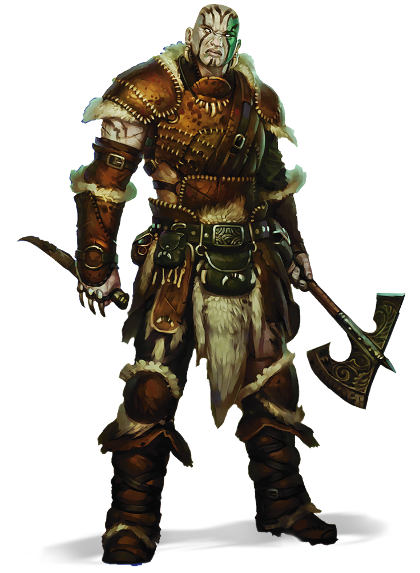
At the highest peaks of the world, beyond where trees dare grow and where the wind howls with unrelenting fury, dwell the Goliaths—a people carved from stone, ice, and hardship. These nomadic tribes roam the harshest landscapes, eking out survival upon the jagged slopes of mountains, tundras, and frozen wastelands, where few others can endure.
Though descended from true giants, Goliaths do not revere their towering kin. They despise them. Giants, especially Frost Giants and Fire Giants, often hunt them for sport, viewing them as failures, weak imitations of their own grandeur. This long history of persecution and bloodshed has shaped Goliath culture into one of self-sufficiency, endurance, and quiet defiance.
To be a Goliath is to live by a single truth: your worth is measured only by your strength and survival.
Origins
Unlike other giant-kin, Goliaths were not created by the gods or molded from the elements. They are the forgotten offspring of the giants, born of unions between lesser giants and mortals or, as some claim, the remnants of a cursed bloodline from when the Pantheon of Primus struck down the Elementari of old.
In the eyes of their giant ancestors, the Goliaths are failures, too small, too weak, too mortal. Many Goliaths claim that when the first Goliath Tribes were born, the giants of the world cast them out, branding them unworthy of their lineage. Whether this is myth or truth, the enmity between Goliaths and giants has never faded.
To this day, Frost Giants and Fire Giants still hunt Goliaths, sometimes as mere sport, sometimes as brutal reminders of their inferior place in the world.
But the Goliaths do not kneel. They fight. They endure. They prove that survival is not gifted by blood—but earned through sheer, unyielding will.
Physical Appearance & Traits
Goliaths resemble walking mountains, their bodies weathered and carved by the elements. Though smaller than true giants, they tower over most mortals, standing between 7 and 8 feet (2.1 to 2.4 meters) tall and weighing upwards of 350 to 400 pounds (160 to 180 kg).
- Their gray, ashen, or pale blue skin is tough as stone, often marked with dark or white streaks resembling veins of ore or cracked ice.
- Their piercing eyes, typically white, silver, or ice blue, shimmer with a cold, unyielding fire.
- Many Goliaths paint their skin or carve tattoos in giant runes, marking their victories, ancestry, or personal triumphs.
- They are physically immense, their bodies sculpted not for beauty, but for survival.
- Most Goliaths are bald due to harsh climates, though some braid what little hair they have, often adorned with bones, rings, or beads taken from their hunts.
Their powerful physiology allows them to withstand extreme cold, high altitudes, and endure with little food or rest—survival honed through generations of hardship.
Culture & Society
Goliath society is based on merit, survival, and self-worth. Among their kind, there are no kings, no aristocrats, no rulers by blood. Every Goliath earns their place through deeds, not birthright.
The Nomadic Law
Goliaths never stay in one place for long, moving from peak to peak, hunting ground to hunting ground, always searching for a greater challenge. Those who grow weak, slow, or complacent are left behind—a harsh truth, but a necessary one.
Trial by Worth
To a Goliath, you are only as valuable as what you contribute to the tribe. Strength, endurance, and skill determine one’s place in the world.
- A hunter who fails to bring food is no hunter.
- A warrior who cannot fight is no warrior.
- A leader who grows complacent is no leader.
A Goliath’s status is never permanent. Every challenge, every hunt, every battle reshapes the hierarchy. One day, a warrior may command their people; the next, they may find themselves at the bottom, struggling to prove their worth once more.
Honoring the Fallen
Unlike giants, who see death as conquest, Goliaths treat death as a transition. When a warrior falls, they are buried in the snow, their weapons and belongings left for the next wanderer to claim. A life unworthy of memory is a life wasted—thus, only those who achieve great deeds are spoken of in legend.
The Forsaken Giantkin
Goliaths do not worship the giants, nor do they seek their favor. Many despise them, seeing them as tyrants who reject their own kin. Frost Giants and Fire Giants often hunt them for sport, but Goliaths have learned to fight back, felling their colossal kin in acts of defiance.
Though often at odds, Goliaths and Dwarf share a mutual respect, both being hardy mountain folk shaped by struggle and stone.
Goliaths see kingdoms, cities, and empires as weak cages, believing that to live among them is to surrender one's freedom.
They share kinship with barbarians, rangers, and druids who respect nature’s law and live beyond civilization’s reach.
Powers & Abilities
Goliaths fight like avalanches—fast, powerful, and relentless.
- They use raw might, overwhelming their foes with sheer power and endurance.
- They can endure pain and cold far beyond mortal limits, resisting wounds that would cripple others.
- Masters of climbing, tracking, and surviving in harsh climates, they move across mountains as effortlessly as others walk through forests.
- Though smaller than their giant kin, Goliaths have learned to kill them, targeting joints, weak spots, and pressure points that even giants fear.
Many Goliaths wield massive weapons, including greatclubs, axes, and spears, carved from stone, bone, and metal taken from their enemies. Their armor is layered with hides, furs, and the bones of fallen beasts, testaments to their victories.
Legacy
The Goliaths remain wanderers, forever testing their limits, forever proving that they are more than forgotten bloodlines of giants.
While giants build kingdoms, Goliaths forge legends. They do not wait for gods to claim them, nor for fate to guide them. Instead, they carve their own paths, facing the world on their own terms, unchained and unbroken.
They may be exiles, outcasts, and the forsaken children of giants—
But they are still here. And they will never kneel.