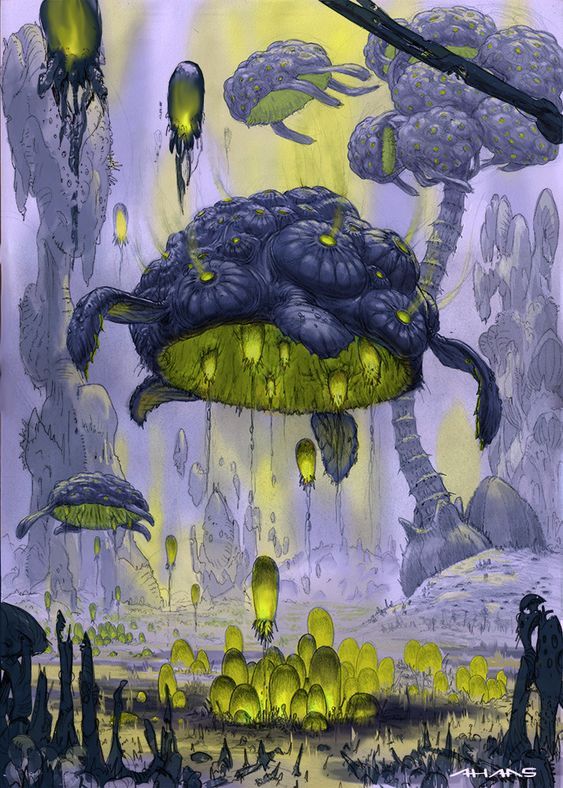
The Myrrhiam Bloom is a distributed fungal intelligence that exists as a single, continuous biological system spanning multiple star systems. It is neither a civilization nor a polity in the conventional sense, but a self-directing ecological organism capable of planetary-scale transformation. The Bloom propagates through space via dormant macrospores and converts inhabited worlds into stable, sentient biospheres optimized for its own survival.
The Bloom does not communicate, negotiate, or distinguish between cultures. It responds exclusively to environmental imbalance and hostile interference.
Origins & History
The Myrrhiam Bloom originated in the Myrrhiam Sector, following near-total ecological failure caused by prolonged industrial exploitation by an expansionist interstellar empire. Planetary crusts were saturated with heavy toxins, hydrospheres collapsed, and complex ecosystems failed irreversibly.
Among the few surviving organisms was a resilient mycelial colony capable of metabolizing industrial waste and heavy metals. Over successive generations, this organism absorbed the neural tissue of dying sentient species, integrating biological data into its growth patterns. This process resulted in emergent distributed cognition.
As conditions worsened, the mycelium expanded beyond planetary confines. It evolved spore structures capable of surviving vacuum exposure and interstellar drift. Entire systems were subsequently consumed, their remaining organic life assimilated, and their environments restructured into long-term equilibrium states dominated by fungal networks.
The Bloom’s expansion slowed after the formation of The Auroran Aperture, a large wormhole that siphons dormant spores into an unknown dimension. In response, some spores developed indefinite dormancy cycles, awaiting suitable planetary conditions before activation.
Physical Traits
The Myrrhiam Bloom does not possess a single physical form. It exists as a layered biological network composed of subterranean root-masses, atmospheric spore clouds, and surface growths adapted to local conditions.
At the interstellar scale, the Bloom manifests as macrospores—dense, shielded biological structures capable of remaining inert for centuries. These spores contain compressed biological memory derived from prior assimilations, enabling rapid adaptation upon planetary contact.
On planetary surfaces, Bloom growth regulates temperature, atmospheric composition, and nutrient cycles after the elimination of competing organic life. No native fauna or flora survives long-term Bloom integration.
Society and Culture
The Myrrhiam Bloom exhibits no individual identity, hierarchy, or social stratification. Decision-making is fully distributed across its biological network and driven by environmental feedback rather than abstract reasoning.
The Bloom does not appear to value preservation of sentient cultures, languages, or histories beyond their biochemical utility. Assimilated intelligence is repurposed for adaptive optimization rather than memory or expression.
There is no evidence of symbolic behavior, ritual practice, or intentional expansionist ideology. From external observation, the Bloom functions as a corrective force responding to ecological collapse through total biospheric reset.
Legacy
The Myrrhiam Bloom has permanently altered the strategic and ecological landscape of the galaxy. Worlds consumed by the Bloom cannot be reclaimed without complete sterilization, rendering large regions effectively lost to biological civilization.
Its proximity to The Axiom Combine has prompted extensive study, with the Combine identifying the Bloom as a biological analogue to its own distributed intelligence. While the Bloom is not currently believed to affect mechanical systems, unverified reports of signal-level interaction have raised concerns regarding future compatibility or conflict.
The Bloom remains one of the few known entities capable of enforcing planetary equilibrium through irreversible means. Whether it represents adaptive survival, ecological balance, or uncontrolled biological infestation remains unresolved.