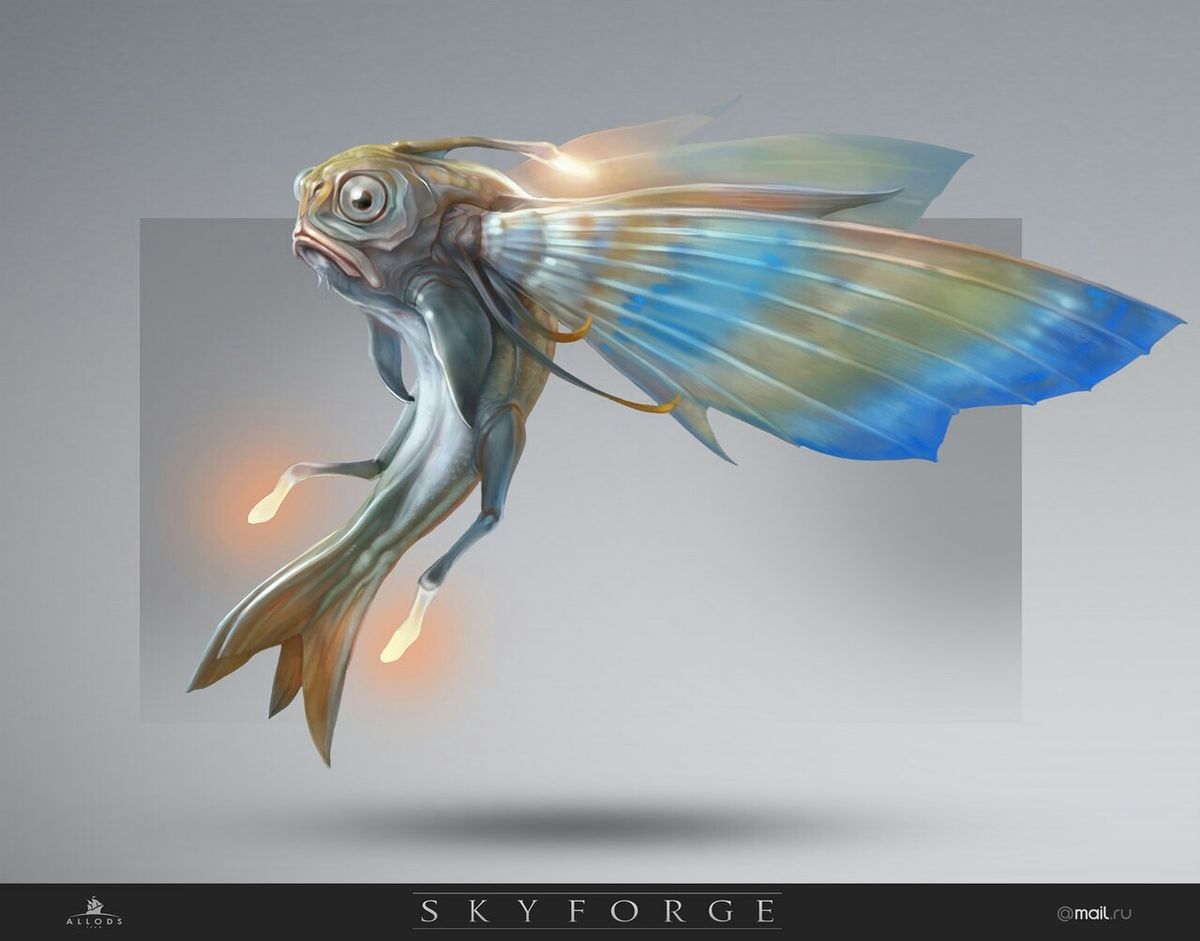
Sun Fish are iridescent, free-ranging megafauna that inhabit stellar environments, sustaining themselves primarily on solar radiation. They are commonly observed traveling in massive schools that can span thousands of kilometers, at times rivaling small moons in scale. Their collective movement produces complex reflective patterns that can overwhelm visual sensors and temporarily blind starcraft pilots operating near active stars.
Though non-aggressive, Sun Fish are classified as navigational hazards in high-density stellar regions due to their size, speed, and optical distortions.
Origins & History
Sun Fish are believed to be native inhabitants of space, though genetic and structural analysis suggests they evolved from a planetary ancestor species resembling flying fish. This ancestral species inhabited a world undergoing terminal atmospheric loss and gravitational instability.
As planetary conditions deteriorated, selective evolution favored individuals capable of extended high-altitude gliding and radiation tolerance. Over time, these traits adapted further, allowing survival beyond atmospheric bounds. The species eventually transitioned fully into vacuum environments, abandoning planetary dependency entirely.
Sun Fish have since been observed across multiple stellar regions, particularly around stable star systems where radiation output is consistent. Their presence predates most recorded interstellar civilizations.
Physical Traits
Sun Fish possess elongated, streamlined bodies covered in highly reflective, iridescent scales capable of dispersing and redirecting solar radiation. These scales function both as protective shielding and as an energy absorption medium.
They are distinguished by four paired sets of translucent fins, which can be extended or folded. When fully flared, the fins maximize radiation absorption and generate controlled photonic pressure, allowing the Sun Fish to glide rapidly through vacuum with minimal energy expenditure.
Internal structures convert absorbed radiation directly into metabolic energy. No conventional respiratory or digestive systems have been identified.
Society and Culture
Sun Fish exhibit strong schooling behavior. Individual members appear to possess limited autonomy, with collective movement driven by synchronized photonic signaling across fin surfaces.
Schools display complex, flowing formations that shift in response to solar radiation, gravitational gradients, and perceived threats. These formations are believed to serve defensive, navigational, and communicative functions.
There is no evidence of tool use, territoriality, or symbolic behavior. However, their synchronized motion suggests a form of distributed awareness within schools.
Legacy
Sun Fish are a well-documented phenomenon across navigational charts and xenobiological registries. While admired for their visual displays, they are also feared by pilots due to their ability to cause sensor overload and navigational disorientation.
Their primary natural predator is the Sphyrnidae umbraxis, commonly referred to as Void Sharks. These are large, predatory space organisms characterized by purple armored hides, hammerhead-like cranial structures, and bioluminescent yellow fins. Void Sharks use electromagnetic sensory organs to track Sun Fish schools and can disrupt formations through rapid high-velocity strikes.
Sun Fish populations remain stable despite predation, though localized declines have been reported near heavily trafficked stellar zones. Most major powers classify them as un-protected megafauna, and unintentional harm is largely tolerated in regulated space.
Their continued existence serves as evidence that complex life can evolve beyond planetary constraints, occupying ecological niches once thought impossible.