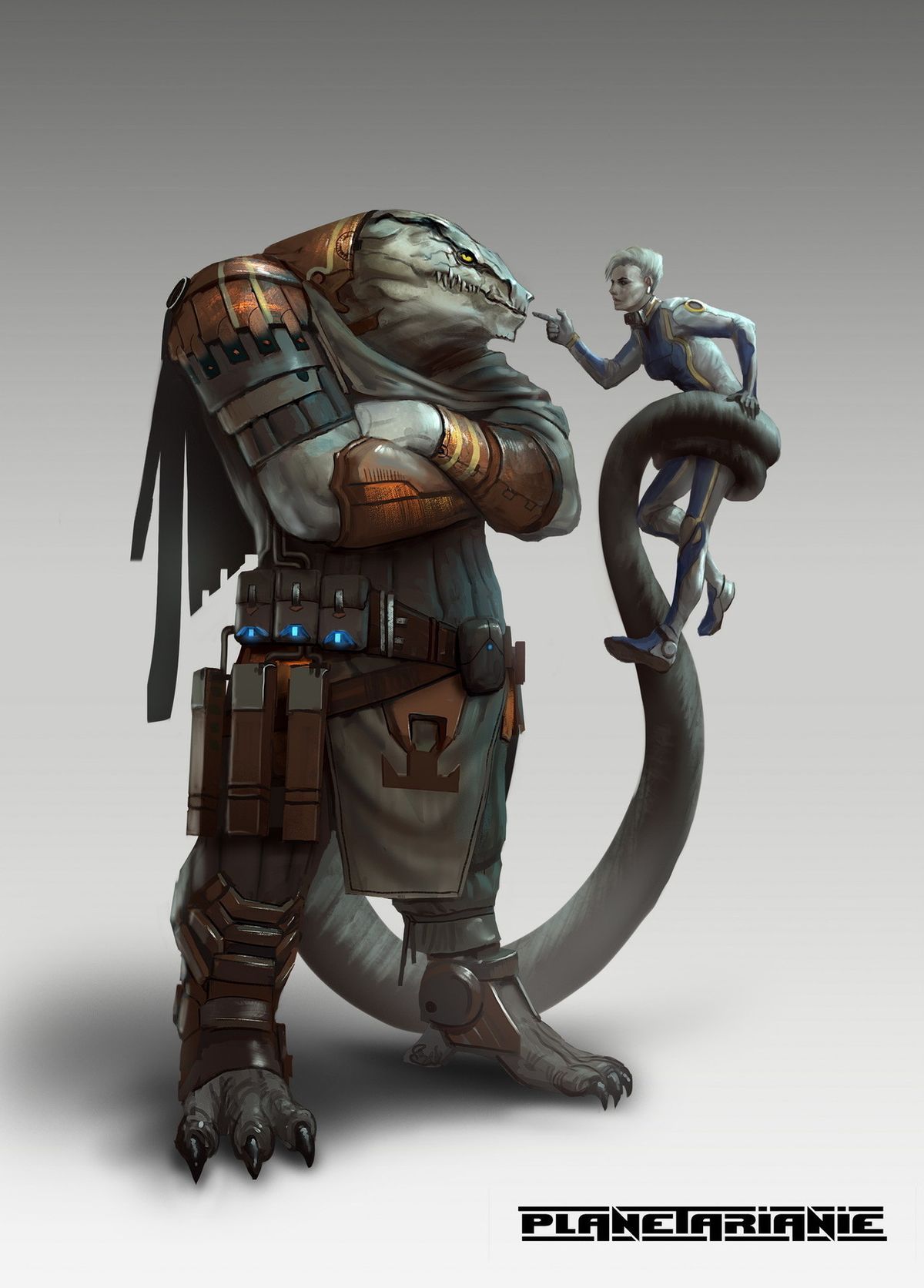
The D’horvakk are a large, heavily built Istryxian sub-species native to the desert continents of Istryx. They are the most physically imposing of the Istryxian lineages, adapted to extreme heat, sandstorms, and arid resource scarcity. Their culture is inseparable from the desert dune-sea and the colossal tunneling organisms that move beneath it.
Among all Istryxian tribes, the D’horvakk are most closely associated with their territorial nature and hostility to outsiders – even other Istryxian.
Origins & History
The D’horvakk evolved across the vast equatorial dune seas of Istryx, where surface survival is limited by heat, dehydration, and predation. Early D’horvakk communities learned that long-term survival depended not on dominating the desert surface, but mastering the space beneath it.
Over generations, they developed a symbiotic and eventually controlled relationship with massive sand-boring megafauna known as Khazrath Sand Worms—colossal, armored tunneling organisms capable of traversing entire dune systems underground.
Those rare individuals capable of successfully bonding with and directing a Khazrath are known as Duneriders. This status is earned through rites of passage rather than inheritance. Historically, Duneriders served as war leaders during inter-tribal conflicts and later during engagements with off-world threats.
Physical Traits
D’horvakk are larger and denser than other Istryxian sub-species, with reinforced skeletal structures and thick, heat-resistant scales. Their dermal plating is often sand-colored or muted ochre, providing natural camouflage in desert conditions.
Their musculature is optimized for short bursts of explosive force rather than prolonged speed. Enhanced vibration sensitivity allows them to detect subterranean movement—an essential adaptation for navigating and commanding Khazrathian tunnels.
Mandibular structure is more pronounced than in other Istryxian lineages, capable of exerting significant bite force. Claws are broader and thicker, adapted for digging and anchoring in shifting sand.
Society and Culture
D’horvakk society is structured around clan hierarchies determined by survival merit and bond strength with Khazrath serpents. While all members are considered warriors, only Duneriders command full clan authority during wartime.
Taming a Khazrath requires entering its tunnel network alone and surviving direct confrontation. If the serpent does not kill the aspirant, a bond may form through pheromonal and vibration-based signaling learned through generations of observation. Failure typically results in death.
Desert ambush warfare is central to D’horvakk strategy. Entire caravans or invading forces have been swallowed beneath the dunes through coordinated subterranean strikes. Despite this, they do not wage war indiscriminately; their aggression is reactive and territorial.
Material culture among the D’horvakk is minimal but practical. Armor and weapons are crafted from desert-hardened chitin, Khazrathian scale fragments, and salvaged off-world materials.
Legacy
Within The Halcyion Federation, the D’horvakk are regarded as elite shock troops and hostile-environment specialists. Their experience in subterranean warfare has proven valuable in asteroid mining security, desert colony defense, and tunnel-clearing operations.
Duneriders, in particular, are treated with a mixture of respect and caution. Off-world observers often underestimate the intelligence required to maintain Khazrath bonds.
The D’horvakk represent the principle that mastery of environment can substitute for industrial dominance.