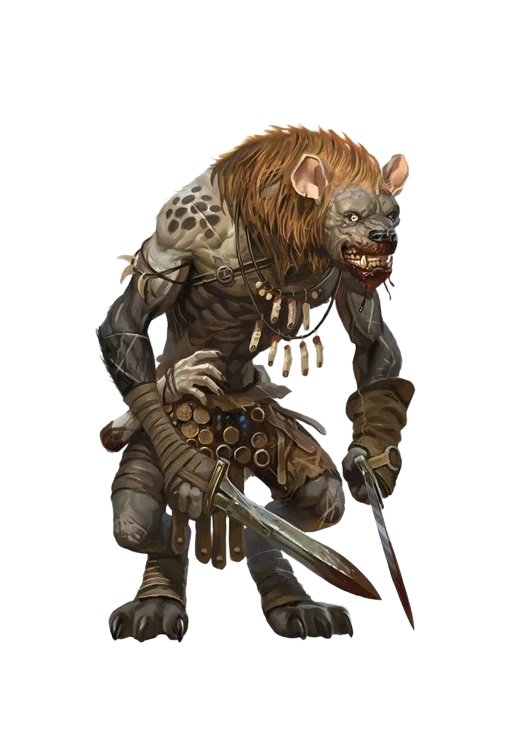
Gnolls were Humanoid-like Fiends who stood between 6 and 7 feet tall and weighed between 200 and 300 pounds. They had Hyena-like features, including fur-covered bodies, long muzzles, and sharp teeth. Their fur varied in color, typically appearing in shades of brown, tan, or spotted patterns. They had powerful limbs built for speed and endurance, making them effective hunters and warriors. They lived up to 30 years, maturing quickly and reaching adulthood in only a few years. They primarily spoke their own growling and yipping language, Gnoll, but often learned Common and Goblin. Their darkvision allowed them to see clearly in low-light conditions.
Gnolls were known for their aggression and pack-oriented behavior. They acted with instinctive coordination, relying on their senses and quick reflexes to react to threats. Their birth rates were high, with litters often producing multiple offspring at once. Unlike many other smallfolk, gnolls were not always born in a natural way. Some were created from violent events or the influence of Demonic forces, leading to unpredictable bursts in their population. Gnolls were not given names until they had proven themselves, but when they had, they were usually dual-syllabic and guttural, often resembling the sounds of their native speech. Typical names included Aargab, Itmmor, and Ulthak.
Gnoll culture centered around survival, hunting, and dominance. They lived in tightly organized groups where leadership was determined by strength and cunning. Cooperation within a pack was essential, but gnolls viewed outsiders as either potential prey or threats to be eliminated. They respected power above all else, and those who could not keep up were often left behind. Their philosophy was rooted in the idea that the strong took what they could, while the weak suffered. Most gnolls had little concept of permanent settlements, preferring a nomadic or raiding lifestyle that kept them moving.
Common in Somnum, gnolls were largely driven from the settled populations, but still existed in the lower mountains and the Neck of the Greatwyrm. The roamaed as predators and raiders, frequently clashing with rural communities. Many were feared for their destructive tendencies, particularly in regions where they formed large warbands, such as the Dotted Plains. Some packs became mercenaries or enforcers for stronger factions, using their natural ferocity in exchange for resources. Others avoided civilization altogether, hunting across the wilds in relative isolation.