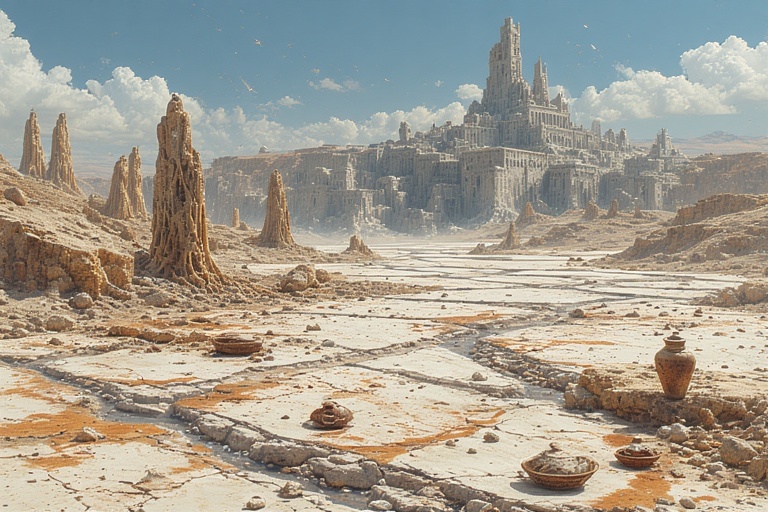
The Dead Petal
Player-Facing Overview
There is a petal the maps no longer show.
Nashtah Ridayam was once a sovereign realm, older than some gods and richer than its neighbors ever admitted. It did not fall to invasion or famine. It did not fade slowly. One day it was present. The next, it was not.
People still speak its name quietly.
Those who come from Nashtah Ridayam do not say they are refugees. They say they are from elsewhere. Their homeland exists only in memory, trade goods, and ritual fragments that no longer point to a living place.
The land itself is said to be uninhabitable. Ash, salt flats, wind-scoured ruins. Water that does not stay. Stone that remembers being shaped but no longer yields. Magic that answers once, if at all.
What little reaches the outside world arrives as salvage:
-
amber and fossil resins, warm to the touch
-
incense that burns without blessing
-
sealed wines from before the silence
-
jewelry whose symbols no one can read anymore
These things are valuable, not because they are useful, but because they cannot be replaced.
People say Nashtah Ridayam died in a war between gods. Others say it was sacrificed so other worlds would not follow it. No one agrees on which version is kinder.
What is known is this:
People survived.
The land did not.
And whatever happened there is not meant to happen again.
How It Feels to Be Near Its Legacy
Stories of Nashtah Ridayam carry weight.
Travelers report that objects from the Dead Petal feel heavier than they should. Incense burns with no warmth. Water tastes flat. Magic behaves cleanly, precisely, and without mercy.
Survivors of Nashtah Ridayam are often practical, unsentimental, and intolerant of waste. They respect strength but distrust power. They rarely pray.
When asked what their homeland was like, most answer:
“It worked.”
And nothing more.
Why Adventurers Care
Nashtah Ridayam matters because it proves something.
Worlds can be ended on purpose.
Not by monsters.
Not by accident.
By decision.
If you travel far enough, or dig deep enough into old wars and sealed accords, you will eventually find its shadow.
And you may be asked whether it was worth it.