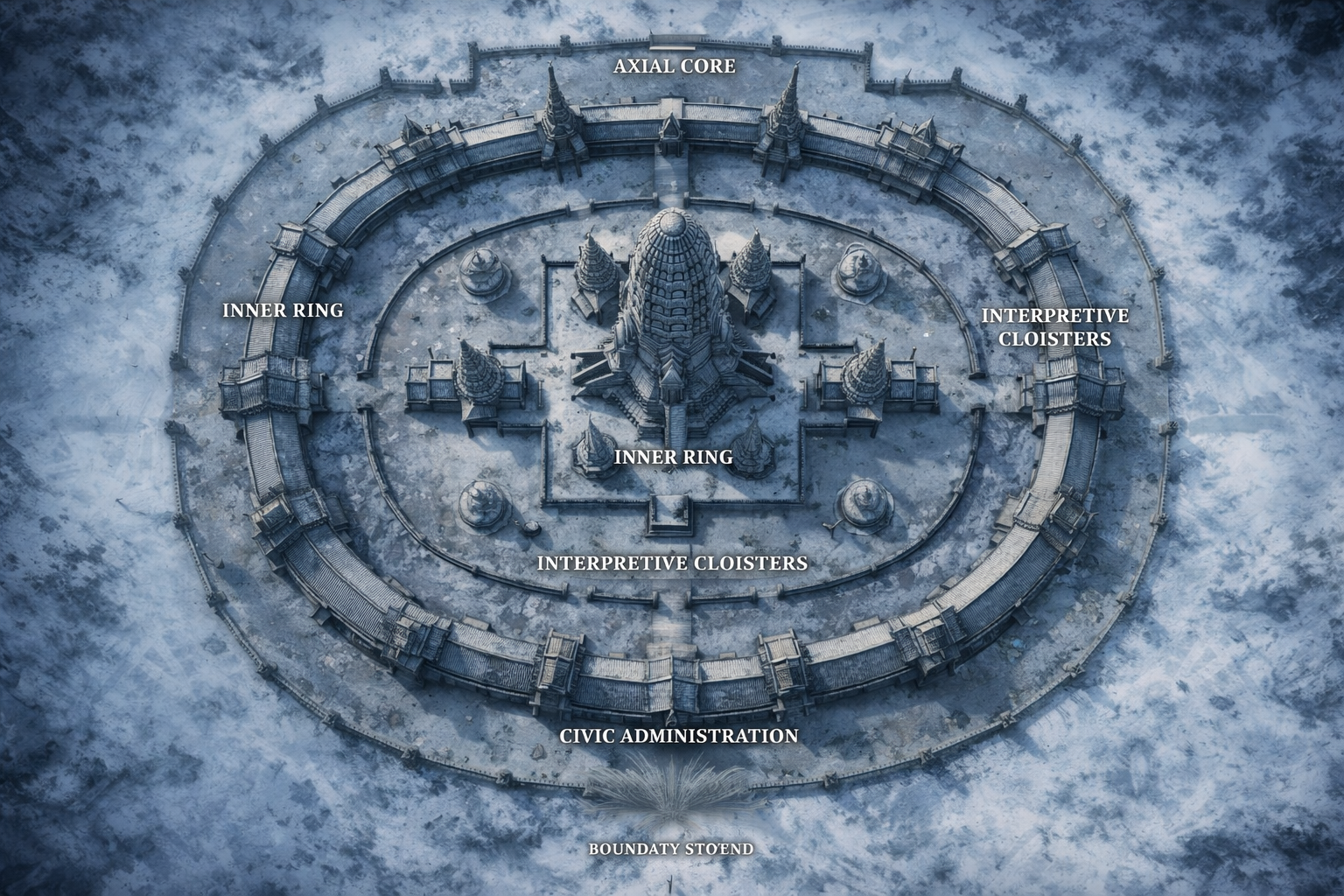
Sacred Center of Kalorand
Kalorand’s sacred center is not merely a mandala.
It is the original integration of relic, ritual, and rule, built when the distinction between governance and regulation had not yet hardened.
Every other mandala city imitates it imperfectly.
Kalorand still functions because this center remains intact.
1. The Axial Core – The Relic Sanctum
At the exact geometric center of Kalorand stands the Relic Sanctum, a sealed, windowless structure housing the city’s primary relic assembly.
-
No throne
-
No altar
-
No permanent occupants
-
No ornamentation beyond calibration geometry
The relic is not venerated here.
It is aligned.
Entry requires:
-
formal rite
-
sangha authorization
-
and royal assent acting together
Neither alone is sufficient.
This space is silent, cold, and indifferent to authority.
2. The Inner Ring – Ordination and Regulation Halls
Surrounding the Sanctum is a tight ring of ubosot-like ordination halls, chant galleries, and resonance corridors.
These halls serve three functions:
-
sustaining ritual cadence
-
maintaining harmonic balance
-
training those permitted to conduct rites
Key characteristics:
-
oriented to cardinal and axial lines
-
acoustically engineered for low-frequency chanting
-
marked by boundary stones that forbid casual entry
This ring belongs to the Sangha alone.
The king may enter only as a participant, never as a ruler.
3. The Second Ring – The Interpretive Cloisters
This is where Kalorand becomes unique.
The next ring outward consists of interpretive cloisters: covered galleries where meaning is translated into action.
Here work:
-
senior scribes
-
sangha-adjacent auditors
-
ritual statisticians
-
calendrical stewards
They do not perform rites.
They do not issue law.
They answer one question only:
“What does the mandala require the city to do next?”
Their outputs take the form of:
-
seasonal directives
-
ration adjustments
-
patrol density recommendations
-
warnings phrased as probabilities
This ring is where knowledge becomes governance, but without command.
4. The Third Ring – The Royal Interface
This ring contains the King’s Mandala Court.
Architecturally, it is less sacred and more formal:
-
columned halls
-
audience chambers
-
oath floors
-
archival vaults
The king rules here, but not absolutely.
Royal authority functions as:
-
an executor of interpretive findings
-
a coordinator of response
-
a mediator between necessity and politics
Edicts issued here are valid only because:
-
the inner rings continue to function
-
the king publicly acknowledges their primacy
This is why Kalorand’s monarchy endures while others fracture.
5. The Fourth Ring – Administrative Ministries
Here begins full civil government.
This ring houses:
-
tax offices
-
census halls
-
grain bureaus
-
patrol commanderies
-
judicial chambers
Architecture shifts noticeably:
-
more rectangular
-
less axial
-
easier to modify
Officials here may never enter the inner rings.
They operate on:
-
schedules
-
quotas
-
and reports filtered outward from the cloisters
This ring believes it runs the city.
It does not.
6. The Boundary Ring – Stones of Jurisdiction
The final ring is marked by boundary stones similar to those you observed in Ayutthaya.
In Kalorand, these stones:
-
define where sacred authority ends
-
define where law fully applies
-
mark the last place where ritual failure can still be corrected locally
Beyond these stones:
-
patrols thin
-
law becomes situational
-
warmth is weaker
-
belief replaces certainty
This is where the city dissolves into territory.
Functional Summary
-
Relic stabilizes reality
-
Sangha maintains conditions
-
Cloisters translate outcomes
-
King coordinates response
-
Government enforces policy
-
Territory absorbs failure
Remove any layer and the ones outside it collapse.
Diagram: Kalorand Sacred Center (Top-Down)
                [ AXIAL CORE ]
              Relic Sanctum
            (sealed, silent)

        =========================
        |  INNER RING           |
        |  Ordination Halls     |
        |  Chant Galleries      |
        |  Regulation Corridors |
        =========================

      =============================
      |  INTERPRETIVE CLOISTERS   |
      |  Auditors, Scribes       |
      |  Calendars, Warnings     |
      =============================

    =================================
    |  ROYAL INTERFACE RING          |
    |  King’s Court                 |
    |  Mandala Oaths & Edicts       |
    =================================

  =====================================
  |  CIVIC ADMINISTRATION              |
  |  Tax, Grain, Justice, Patrols      |
  =====================================

========================================
|  BOUNDARY STONES OF JURISDICTION      |
|  Sacred Law Ends / Civil Law Begins   |
========================================

          OUTER CITY / TERRITORY