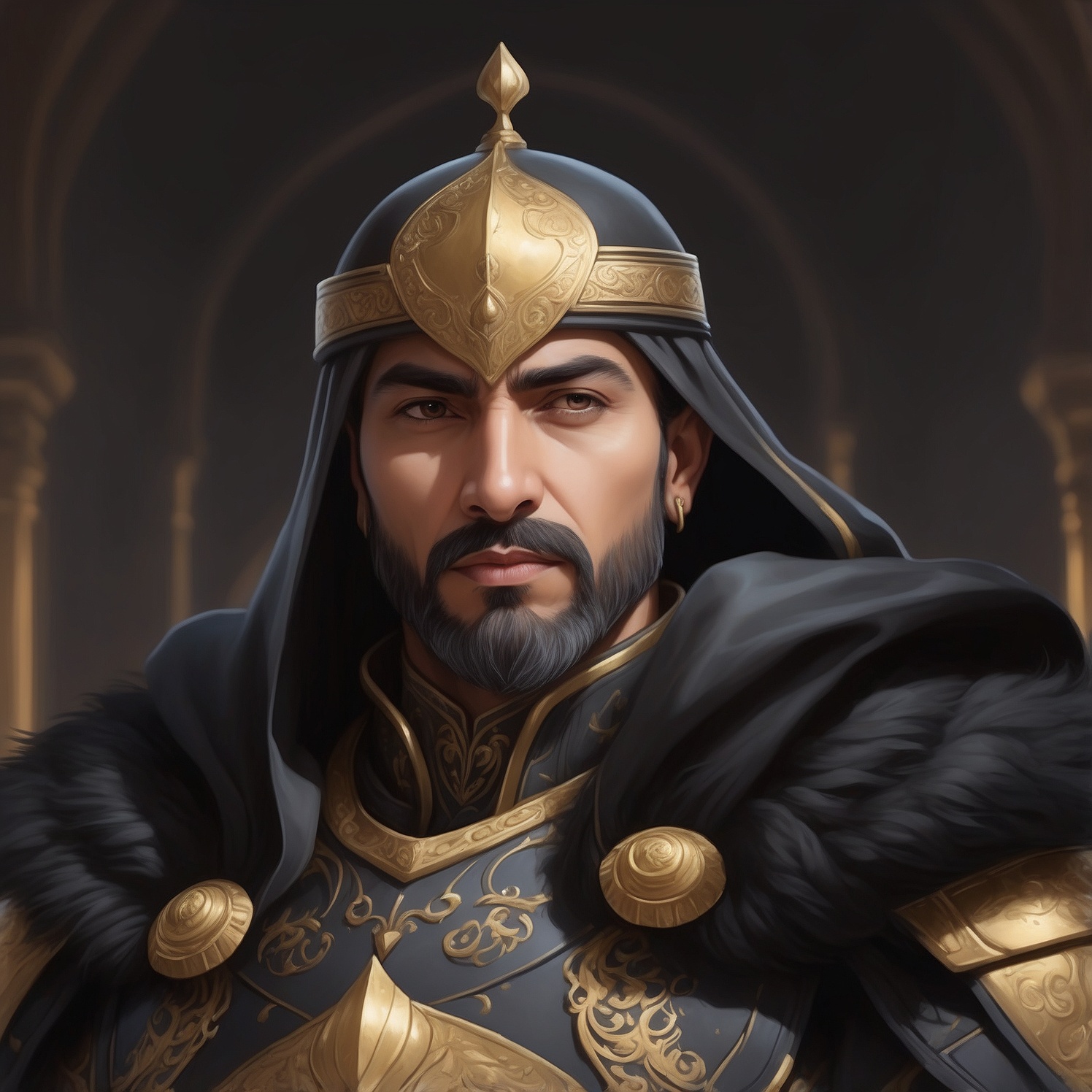
Following the ascension of Anubis Khein, it would be over two decades before the God King Horus Khein found another mortal worthy of the Dynasty’s eternal bloodline. In the year 74 of the Second Age, that mortal emerged — not from courtly halls or priestly sanctuaries, but from the brutal war-camps of the eastern frontiers. His name was Ahriman, a native warlord of savage repute, whose ambition and ferocity were unmatched.
Seeking to test this bold upstart, the God King set forth a private trial: Ahriman was tasked with slaying a beast of infernal fire, a creature Horus himself had summoned from beyond the mortal world to destroy him. Armed only with crude weapons and the will to survive, Ahriman fought the demon for three days and three nights. When he returned — his body scorched, his armor in ruins — he carried the smoldering head of the beast strapped to his burnt back.
In awe of his relentless spirit, Horus summoned Ahriman to Kheinopolis, the heart of the Dynasty, where he was indoctrinated into the faith and traditions of the God King. There, Horus granted him immortality and divine power, raising him as his second adopted son and naming him Prince Ahriman Khein, the Dreadful.
Among the people of the Dynasty, Ahriman became both a hero and a nightmare. His legacy is marked by a long list of dreadful deeds — the slaying of great beasts, the crushing of rebel armies, the purging of foreign threats — all done in the name of protecting the Dynasty. His name became synonymous with bloodshed in the service of order, and few dared to speak it lightly.
Despite his loyalty to Horus, Ahriman is a man of sharp flaws. Fiercely competitive, he often clashed with his fellow Princes, viewing their diplomatic posturing and careful strategies as weakness. On more than one occasion, his ambition and lust for conquest blinded him to greater consequences, leading to reckless victories that left regions in ruin. Whispers among the nobility claim that Ahriman’s heart beats not for the Dynasty, but for personal glory. Yet in every age, when called, Ahriman has fought and bled for the God King, silencing doubts with the blade rather than words.
One of his most legendary feats came during the Siege of Eryndil in the year 130 of the Second Age. Leading a massive host against the Silver Dominion’s fortified city, Ahriman hurled himself into the heart of battle. With his towering scimitar, he carved a path through defenders, inspiring terror and devotion in equal measure. Though Eryndil was ultimately lost again after his forces withdrew, Ahriman himself never considered it a failure — to him, conquest was a cycle, and the city would fall anew when the time was right.
Throughout centuries of warfare, Ahriman has earned countless titles: Breaker of Walls, Slayer of Giants, the Black Flame of Khein. His presence on the battlefield is an omen of destruction, his victories celebrated with awe, his failures viewed as mere pauses before the inevitable. Today, Prince Ahriman Khein remains a living embodiment of the Dynasty’s wrath — a grim reminder that peace is often built upon dreadful deeds, and that sometimes, the strongest pillar of empire is the sword.