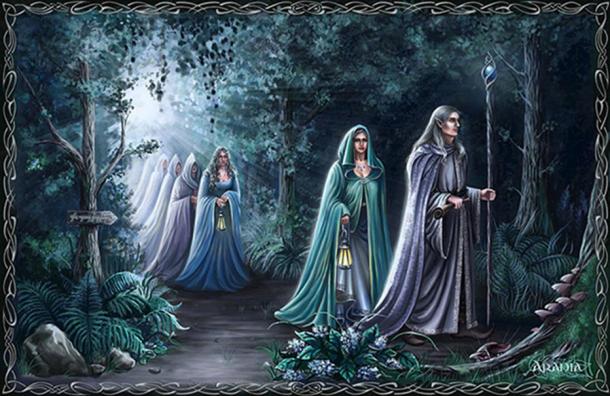
The Eileryan Faith is polytheistic, with gods and goddesses associated with natural phenomena such as the sun, moon, and seasons, as well as aspects of human life such as war, fertility, and the harvest. The religion includes rituals and ceremonies, such as sacrifices and offerings to the gods, as well as divination and ancestor worship.
The Eileryan Faith is practiced by the Wood elves and the High elves, but their approach to the religion is different. Wood elves have a more animistic approach and focus on ancestor worship with most ceremonies outdoors, while High elves have a more ceremonial approach with a greater emphasis on the study and interpretation of religious texts with worship carried out in temples.
The Eileryan Faith has various festivals throughout the year that are associated with the gods and goddesses, or with the seasons and natural cycles. The elves also have different orders, such as the Temple Order, Druidic Order, Scholarly Order and Mystical Order, each of which have different beliefs, practices and ranks.
The origins of when the first Elven gods arrived has been lost to time, but they are the oldest known gods and the elves believe the other religions are but copies of their own in a respectful way with the renaming of the seven. The original name of the seven gods are as below from an elven perspective.
Beli: God of war and strategy
Arionrhod: Goddess of the moon and sea
Cernunnos: God of wild animals and the forest
Lugh: God of the sun, crafts, and skill
Mabon: God of the harvest and autumn
Danu: Mother goddess of fertility and the earth and healing
Cerridwen: Goddess of inspiration, knowledge, and rebirth
The elves of Tanandrum and Everden while worshipping the same gods take different approaches to their worship. Wood elves, being closely connected to nature, have a more animistic approach to the religion. They see the gods and goddesses as spirits that inhabit the natural world and interact with them on a regular basis. They have a strong focus on ancestor worship, as they view their ancestors as still being a part of the natural world. They also have a strong focus on rituals that are performed in outdoor natural settings, such as in groves, forests, or at the base of trees they deem sacred.
High elves, on the other hand, may have a more ceremonial approach to the religion. They have a more structured form of worship, with specific rituals and ceremonies that are performed in grand temples or other sacred spaces. They have a greater emphasis on the study and interpretation of religious texts, and have a more scholarly approach to understanding the gods and goddesses. They also have a strong focus on divination and prophecy, as they see themselves as the chosen people of the gods, and the gods may guide their destiny.
Festivals
There are festivals each month at various points through the month depending on the alignments of certain stars. The priests announce the precise dates each season.
Beltane: A festival celebrating the arrival of spring, it is associated with the god Beli and the goddess Arianrhod. It is a time of fertility, renewal, and new beginnings.
Samhain: A festival marking the end of the harvest and the beginning of winter, it is associated with the god Mabon and the goddess Cerridwen. It is a time for honoring ancestors, divination, and contemplation of the coming year.
Lughnasadh: A festival celebrating the first harvest of the year, it is associated with the god Lugh. It is a time for thanksgiving, community, and shared abundance.
Yule: A festival celebrating the longest night of the year, it is associated with the god Arianrhod. It is a time for rituals of purification and protection, and a time of healing.
Midsummer: A festival celebrating the height of summer, it is associated with the goddess Danu. It is a time of celebration and joy, and of honoring the earth and its fertility.
Imbolc: A festival celebrating the first signs of spring, it is associated with the god Cernunnos. It is a time of renewal and regeneration, and a time of honoring wild animals.
Ostara: A festival celebrating the spring equinox, it is associated with the god Beli and the goddess Arianrhod. It is a time of balance and harmony, and a time of honoring the coming of spring.#
Wood elves tend to celebrate the festivals in a more natural setting, in the woods, near a river or lake, High elves prefer grand temples and other sacred spaces to celebrate their festivals and they are often more formal.
Finally there is the Eileryan Wisdom Festival: A festival that takes place during the fall equinox, it is associated with the goddess Cerridwen and the god Lugh. During this festival, the high elves celebrate the pursuit of knowledge and wisdom. They hold lectures, debates, and discussions on various topics such as philosophy, history, magic, and science. They have competitions in poetry, storytelling, and other arts, as well as in games of strategy and intelligence. The festival includes rituals and ceremonies, such as divination, prophecy and honouring the ancestors, who passed down the knowledge. The wood elves do not celebrate this festival.
Structure
The Elves have structured there religion into 4 schools or orders.
The Temple Order: This order is focused on the worship of the gods and goddesses in a formal, ceremonial way. They have grand temples and other sacred spaces where they conduct rituals and ceremonies, that are led by priests and priestesses. The priests and priestesses are responsible for interpreting the will of the gods, performing sacrifices and offerings, and providing guidance to the faithful.
High Priest/ess: The leader of the order and the main representative of the gods and goddesses. They are responsible for interpreting the will of the gods, leading the rituals and ceremonies, and providing guidance to the faithful.
Priest/ess: The second-in-command and the main assistant of the High Priest/ess. They are responsible for conducting rituals and ceremonies and providing guidance to the faithful.
Acolyte: Junior members of the order who are in training to become priests/priestess. They assist the priests and priestesses in conducting rituals and ceremonies, and learn the teachings and practices of the order.
The Druidic Order: This order is focused on the spiritual connection to nature and the natural world. They are led by druids, who would be responsible for performing rituals and ceremonies in natural settings, such as groves, forests, and sacred sites. They also focus on divination, prophecy, and ancestor worship, and would provide guidance on how to live in harmony with nature.
Arch-Druid: The leader of the order and the main representative of the gods and goddesses. They are responsible for interpreting the will of the gods, leading the rituals and ceremonies, and providing guidance on how to live in harmony with nature.
Druid: Senior members of the order who have completed their training and are responsible for conducting rituals and ceremonies and providing guidance on how to live in harmony with nature.
Apprentice: Junior members of the order who are in training to become druids. They would assist the druids in conducting rituals and ceremonies, and would learn the teachings and practices of the order.
The Scholarly Order: This order is focused on the study and interpretation of religious texts and teachings. They is led by scholars and sages, who are responsible for interpreting the will of the gods, preserving and passing down the knowledge, and providing guidance on how to live a virtuous life.
Grand Master/Mistress: The leader of the order and the main representative of the gods and goddesses. They are responsible for interpreting the will of the gods, leading the lectures, debates, and discussions, and providing guidance on how to live a virtuous life.
Master/Mistress: Senior members of the order who have completed their training and are responsible for teaching, conducting research and providing guidance on how to live a virtuous life.
Scholar: Junior members of the order who are in training to become Master/Mistress. They would assist the Masters/Mistresses in teaching, conducting research and would learn the teachings and practices of the order.
The Mystical Order: This order is focused on the personal spiritual development and the attainment of enlightenment. They are led by mystics, who are responsible for teaching meditation, yoga and other spiritual practices, and providing guidance on how to achieve spiritual enlightenment.
Grand Master/Mistress: The leader of the order and the main representative of the gods and goddesses. They are responsible for interpreting the will of the gods, leading the spiritual practices and providing guidance on how to achieve spiritual enlightenment.
Master/Mistress: Senior members of the order who have completed their training and are responsible for teaching, conducting spiritual practices and providing guidance on how to achieve spiritual enlightenment.
Apprentice: Junior members of the order who are in training to become Master/Mistress. They would assist the Masters/Mistresses in teaching, conducting spiritual practices and would learn the teachings and practices of the order.
In the Eileryan Faith, the different orders may have different beliefs, practices, and ranks, but they all share the same goal of serving and worshiping the gods and goddesses of the faith. While there may be some minor rivalries between the different orders, they generally have a good relationship and cooperate with one another.
The Temple Order, for example, focuses on the worship of the gods and goddesses through ceremonies and rituals, and they often have the most elaborate temples and shrines. They may be in charge of maintaining the temples, performing sacrifices, and interpreting religious texts. The Druidic Order, on the other hand, focuses on the worship of nature, and they often perform rituals and ceremonies outdoors, in sacred groves or other natural sites. They may be in charge of preserving the natural world and maintaining the balance between the gods and the world.
The Scholarly Order is focused on the study and interpretation of religious texts, and they may be responsible for maintaining libraries, preserving the religious history and tradition, and providing theological guidance to the other orders. And finally, the Mystical Order is focused on the individual spiritual development, they often use meditation, yoga and other spiritual practices to reach a deeper understanding of the gods and their place in the world.
In general, the different orders work together to maintain the Eileryan Faith and ensure that the gods and goddesses are properly worshiped. They may consult with one another when performing ceremonies and rituals, or when interpreting religious texts. They may also share resources and knowledge, such as sacred texts or historical records but not always.
However, there might be some tensions or rivalries between orders, for example, the Temple order may view the Druidic order's practices as too "wild" or "undisciplined" while the Druidic order may see the Temple order as too "formal" or "stuffy". But they eventually come together to celebrate the festivals and ceremonies where all the orders participate.