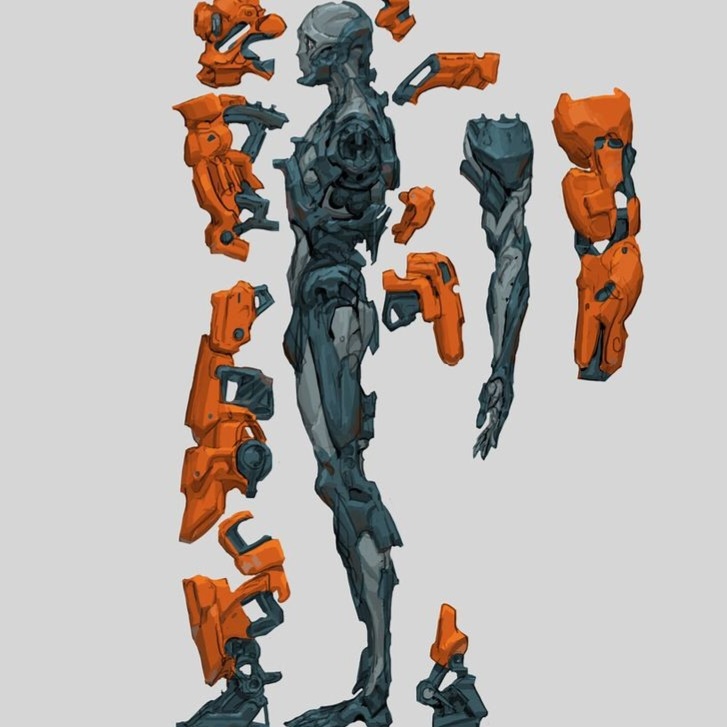
Cyborgs exist in many forms across Human Space as a minority outside of the Afri-Zen Synthocracy. While they each have their own cultural identity based on their origins, cyborgs share certain characteristics that define them as a distinct group or, in some areas, an ethnicity.
A cyborg is generally defined as a baseline Human who has been augmented with cybernetic enhancements to the extent that their body no longer operates as a human. Typically, a cyborg retains around 10-50% of their original organic body within a robotic shell or harness. A person who has replaced only a limb, an eye, or a single organ is classified as augmented, not a cyborg.
Most cyborgs retain visible signs of their humanity, such as hands, facial features, or eyes, which they use to maintain a connection to their past. However, in more extreme cases, only parts of a body remain, such as a head containing organs, or even just a brain encased in a mechanical frame. It's universally accepted that an organic component must exist within a cyborg. Brain scans or consciousness uploaded into machines are considered synths or engrammes, and they do not possess what most scientists, theologians, or philosophers consider a "soul," distinguishing them from true cyborgs, who are regarded as human.
The reasons behind becoming a cyborg are varied: severe injury, personal choice, beliefs, fashion, or identity. Some cyborgs modify their bodies to fit certain roles or as a form of punishment. For others, it’s a matter of preference, similar to changing clothing, or fulfilling gender norms.
Cyborgs' experiences differ widely. Some revel in their new forms, feeling more alive and powerful; others face trauma, emotional numbness, or dread as they lose the ability to feel or even breathe, especially when significant parts of their brain are replaced with cold, logical programming, whether by choice or necessity. Often, their emotional state depends on the quality of their augmentations.
Cyborgs' rights also vary greatly. In some places, they enjoy rights superior to those of baseline humans. In others, they are treated as equals or as second-class citizens. Some cyborgs are corporate property or bonded laborers, while in other regions, they are seen as abominations and hunted down.
Cyborgs are the second most common "subspecies" of humanity and exist throughout the socio-economic spectrum. They serve in the armies and mines of The Lunarian Hegemony, as spies and wealthy elite in 4th Republic of Erica, as long-lived lords and indentured workers in the Império de Tarsis, and across all levels of society in the Synthocracy.
They can be found as void engineers working on ship hulls in the far reaches of human space, hardened colonists enduring the toxic or radioactive environments of moons, gardeners in lush, affluent parks, the common workers of urban megacities, or even fashion trendsetters in popular districts.